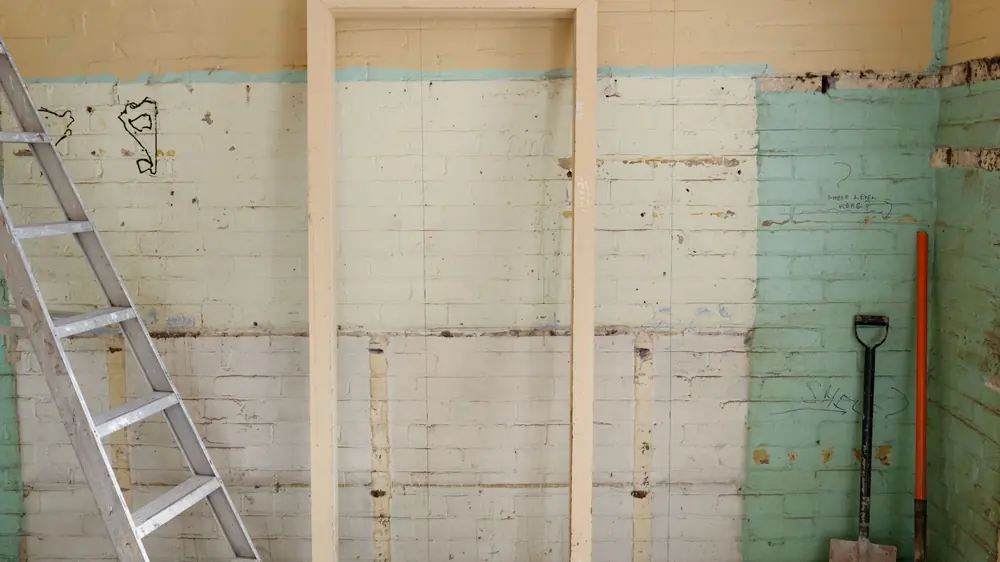
Tile removal in Varna: wall and floor tiles, with or without the adhesive
Old tiles off the walls and floors of any room: bathroom, kitchen, hallway, terrace. We tell you beforehand whether the adhesive stays or has to come off to the base, because that decides both the price and what the next tradesman needs.
Our clients on video · all videos (in Bulgarian)
Tile removal in Varna covers wall and floor tiles in any room, with or without the adhesive underneath. Tiles in the bathroom, kitchen, hallway or on a terrace come off, go into strong bags and are taken to a designated site. The tiles are taken off by the craftsmen we work with; we organise it and stay your one phone number. The price depends mostly on how hard the tile is and on how far down the work has to go, and we give it by phone after photos and measurements, before the work starts. If the toilet, bath and water heater have to go as well, see bathroom strip-out; for the whole range of jobs, see home renovation in Varna. Ring +359 52 993 333 or email info@kanalvarna.com — write to us in English and we reply in English.
Updated November 2026Which tiles come off, from the bathroom to the terrace
This page is only about the tiling itself, on the walls or floor of any room. If the bath, toilet and water heater go too, read bathroom strip-out, where the work is described for the whole room. If the floor also has to come out down to the slab, that is screed removal.
- Wall tiles in a bathroom, toilet, kitchen or any wet room. They are usually thinner with a softer body and come off in pieces with part of the adhesive.
- Floor tiles in a kitchen, hallway or bathroom. Harder than wall tiles and bonded to the screed; the skirting tile at the edge comes off with the floor.
- Porcelain and large-format tiles: dense, heavy, often 60 by 60 cm or bigger and bonded over the full back. They break slowly and the adhesive holds firmly.
- A kitchen splashback, the strip between base and wall units. The units and worktop must be off first and the sockets there are switched off.
- A hallway, where every bag has to pass on its way out; the route to the door is covered.
- A terrace. Under terrace tiles there is often a waterproofing layer stuck to the adhesive, and it almost always tears when the tiles come off, so a new one is needed; see balcony waterproofing.
- Steps in a house, where every edge is a job of its own and the price is set after a look.
How the tiles are measured
Walls and floor are different jobs: a wall is worked from the top down and around the pipe outlets, and a floor needs heavier tools. So each is measured on its own.
- Walls: the length of each tiled wall times the height of the tiles. If the tiles stop at 1.5 m, we measure to 1.5 m, not to the ceiling.
- Openings: the door and window are deducted; window reveals and tiled niches are added, because they are taken out too.
- Floor: length times width of the room; the area under the bath or kitchen units counts only if there are tiles there.
- Skirting tiles: taken off with the floor and not measured separately.
If you send the room dimensions and the height of the tiles, we measure from those and confirm on site.
Does the adhesive have to come off as well?
This is the most common question, and the answer changes the price. The adhesive can stay when skimming and paint will follow on a smooth wall, or when the base under it is sound and the next tradesman agrees to level on top. In most cases, though, it has to come off:
- New tiles are going on. Old lumps and comb ridges are uneven by several millimetres, a new tile cannot lie flat on them and the tiler will ask for a smooth base.
- There is waterproofing under the tiles, in a bathroom or on a terrace. It is stuck to the adhesive and usually tears with it. If a new one is going in, everything comes off down to the screed.
- The adhesive is thick. On walls levelled with adhesive the layer is sometimes two or three centimetres, and nothing can be stuck on top.
- The base was wet. Wet adhesive crumbles and holds nothing.
Gypsum plaster under the tiles. In some newer flats the tiles are stuck straight onto gypsum plaster; it comes off in pieces with the tile, and the wall is then cleaned back to the brick. That is a separate item, only for the area where plaster has not stayed. For walls in general, see wall removal.
If you do not know what comes after us, tell us who will tile or skim, and we agree how far down to go so that you do not pay twice for the same wall.
Two layers of tiles, hollow tiles and tiles on plasterboard
Three cases we often see in old Varna blocks and houses:
- Two layers of tiles. A previous renovation stuck new tiles on top of old ones. You can see it at the edge of the door or around the taps. Both layers come off together, but there is more work and more rubble, so the price is set after a look.
- Hollow tiles. Tapping gives a dull sound where the tile is no longer bonded. These come off easily, but they show that the adhesive has lost its grip, and a new tile cannot be stuck on top of them.
- Tiles on plasterboard. They are taken off carefully, in small pieces with a scraper rather than by blows. To be honest, the plasterboard often does not survive, because its paper tears with the adhesive; if new boards are needed, see plasterboard.
Send a photo of the wall or floor, the approximate area and the floor you are on — we tell you the price by phone and whether the adhesive can stay.
📞 +359 52 993 333When you do not need tile removal
- Only the grout is crumbling and the tiles hold. The grout and silicone are renewed instead: regrouting, and if the grout is leaking, leaking tile grout.
- You want a new look and the old tiles are sound, flat and do not sound hollow. Sometimes new tiles can go over old ones if the floor height and the doors allow it and the base is dry. Tiling explains when.
- One tile has fallen. Only that tile comes off, the spot is cleaned and the tile is stuck back: a small repair, not a strip-out.
New tile on old does not work when the old tiles are hollow, cracked or wet underneath, or when they are in a shower where the water has to run along a fall that would be lost.
Laminate and parquet
When a whole flat is renovated, the old laminate or parquet often has to come up too. Laminate floats on its underlay and comes up with the skirting boards. Parquet may sit on black bitumen adhesive, which can contain asbestos; we do not touch it, and a specialist company has to deal with it. Laminate and parquet without such adhesive are taken up and leave with the tile rubble; the price is set after a look.
The rubble: how heavy tiles with adhesive are
Tiles with their adhesive are heavy, and people tend to underestimate it. An ordinary tile with the adhesive behind it weighs roughly 20 to 35 kg per square metre, porcelain more, and if plaster comes off too, more again. In practice one square metre of tiles with adhesive fills about one bag.
- Bags are filled to a weight you can carry on stairs, not to the top.
- They go down in the lift if the rules of the building allow it, or by the stairs.
- Builders' waste does not go in the household bin; it is taken to a designated site in a separate trip.
We tell you the number of bags and trips after a look. Details on waste, containers and the paperwork for handing it in are on the page about builders' waste removal. Dust and noise are limited, not removed: the wall or floor is dampened first and a wet-and-dry vacuum collects the dust while the breaker and hammer drill are working. There is no breaking out between 14:00 and 16:00 or in the evenings, and on Saturdays only by agreement with the owners' association.
Owners abroad: what to send us
Send a photo of the wall or the floor, the address, roughly how many square metres, the floor and whether there is a lift, and say who can open the door. By phone we give you the price, say whether the adhesive can stay and whether and when we can start. Payment is by cash, card or bank transfer after the work, with an invoice on request. We work every day from 06:00 to 23:00.
Frequently asked questions
How much does tile removal cost?
It depends mostly on how hard the tile is (soft wall tile, hard floor tile, porcelain), on whether the adhesive has to come off too, on the area, the floor and the amount of rubble. Walls and floor are measured separately. We give the price by phone after photos or a visit, before the work starts.
Does the adhesive under the tiles have to come off?
If new tiles are going on, almost always yes, because a new tile does not lie flat on old lumps of adhesive. It can stay if the base is sound and the next step is levelling or skimming and paint and the tradesman agrees. We tell you at the visit, before we start.
How many bags do the tiles from a bathroom or kitchen make?
As a guide, one square metre of tiles with adhesive fills about one bag. The exact number is known only when the bags are full.
There is underfloor heating under the tiles. Can the tiles still come off?
Yes, but first we switch on the heating and look at the floor with the thermal camera while it is warm. Water pipes are normally in the screed and stay when only the tiles come off. Electric cables are often in the adhesive and rarely survive, and we say so beforehand.
Do you also take the rubble away?
Yes: strong bags are filled, carried down and the rubble goes to a designated site. We do not have a container. How many bags and trips, we tell you after a look.
I let the flat and live abroad. Can you deal with it?
Yes. Email the address and photos, say who can open the door, and write to us in English and we reply in English. You pay after the work, by card or bank transfer.
Old tiles to come off?
Send a photo of the wall or floor, the approximate area and the floor you are on — we tell you the price by phone and whether the adhesive can stay.
📞 +359 52 993 333or email info@kanalvarna.com — write in English and we reply in English.
Send us a message
Leave your name and a phone number with the country code. Add your email if you prefer a written reply — write in English and we reply in English. We confirm the price before any work starts.