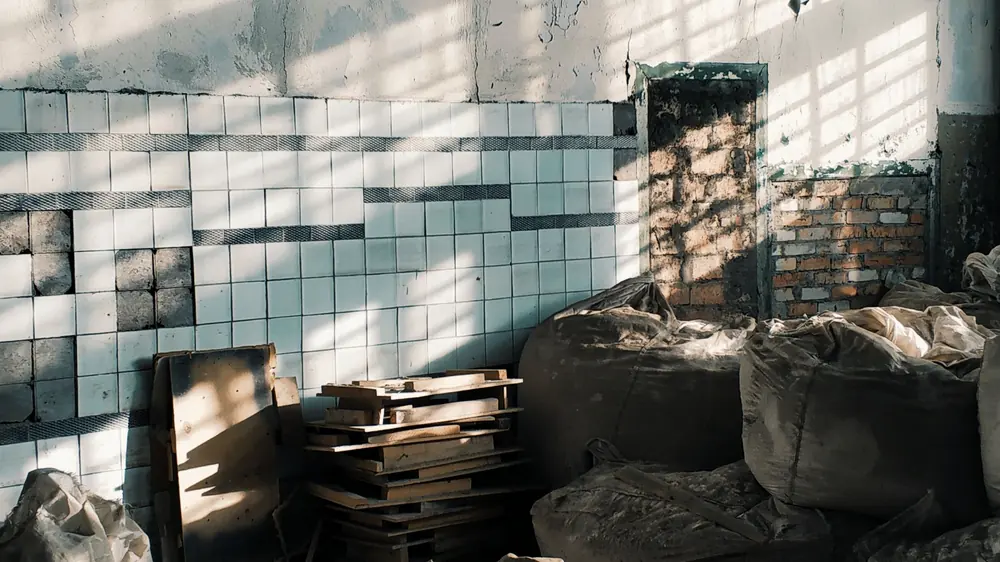
Builders waste removal in Varna: from your floor to the designated site
The renovation is done and the bags of rubble stand in the hall. They are sorted, carried down to the entrance and taken to a designated site — not left by the household bins. You tell us what was broken out and which floor you are on.
Our clients on video · all videos (in Bulgarian)
Builders waste removal in Varna means the rubble from a renovation — tiles with adhesive, plaster, screed, bricks, concrete, plasterboard — is sorted into bags, carried down from the floor and taken to a designated site. It is not household waste and is never left beside the bins. We organise the carrying and the transport; the work is done by the craftsmen we work with, and we stay your one phone number. We do not offer containers; we tell you whom to ask. It is the last step of a home renovation. Call +359 52 993 333 or email info@kanalvarna.com — write to us in English and we reply in English.
Updated November 2026What goes in the bag and what does not
The bag holds the rubble of the renovation: tiles with adhesive, plaster, screed, bricks, concrete and plasterboard. Paint, asbestos, lamps and household rubbish do not go in — they follow another route. Removing the waste is the last step of the renovation, but it is decided when the first bag is full.
Builders' waste. Waste from building, renovating and demolition: concrete, bricks, tiles, plaster, screed, plasterboard, roof tiles, soil from digging. It is not household rubbish: it is not left by the bins but handed in at a designated site.
- In the bag: tiles and adhesive, plaster, screed, bricks and aerated blocks, pieces of concrete, plasterboard, the ceramic of an old sink or toilet.
- Beside the bags, separately: wood — parquet, skirting, old doors; metal — reinforcement, old pipes, radiators; old window frames with the glass; the cardboard and plastic of the new materials.
- Not in the bag: tins of paint and solvents, oils, batteries, fluorescent lamps, household rubbish. Asbestos-cement and old pipes of that kind we do not touch — only a specialist company.
Sorting is done as the bags are filled, not on the pavement, and with an FFP2 mask — tipped rubble raises the same dust as breaking out. Clean concrete and brick are easier to hand in than a mixture with wood, plastic and old cables. Glass from windows does not go among the rubble: it cuts both the bag and the hand that carries it. If the rubble comes from a bathroom, tell us what else came out — the bath, the water heater and old pipes are carried separately; see bathroom strip-out.
One request from a drainage company: wash nothing from the renovation down the sink or toilet. Adhesive, grout and plaster settle in the trap and the horizontal pipe and set there. Let the bucket of tool water stand: the clear water on top can go down the drain, and the sediment dries and goes in a bag. If the sink already runs slowly, see blocked sink trap.
Bags, a small lorry or a container: which for what amount
The amount decides how it is taken away: a few bags are carried down and loaded onto a small lorry, a bathroom broken out down to the slab goes in several runs or on a larger lorry, and the renovation of a whole flat sometimes calls for a container. But volume misleads: broken concrete takes more room than the slab it came from, and a bag of tiles filled to the top cannot be lifted.
| Amount or situation | Sensible option | Watch for |
|---|---|---|
| A few bags — one sink, one wall of tiles | Bags carried down to the entrance and loaded onto a small lorry | Not by the household bins, even if it is only a little |
| A bathroom or kitchen broken out to the slab | Bags and a lorry in several runs, or a larger lorry | Heavy rubble goes half-way up the bag, or it tears on the stairs |
| A whole flat with partition walls removed | A larger lorry or a container; we organise the transport but have no container of our own | A container on the pavement or street is placed by the municipality's rules, usually with a permit |
| An old concrete pad or steps in the yard | Loose, by lorry | Pieces with reinforcement are heavy and hard to load — see concrete breaking |
| Soil and stones from digging | Separately from the rubble, by lorry | Tell us beforehand: soil is not mixed with concrete and brick |
A container suits a big renovation where bags fill for days. In front of a block, though, it takes a parking space or pavement and should not stand open, because neighbours soon fill it with their own junk. For a smaller amount, bags and one run are often more sensible.
Carrying down: stairs, lift and parking
The bags go down the stairs, or in the lift if the building's rules allow it, and they reach the entrance only just before loading — not earlier. Most damage in this job happens not on the road but in the stairwell: a torn bag, a scraped wall, a dented banister.
- A bag a person can carry safely. Heavy rubble is not filled to the top. Sharp pieces of tile pierce plastic, so they go in smooth side out or in a double bag.
- The stairs. An old bath, a radiator and a water heater are carried by two. Gloves are essential — old plaster has nails and wire in it.
- The lift. Only if the building's rules allow. The floor and walls of the cabin are covered with cardboard and the load stays within the limit on the plate inside. Sand spilled from the bags is swept after every run.
- Parking. The lorry stops by the entrance only for loading, without blocking the neighbours' way out. If the street is narrow or there is no space in front, tell us beforehand.
In a block it is easier when the building manager knows in advance when the carrying will happen, and noisy work follows the quiet hours of the building. If you let the flat and are abroad, tell us who will open the door — a neighbour, the building manager or whoever holds the keys.
Tell us what was broken out, which floor you are on and whether there is a lift. A photo of the pile by email helps, and we tell you how many bags it is and what transport it needs.
📞 +359 52 993 333Paperwork and where the waste goes
Builders' waste has one proper route: it is carried and handed in at a designated site. Not to the household bins, not by the roadside, not into the ravine behind the villa. This holds also when the renovation contractor, not you, arranges the removal.
The transport to the designated site is organised by us. If you need a document for the hand-over — for the owners' association or the municipality — say so when you order: whether and what document is possible in your case, we say by phone. Do not give the bags to a random carrier: if waste from your renovation turns up dumped somewhere, questions may come back to you.
For small household amounts there is another route. The municipality has to provide places where households hand in bulky and some other waste without paying. Which places these are in Varna, whether they take renovation rubble and on what terms, check on the Varna municipality website or at the district administration.
Asbestos does not go in the bag. Grey wavy sheets of old asbestos-cement, pipes of that kind in a cellar or on a shed, the thick grey sewage riser in the bathroom of an older block — do not break or cut them. Only a specialist company removes them. We do not touch them, not even one piece.
How the removal goes, step by step
- Description by phone. You tell us what was broken out, roughly how many bags and which floor; a photo of the pile helps. On that call we say how many bags it makes and what transport is needed.
- Sorting. Rubble apart, wood and metal apart, paint, lamps and batteries to the side. If something looks like asbestos-cement, we stop and tell you.
- Filling and carrying down. Heavy rubble goes half-way up the bag. The lift is covered, heavy items go with two people and bags come down to the entrance just before loading.
- Transport. The load is taken to a designated site. What kind of transport comes, you know beforehand; when we can come, we tell you by phone.
- Sweeping. After the last bag the stairwell and the landing are swept. The fine dust inside the flat is a separate job — see after-builders clean.
When you do not need us, and what the price depends on
- One piece of tile or a handful of plaster: see what the municipality accepts from households — for that amount it may be enough.
- Your contractor takes the waste away: then you do not pay twice — just ask where it is handed in.
- Only old furniture and appliances: that is another route — old furniture removal.
- A cellar or loft full of junk: basement clearance.
- Asbestos-cement: a specialist company, not us.
The price is given by phone after a short description or photos. Tell us what was broken out and from what (tiles, screed, brick, plasterboard); whether the bags are already filled or the rubble is in a pile; the floor and whether the lift can carry a load; where a lorry can stop and how far that is from the entrance; whether there is wood, metal, old windows, paint or anything that looks like asbestos-cement among it; and whether you need hand-over paperwork. The price depends on volume and weight, how mixed the waste is, the floor and lift, the distance to the loading point and whether the bags are still to be filled. An invoice is issued for the work we take on.
Frequently asked questions
Can it go in the household bins if it is only a few bags?
No. Builders' waste is not household waste, even a little; the bins are not for it, and a heavy bag beside them blocks the whole entrance. For small household amounts, check what the municipality accepts on its website or at the district. If that is not enough, tell us by phone how many bags and which floor.
How many bags does one bathroom make?
It depends how far it was broken out. Wall tiles alone give far fewer than a bathroom taken down to the slab with its screed, and more again if there is an old second layer under the tiles. Because bags of tiles and concrete are filled halfway, the count always looks big. From a photo of the bathroom we say roughly what to expect.
Do I need a permit for a container in front of the block?
Usually yes. A container on the pavement or the street is placed by the municipality's rules, most often with a permit arranged by the company providing the container or by you. Tell the building manager too. We do not offer containers; if the volume calls for one, we tell you by phone whom to ask.
Do you take away soil and earth from digging in the yard?
Yes. Soil is loaded separately from rubble, since it should not be mixed with concrete and brick, and is taken to a designated site as builders' waste, not to the bins. Tell us roughly how much there is and whether it has stones, roots or old pipes in it. If the digging is for a drain, see garden drainage.
Related pages
The order of the work, from strip-out to paint Bathroom strip-out
Where most of the bags come from Concrete breaking
A pad or steps in the yard: heavy rubble After-builders clean
Dust and leftovers once the bags are down Old furniture removal
Wardrobes, sofas and appliances go another route
Bags of rubble in the hall?
Tell us what was broken out, which floor you are on and whether there is a lift. A photo of the pile by email helps, and we tell you how many bags it is and what transport it needs.
📞 +359 52 993 333or email info@kanalvarna.com — write in English and we reply in English.
Send us a message
Leave your name and a phone number with the country code. Add your email if you prefer a written reply — write in English and we reply in English. We confirm the price before any work starts.