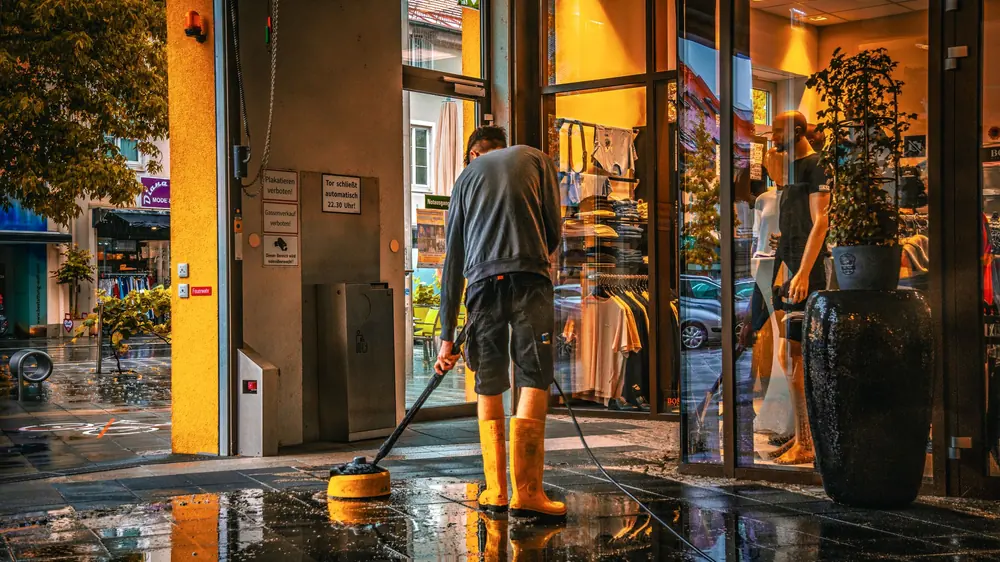
Pressure washing in Varna, at a pressure the surface can take
A patio or driveway, a rendered wall or fence, a pool before the season, a café terrace: each surface gets its own nozzle, its own pressure and a clear plan for where the dirty water goes. This is a newer line of work for us — send photos and we tell you whether and when we can take it on.
Our clients on video · all videos (in Bulgarian)
Pressure washing in Varna means cleaning outdoor surfaces you can reach from the ground with water under pressure: block paving, concrete and tiles in the garden, facades, fences and plinths up to 3–4 m, a pool before the season, the terrace of a café or hotel. The pressure, the nozzle and any cleaning product are chosen for the surface, and the dirty water goes into the property's own drains, not into the street gully. We wash with cold water. This is a newer line of work for us, so by phone we tell you whether and when we can take the job on. Call +359 52 993 333 or email info@kanalvarna.com — write to us in English and we reply in English.
Updated November 2026Pressure washing: what we clean, and where we stop
Jet washing suits what is outside and within reach from the ground. Because this service is newer for us, this page says plainly how the work is done and which jobs we turn down.
Pressure washer. A pump that forces water out through a narrow nozzle. The impact of the jet lifts the dirt off; the flow of water then carries it away.
- block paving, concrete and tiles in the garden — patio cleaning and driveway cleaning;
- rendered, brick and stone walls, fences, retaining walls and plinths, up to 3–4 m from the ground;
- a pool before the season, while it is empty;
- the terrace, entrance and bin store of a café, restaurant or hotel.
- Solar panels — their manufacturers do not allow washing with a strong jet.
- Chewing gum, graffiti and oil — these need hot water or steam, and we work with cold water only.
- Pitched roofs and walls above 3–4 m — that is work for a partner with a cherry picker, or for rope-access partners (abseilers).
- Cars in the street — the municipal rules do not allow vehicles to be washed in public places.
More pressure does not mean cleaner
A harder jet does not clean better; it simply does damage sooner. The pressure loosens the layer of dirt and the water removes it. Distance matters as much as pressure: a nozzle a hand's width from the paving and one held a metre away are two different tools.
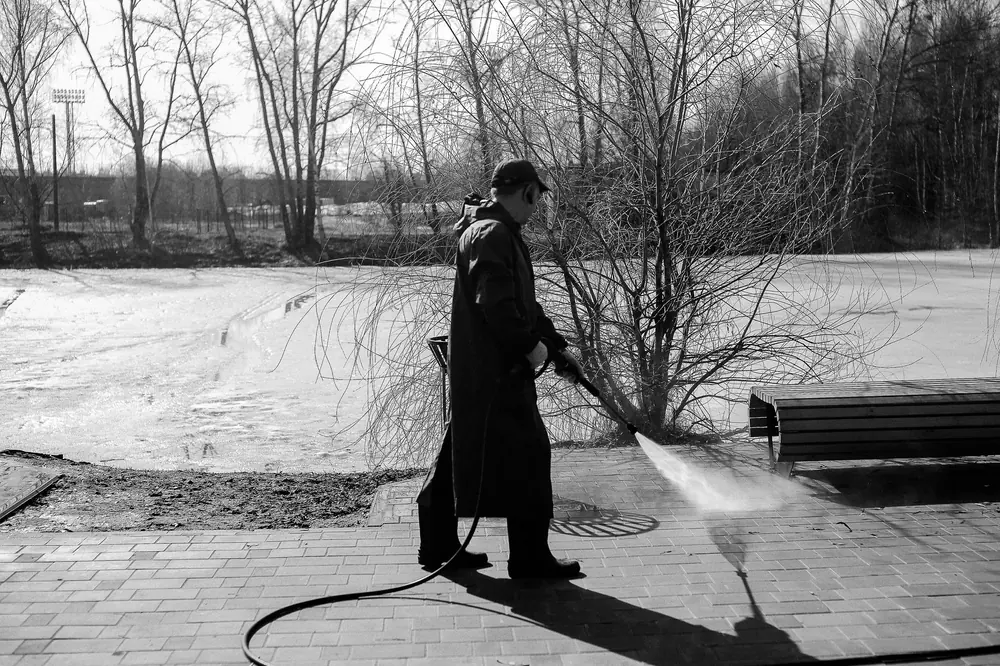
- Fan nozzle — a flat jet for most paving and walls.
- Rotary (turbo) nozzle — spins and hits a single point. It roughens concrete and washes out joints and render, so it is only for small, stubborn spots.
- Rotary surface cleaner — a cover with spinning jets held at one height above the ground: no stripes and no spray.
- Soft washing — low pressure with a cleaning product, for facades, awnings, timber and pool liners.
Our core trade is leaks and drains, so before we start we look at where the water will run — into a gully, a manhole or under the neighbour's door sill. And whether a surface is dry enough for a sealer or paint is decided by our moisture meter, not by eye.
The four pressure washing services, and related jobs
All four pages are about outdoor surfaces, and each starts from the material: what it can stand and what it cannot.
Patio and driveway cleaning
Block paving, concrete and tiles: moss out of the joints, a surface cleaner with no stripes, then dry sand brushed back into the joints.
Facade and wall cleaning
Render, brick, stone, fences and retaining walls up to 3–4 m — mostly soft washing, after a test patch.
Pool cleaning
Draining with a pump, washing, and a look at the lining while the pool is empty.
Restaurant terrace cleaning
The paving under the tables, the entrance and the bin store — before opening and after the season.
Three jobs involving water under pressure belong to other sections, where our drain machines and camera do the work: grease and soap coating a kitchen drain — drain jetting; silt in perforated drain pipes and their chambers — land drain cleaning; mud in a basement or garden after a storm — flood cleanup. The forecourt in front of a block of flats is washed only after the owners' association has decided on it; see our page for building managers. A terrace or flat roof that needs cleaning before waterproofing — ask us by phone.
Tell us what needs washing, how big it is and whether there is a tap and a socket nearby. Photos help — from them we tell you whether and when we can take the job on.
📞 +359 52 993 333Water, power and the dirty water: what we need from you
The water and electricity come from the property. We need a tap with enough water, a socket, and somewhere the dirty water can drain.
- the socket on its own circuit breaker, not on the same circuit as an oven or water heater;
- the dirty water with cleaning product goes into the property's foul drains — never into the street gully, a rainwater drain or the sea, because from there it reaches no treatment plant;
- mud and grease are waste: they are scooped up and disposed of properly, not hosed into the street;
- plants are watered before any product goes on and rinsed after it.
If you are not in Varna, tell us who will be there: a neighbour, the building manager or whoever keeps the keys can open the gate and show us the tap and the socket.
How a pressure washing job goes
The work begins and ends with photos.
- Photos and sizes. You send photos, the area and the height. At that point we already tell you whether and when we can take the job on — the service is newer for us.
- Test patch out of sight. In a corner we try the nozzle, the distance and the product. If the stone crumbles or the paint lifts, we lower the pressure or stop.
- Protection. Windows are closed, outdoor sockets and lights are switched off and covered, plants are watered.
- Washing and rinsing. Walls from the top down, paving from the building outwards. The water goes to the property's drains and the mud is collected.
- Photos and a short note. Before-and-after photos and a short note: when you can walk on the surface, seal it or paint it.
What to tell us by phone, and what the price depends on
We give the price by phone after a short description or photos. Mostly it depends on:
- what is being washed — paving, render, stone, tiles, a pool liner — and how many square metres;
- how dirty it is and with what: moss, mud, black spots, grease stains, white salt deposits (efflorescence);
- access and height — steps, kerbs, walls above the ground floor;
- whether there is a tap and a socket, and where the dirty water can go;
- the deadline — for example, before the season opens;
- for a block of flats — whether the owners' association has made a decision.
When you do not need a pressure washer at all: if there is only dust and leaves on the paving, a broom and a garden hose will do. Green growth on a wall inside the house is damp from within — the question is where the water comes from, see rising damp. Paving that sinks or rocks has a settled base, and washing will not fix it. An old oil stain in concrete only fades with cold water.
All pressure washing services
Green joints, slippery slabs, black spots on concrete: washed, then fresh dry sand Facade cleaning
Green patches on render, a dark fence, stained stonework: soft washing up to 3–4 m Pool cleaning
Draining with a pump, washing and a look at the lining while the pool is empty Restaurant terrace cleaning
Greasy paving, sticky bar area, smelly bin store: washed before opening and after the season
Frequently asked questions
Do you need our water and electricity?
Yes — both come from the property. You need a tap with enough water and a socket on its own circuit breaker. If there is no power outside or the water pressure is weak, say so on the phone, so we can judge before setting out whether the job can be done there at all.
Can you wash the upper floors of a block of flats? Who decides?
We wash only what can be reached from the ground: the forecourt and steps by the entrance, the bin area, and the ground floor up to about 3–4 m — and only after the owners' association has decided. Higher up is work for a partner with a cherry picker or rope-access partners. The building manager sends photos and the decision, and we say whether and when we can do it. The water goes into the block's drains, not the street. For the walls themselves see facade cleaning.
Do you use chemicals, and will they hurt my plants?
A cleaning product goes on only where water alone is not enough — moss, algae, black spots and grease stains. It is chosen for the surface and used as its maker instructs, and different products are never mixed. Plants are watered before and rinsed after. If there is a fish pond or a vegetable bed by the wall, tell us in advance.
How long does it take to dry after washing?
It depends on the material, the sun and the wind. Smooth paving in sunshine soon dries on top, but concrete, stone and render hold water deeper and for longer. That does not stop you walking on it; it does matter before a sealer or paint. Then we compare the washed area with a dry one using a moisture meter, the same way as in a damp survey.
Do you wash cars and vans?
Not in the street or in a car park — the municipal rules do not allow vehicles to be washed in public places. Company vans on your own premises, where the water runs to the drains, are another matter: mud and dust off the bodywork, ask us by phone. Engines and oil we do not wash, as they need hot water.
When is the best time of year?
Paving and facades — from March to June, and in September and October, when it is warm and dry: the sand in the joints dries out and a wet wall does not freeze. Pools and café terraces are washed before opening, so call a few weeks ahead. Drains and land drains are best flushed in autumn too, before the heavy rain.
I live abroad and let the house out. Can you deal with it?
Email photos, the rough size and the address to info@kanalvarna.com, and tell us who can open the gate and show us the tap and the socket — a neighbour, the building manager or the person with the keys. We tell you by phone whether and when we can take the job on, and the price. Write to us in English and we reply in English.
Related pages
A patio, a wall or a pool to wash?
Tell us what needs washing, how big it is and whether there is a tap and a socket nearby. Photos help — from them we tell you whether and when we can take the job on.
📞 +359 52 993 333or email info@kanalvarna.com — write in English and we reply in English.
Send us a message
Leave your name and a phone number with the country code. Add your email if you prefer a written reply — write in English and we reply in English. We confirm the price before any work starts.