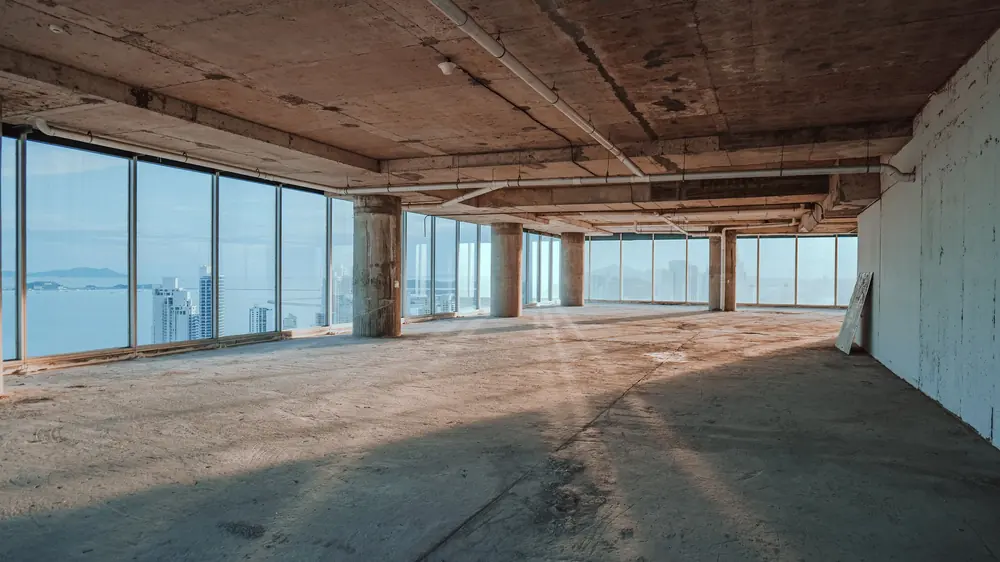
Screed removal in Varna: down to the slab, and old mosaic floors
Old, cracked, hollow or wet screed is taken out down to the concrete slab, and the work stops there. How much work it is depends on the thickness and on whether there is a mesh in it, so a small trial hole is opened first.
Our clients on video · all videos (in Bulgarian)
Screed removal in Varna takes out the layer between the building's concrete slab and the floor finish: screed that is cracked, crumbly, hollow or wet, or in the way of a new level, plus old mosaic floors. The work goes down to the slab and no deeper. Thickness and any steel mesh are found by a trial opening, and where underfloor heating may be buried the pipes are located with the thermal camera first and then the floor is worked by hand. The screed is taken out by the craftsmen we work with; we organise it and stay your one phone number. We give the price by phone after photos or the trial opening, before the work starts. The other strip-out jobs are under home renovation in Varna. Ring +359 52 993 333 or email info@kanalvarna.com — write to us in English and we reply in English.
Updated November 2026Screed removal: when it is needed and when the screed can stay
Screed is the layer between the concrete slab of the building and the floor finish. If it is sound, it is the best base for a new floor and there is no point paying to remove it. It is taken out when it gets in the way of the renovation or no longer holds.
- Cracked or crumbly: it wears away under your finger, sand collects in little heaps and the cracks open. A new floor on top will crack along the same lines.
- Hollow: whole patches sound hollow when tapped with a hammer; it has come away from the slab and will break under load.
- Wet after a leak: sometimes it dries and sometimes not; we decide after a moisture meter reading, not by eye. See water under the floor.
- A new fall is needed: in a bathroom the floor must lead water to the trap, and if the old slope runs the wrong way the screed goes.
- The height is not enough: the new floor would stand above the front-door threshold or scrape the doors.
- Underfloor heating is being replaced: the old pipes lie in the screed and come out only with it.
The screed can stay when it is dry, sound, without hollows and sloped correctly. Then only the tiles with their adhesive are taken off, see tile removal. Partial removal is often sensible: only the wet or hollow patch is taken out and the rest stays.
How we find the thickness and whether there is a mesh
There is no single thickness for all blocks: one flat can have 3 cm in the bedroom and over 8 cm in the hallway where someone levelled it. So we measure instead of guessing.
- The threshold: under the door sill or where the floor ends at the entrance, the cut is often visible, screed on top and the slab below.
- The next room: if the floor in one room is already off, the difference in height shows the thickness.
- A trial opening: in an unobtrusive spot a small square is opened down to the slab and measured with a rule. It also shows whether there is insulation underneath.
- The mesh: the opening shows whether there is a reinforcing mesh; during the work it shows when pieces do not fall but hang on wire.
Reinforced screed is slower work, because each piece must be freed from the mesh and the mesh cut. That is why it costs more than unreinforced screed, even when it is thin.
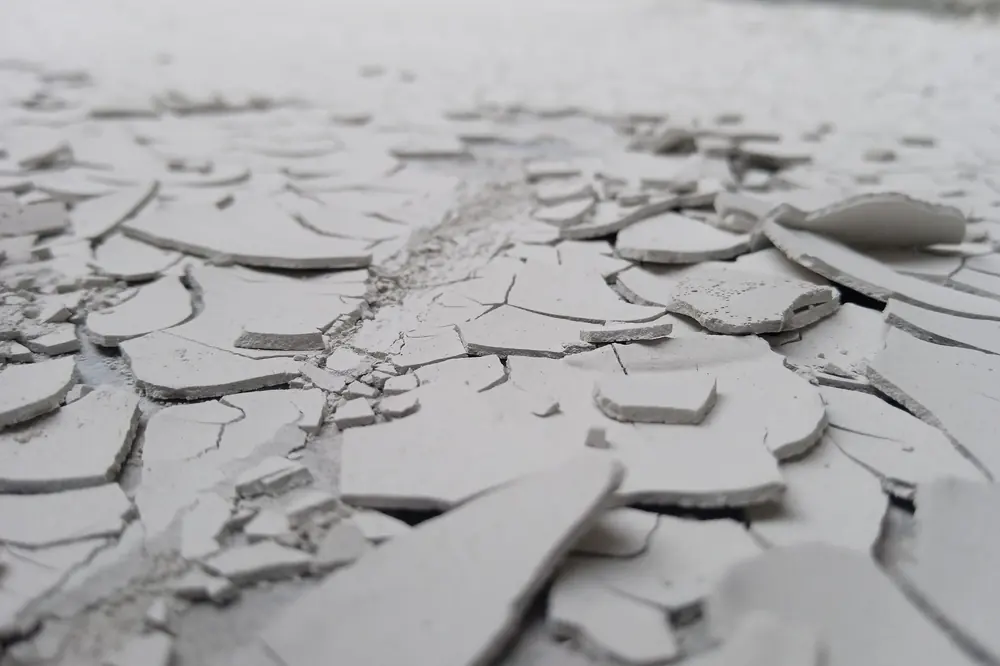
Down to the slab and no deeper: insulation, sound insulation and low floors
The floor slab is the structure of the building, shared between you and the neighbour below. It is not dug into, no hollows are made in it for pipes and its reinforcement is not cut. Near the concrete the last centimetres of screed are taken off with a lighter tool at a shallower angle, so that the edge of the slab is not chipped. If you need a channel cut into the slab itself for a new pipe, that is work on the structure and needs an engineer.
Sometimes the screed does not lie directly on the concrete. A floating screed is laid over polystyrene, mineral wool or an acoustic underlay with film. That layer is not broken out but cut and lifted by hand, and if it is wet or crushed we recommend a new one.
On the ground floor above a cellar, or in a house, the screed may lie on a concrete bed on the ground; the work stops there and the waterproofing is protected. Breaking that bed is another job, see concrete breaking.
Underfloor heating under the screed: thermal camera first, then by hand
Hot-water underfloor heating lies in the screed itself, a few centimetres under the surface. If the breaker hits a pipe, you have a leak and a circuit to repair. So we find it first.
- Switch the heating on in advance. A few hours before we come, so that the floor warms. Cold pipes look like concrete on the camera.
- Photograph the floor. The warm lines show the route, the bends and the manifold. We mark them on the floor.
- Switch it off and break out. Away from the lines the breaker is used; over the pipes the work is by chisel and hammer, piece by piece.
If the whole heating is being replaced, everything comes out, but the manifold and the wall connections are still marked: the plumber will use them. Underfloor heating by electric cable or mats does not always show on the camera and can rarely be saved, so tell us in advance if you have it. For a new water system after the strip-out, see underfloor heating installation.
Send the area, the floor and a photo of the threshold — we tell you the price by phone after a trial opening or photos.
📞 +359 52 993 333How heavy old screed is: bags, stairs and carrying away
Cement screed weighs about two tonnes per cubic metre. That is felt most in the bags: every centimetre of thickness is about 20 kg per square metre, so 5 cm of screed gives roughly 100 kg from each square metre, and the floor of an average room is more than a tonne of rubble. Bags are filled only to a weight that can be carried down without splitting, so there are several per square metre.
Without a lift, or if the rules of the building keep rubble out of it, the bags go down the stairs by hand. Builders' waste does not go into the household bin; it is taken to a designated site, and we organise that. For the paperwork and the options, see builders' waste removal. Old vinyl tiles or black bitumen adhesive under a floor may contain asbestos; we do not touch them, and a specialist company has to deal with it.
Taking up a mosaic floor
A mosaic floor, a cement layer with marble chips ground smooth, is typical of old blocks in Varna: staircases, balconies, bathrooms, hallways and kitchens. Underneath there is almost always a concrete bed, sometimes quite thick, and the mosaic is fused with it into one slab. So it is slower than ordinary screed: the stones are hard and do not crumble, the smooth surface lets the chisel slide, and the pieces are sharp and heavy. It is taken up in smaller areas, and by hand along walls and thresholds. The bed under the mosaic is a separate item, priced by its thickness, and a thick or reinforced bed is priced after a look.
- Bathroom and kitchen: old drain pipes often run under the mosaic; they are plugged and opened carefully around.
- Balcony: the mosaic is sometimes the only protection against water for the neighbour below. Once it is off the balcony needs waterproofing, see balcony waterproofing.
- The common staircase: mosaic on the shared stairs and landings is a common part of the building and is taken up only on a decision of the owners' association, not at the request of one owner.
Sometimes the mosaic does not need to come up: if it is sound and flat, new tile can be stuck on it. Tell us what will go on top and we say whether removal makes sense.
Drains and pipes in the floor, dust, and the neighbour below
In a bathroom and kitchen the drain from the toilet, trap and bath almost always runs under the screed. Before the first blow the openings are plugged so that no rubble falls in. If the drain stays, the work goes around it; if it is replaced, the plumber says how far to open. Cold-water pipes and drains do not show on the thermal camera, so their route is judged from the outlets and the riser. If you want the drain looked at with a camera while it is open, see the CCTV drain survey.
A floor is louder to break than a wall because the blow goes into the slab and the slab carries vibration to the whole entrance. The neighbour below feels it most: their ceiling rings, and on a very thin or old slab plaster can fall or a crack appear. So the neighbour below is warned beforehand and a lighter tool is used close to the concrete. There is no breaking out between 14:00 and 16:00 or in the evenings, and on Saturdays only by agreement with the owners' association. Preparing the flat for dust is described under demolition and strip-out.
What follows, and the owners abroad
What is left is a bare slab, swept and cleared. After that comes the plumber for pipes and underfloor heating if planned, then a new cement or self-levelling screed with the right fall and height, then the flooring; see flooring and floor screed.
If you own the flat and live abroad, send photos of the floor and of the threshold or of an opening in the floor, the area, the floor and whether there is a lift, and say who can open the door. We tell you by phone whether and when we can start. Payment is by cash, card or bank transfer after the work, with an invoice on request. We work every day from 06:00 to 23:00.
Frequently asked questions
How much does screed removal cost?
It depends on the thickness, whether there is a mesh in it, the area, the floor you are on and the amount of rubble; mosaic is counted separately. We give the price by phone after photos or a trial opening, because the thickness is rarely the same all over the flat, and always before the work starts.
Does all the screed have to go, or only the wet part?
Not always all. The moisture meter finds the edge of the wet area; if the rest is sound and dry, only the affected patch is taken out. If the water has spread under the whole room or under a floating screed, or the screed is hollow, it is more sensible to remove all of it.
Can screed with underfloor heating be broken out without puncturing a pipe?
Yes, if the pipes are found first. Switch the heating on in advance, we look at the floor with the thermal camera and mark the route, and over the pipes the work is by chisel and hammer. Tell us about electric heating beforehand, since it does not always show.
I let the flat out and am abroad. Can you do this?
Yes. Email the address and photos, say who can open the door, and write to us in English and we reply in English. In a block, tell the building manager about the noise; you pay after the work.
Old screed to come out?
Send the area, the floor and a photo of the threshold — we tell you the price by phone after a trial opening or photos.
📞 +359 52 993 333or email info@kanalvarna.com — write in English and we reply in English.
Send us a message
Leave your name and a phone number with the country code. Add your email if you prefer a written reply — write in English and we reply in English. We confirm the price before any work starts.