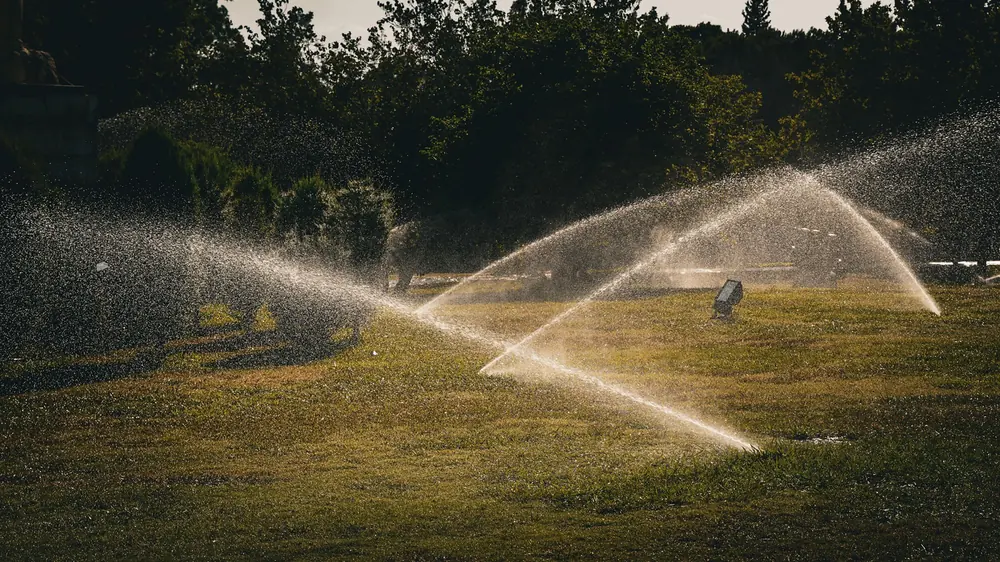
Garden irrigation systems in Varna: lawn, beds and hedge watered on a schedule
The lawn, the flower beds and the hedge watered on their own, on a schedule set on a controller. We build the system, start it up in spring, winterise it in autumn and repair it — and we begin by measuring the water at the inlet.
Our clients on video · all videos (in Bulgarian)
A garden irrigation system waters the lawn, flower beds and hedge by itself, zone by zone, on a schedule set on a controller. In Varna we build these systems ourselves, start them up in spring, winterise them in autumn and repair them. We begin at the water meter: we measure the pressure and flow at the inlet, split the garden into zones according to them, and at handover we check that the system is not losing water. This is a newer line of work for us, so we tell you by phone whether and when we can take on your garden. Call +359 52 993 333 or email info@kanalvarna.com — write to us in English and we reply in English.
Updated November 2026What a garden irrigation system is, and what we take on
An irrigation system is a network of pipes under the ground that waters the garden by itself, one zone at a time, when the controller says so. An automatic watering system frees you from the hose, but only works well if it is designed around the water you actually have.
Zone (watering circuit). A group of sprinklers or drip lines opened by one valve, so they water at the same time. How many zones a garden gets is decided by the water at the inlet, not only by the size of the lawn.
A typical sprinkler system has these parts:
- the connection to the water — after the water meter, or to a pump with a tank;
- a filter that keeps sand out of the nozzles and drippers;
- backflow protection, so water from the lawn cannot run back into the drinking-water supply;
- solenoid valves in a valve box below ground, one for each zone;
- polyethylene (PE) pipe in a shallow trench, out to the sprinklers and drip lines;
- a controller (timer) and a rain sensor.
- Not ours: the pump in a well or borehole. If you want your own source, a borehole can be arranged through our partners. We do not fit the pump in it; we connect the system to the finished source.
- A new 230 V socket outdoors is work for an electrician.
- Gardening — mowing, planting and lawn care — we do not do.
Why watering starts at the water meter
The water arriving at the meter decides how many sprinklers can run together. If a zone has more heads than the tap can feed, the last ones fall short and dry circles are left in the grass.
So before any plan is drawn, we measure the pressure and the flow at the tap — the pressure with our pressure gauge — and only then divide the garden into zones. How we measure, and what to do when the water is not enough, is on the irrigation installation page.
There is a second reason: in summer a cracked pipe or a valve that does not shut drains water away unnoticed. Finding leaks is our core trade, so every job on a system ends the same way: all zones stopped, and the water meter standing still. If it creeps, the loss is after the meter — in the irrigation line, or in the pipe between the meter and the house, which is an underground water leak.
Task by task: what is involved and where to read more
Most calls about garden watering come down to one of these tasks.
| Task | What it involves | Read more |
|---|---|---|
| A new system for the lawn | Measuring, a zone plan, trenching, sprinklers, controller | Irrigation installation |
| Drip irrigation for beds and a hedge | Drip lines, filter, pressure regulator | Irrigation installation — the table of what goes where |
| Start-up in spring | Slow filling, checking zone by zone, nozzles, a new schedule | Irrigation servicing |
| Winterising in autumn | Water off, draining from the low points, valves and filter | Irrigation servicing — the winterising section |
| A zone will not start, a sprinkler will not pop up | Controller, cable, valve, soil around the head, low pressure | Irrigation servicing — the table of signs |
| The meter moves while everything is off | A valve letting water through, or a leak in the line | Servicing; for the pipe to the house — underground water leak |
| Puddles and water running towards the house after rain | Falls, channels, leading rainwater away | Garden drainage |
Tell us how big the garden is, what you want watered and where the water comes from. We tell you where we would start, and whether and when we can take the job on.
📞 +359 52 993 333The irrigation services in this section
One page for a garden with no pipes yet, one for a system that already runs.
Irrigation installation
A new system for lawn, beds and hedge: pressure and flow measured, zones drawn, pipes laid, controller set, then a test cycle and an as-built plan.
Irrigation servicing
Spring start-up, winterising in autumn, repairs to sprinklers and valves, leaks in the line — also on systems we did not build.
We build the systems ourselves, with our plumber, from the first reading at the tap to the test cycle. Where a system cannot be drained any other way before winter, the lines are blown out with low-pressure air using a contractor's compressor — we do not have one, and we say so in advance.
A garden in Varna: what makes the difference
Around Varna, the wind, the soil and the slope count most — two neighbouring gardens of the same size may need different systems.

- Wind and salty air. Close to the sea, the wind blows the fine spray from sprinklers away. For beds and hedges, drip irrigation loses less.
- The soil. Clay takes water in slowly: two short cycles with a pause beat one long cycle that runs off. Sandy soil wants water more often, but less each time.
- The slope. In sloping gardens in the villa areas, water drains down to the lowest sprinkler, and it keeps dribbling long after the zone has stopped. A check valve in the head and a separate zone for the lower part help.
- The hour. Early in the morning the wind is weaker and less evaporates, so that is when the controller is set to water.
Watering and groundwater are separate problems. If the ground by the foundations is always wet, or water gets into the basement, look at drainage around the house first.
How work on an irrigation system goes
New system or servicing, the order is the same: the water first, then the pipes.
- A call and photos. You tell us what is to be watered and email photos of the garden and the water meter. On that call we say whether and when we can take the job on.
- The site visit. Pressure and flow measured at the inlet, soil and slope checked, zones drawn.
- The proposal. You get a zone plan, a list of parts and the price for your garden.
- Building or servicing. We lay or repair the pipes and start the system zone by zone.
- A test cycle with you. A full cycle in front of you, then the water meter checked with the system off.
- The controller. We show you how to change the schedule and where the stop tap for the system is.
Away for part of the year, or letting the house? Tell us who will open the gate and show us the water meter — a neighbour, a caretaker or whoever looks after the keys — and who should watch the test cycle — your gardener too, so they know which zone waters what. If the house stands empty through the winter, plan the winterising for autumn; the servicing page explains what it involves.
What to tell us by phone, and what the price depends on
No two gardens are the same, so we publish no prices. You get the price by phone after a short description, or in the proposal after the site visit. It depends mostly on:
- how much lawn there is and what else needs water — beds, shrubs, a hedge, pots;
- whether the system is new, or an old one that needs starting up, winterising or repairing;
- where the water comes from — the mains of ViK Varna (the water company) after the meter, or a well with a pump;
- whether there is an outdoor socket for the controller;
- how many paths, paving slabs or concrete the pipe must cross, and whether the garden is in Varna or in one of the villa areas around it.
Frequently asked questions
Can the system run off the mains, or do I need a well?
It can run off the mains, after the water meter. The system is then sized to the pressure and flow of your tap, and backflow protection is a must. If you have a well with a pump, we connect the system to it. A borehole can be arranged through our partners, but we do not fit the pump in it.
How much does a garden irrigation system cost?
We give the price by phone after a short description, or after a site visit. There is no ready price per square metre: two gardens of the same area can need a different number of zones. Starting up, winterising and repairing an existing system are priced separately.
Can I control the watering from my phone?
That depends on the controller. Some models connect to the home internet and are run from an app; others only have buttons on the unit. The first kind needs a good signal where the controller hangs. We choose the model with you, according to the number of zones — we do not push any brand.
Can I have drip irrigation just for the beds and the hedge, with no lawn?
Yes. Then it runs on drip lines only, which need less water at a time and leave the paths dry. The controller, filter and backflow protection are the same as for a lawn. How a drip system is planned is on the installation page.
Will watering push up my water bill?
There will be extra use — a lawn drinks a lot in summer. What matters is how you water: zones matched to the pressure keep the paths dry, drip lines water only the roots, and the rain sensor stops a cycle after rain. And if the meter moves while the system is off, we look for where the water is going — see leak detection.
The house is near the sea and I live outside Bulgaria — what should I send you?
Photos of the whole garden, of the water meter and of the spot where the controller would go, a rough size of the lawn, and what else you want watered. Email them to info@kanalvarna.com. From the photos we tell you where we would start and whether we can take the job on.
Related pages
Thinking about automatic watering for your garden?
Tell us how big the garden is, what you want watered and where the water comes from. We tell you where we would start, and whether and when we can take the job on.
📞 +359 52 993 333or email info@kanalvarna.com — write in English and we reply in English.
Send us a message
Leave your name and a phone number with the country code. Add your email if you prefer a written reply — write in English and we reply in English. We confirm the price before any work starts.