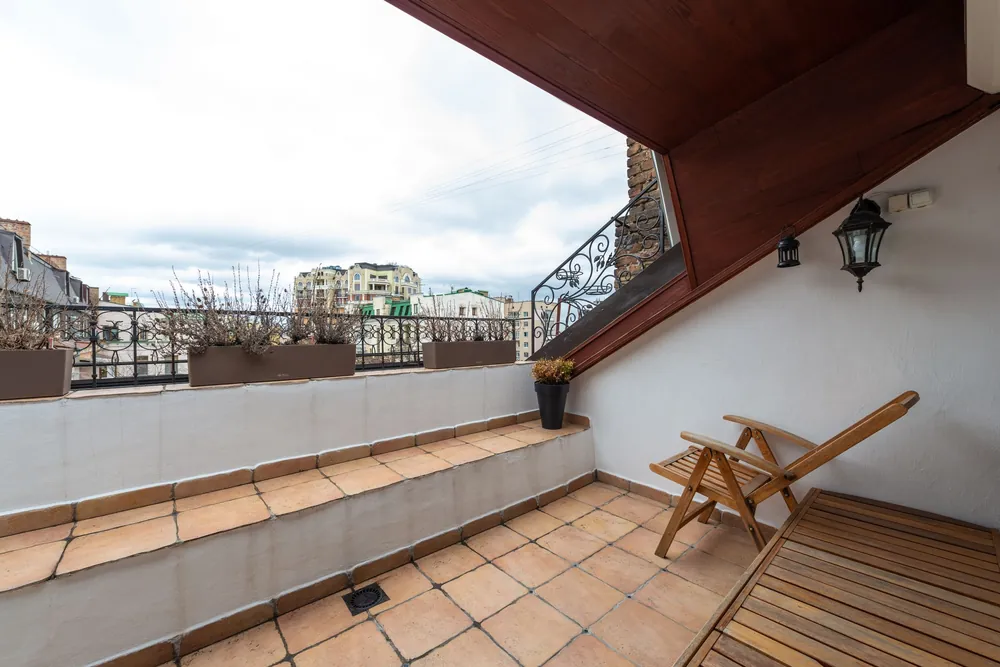
Balcony and terrace waterproofing in Varna: UV-resistant membrane and fall
A damp patch on the ceiling of the flat below, tiles that sound hollow, water that gets in at the edge after every storm: when a balcony or terrace leaks, the water is passing through the slab. We seal it with a membrane made for sun and frost and correct the fall, so the water runs off instead of waiting.
Our clients on video · all videos (in Bulgarian)
Balcony waterproofing in Varna (and terrace waterproofing) is the membrane under the tiles that stops rain going through the concrete slab into the flat below. An open balcony takes sun, rain, frost and sea air, so the membrane must be UV-resistant and elastic, and the fall must carry the water to the outlet; we also treat the movement joints and the edge where the slab meets the wall. We use polyurethane, modified bitumen or EPDM rubber, depending on the terrace, and the work is carried out with the craftsmen we work with. Balcony and terrace waterproofing starts from €18 per m². If the problem is that water does not run away, but the membrane is fine, see balcony drainage. This page belongs to waterproofing in Varna. Ring +359 52 993 333 or email info@kanalvarna.com — write to us in English and we reply in English.
Updated November 2026Why a balcony or terrace needs its own waterproofing
A terrace is exposed to everything: rain, snow, sun, wind and sudden changes of temperature. On the Varna coast a surface in full sun can get very hot in summer and drop below freezing in winter. Water goes into hairline cracks, freezes, expands and tears the material from inside.
A bathroom membrane is covered by tiles and never sees the sun. A terrace membrane stands in direct sunlight, and ordinary bitumen breaks down under it within a few years. That is why terraces get UV-resistant materials.
The second factor is the fall. Water that cannot drain collects in the low spots and finds every tiny crack. Many terraces fail not from bad material but from a missing fall or a blocked outlet.
Terrace waterproofing: the membranes we use
Polyurethane membrane. A two-component liquid that forms an elastic, UV-resistant film with no seams and follows any shape. It copes with big temperature swings and does not crack when the slab moves. It suits terraces with tiles on top and ones left bare. This is the one the price from €18 per m² is for.
Modified bitumen (SBS). Bitumen rolls with a polymer for more elasticity, laid with a torch and finished with a reflective surface against UV. It costs less than polyurethane but has seams that need careful work, and is suited to large open terraces.
EPDM rubber. A synthetic rubber sheet with very good resistance to sun and ozone, supplied in large sheets so that seams are few. It lasts very long but costs more and is harder to fit, so it is chosen for large terraces and roof gardens.
Polyurethane is our first choice for terraces. We tell you which one fits your slab when we know the size and the state of it.
Fall and outlets: the other half of the job
The right fall matters as much as the membrane. Without it even perfect waterproofing fails in time. This is what we check and put right:
- The fall itself. A centimetre or two per metre towards the downpipe, the edge or a drainage channel. If it is flat or slopes the wrong way, we pour a levelling screed with the right fall before the membrane.
- Outlets. Every terrace needs at least one drain, a gully, a channel or an open edge; a large terrace should have two.
- The upstand at the wall. The membrane is turned up the wall and covered with a drip profile that throws the water outwards.
- Gutters and downpipes. We check they are clear of leaves and debris, because a blocked outlet is a common reason for a flooded terrace.
How the openings and the connection to the downpipe are made is described on the page about balcony and terrace drainage. In new buildings the usual fault is too little fall, because the screed was skimped; in old panel blocks it is a single layer of bitumen from the 1980s that has long failed.
Send the size, the floor and a photo of the ceiling below — we tell you the price before we start.
📞 +359 52 993 333Movement joints: the weak point of a leaking balcony
Expansion joints exist where the terrace meets the wall of the building, around columns and on large areas. Their purpose is to take the movement of the structure, but that same movement is what breaks the waterproofing. We treat them with elastic tape and a polyurethane sealant, and on old buildings with wide joints a profiled sealing strip. Each joint is cleaned, primed and filled in stages.
If your terrace leaks mainly in heavy rain or when snow melts, look at the joints first: that is probably where the problem is. Building firms sometimes use poor sealants that harden and crack in a few years, so the joints are treated on new buildings too.
Balcony waterproofing is not the same as a terrace
A balcony is smaller and usually a cantilever, so it can carry less weight. The principles are the same, but with lighter materials: a liquid polyurethane adds almost no weight and goes on quickly. The junction between balcony and wall is where moisture most often gets in, so we add tape and an extra protective layer there.
In Varna, the open balconies of the panel blocks in Vladislavovo, Mladost and Vazrazhdane were built with the minimum of waterproofing, often a single layer of bitumen from the 1980s. It has long since failed, and rain now gets into the slab and the reinforcement and drips into the flat below. A glazed terrace has its own route: water comes in at the threshold and the seals of the windows, and the answer is a liquid membrane over the floor, turned up the walls, with new seals on the frames.
If you only need to find where the balcony leak comes from, see finding a balcony leak. For a flat roof, see flat roof waterproofing.
When to waterproof a terrace
The season matters. April and May are ideal: mild, little rain and enough sun to dry the membrane before the summer heat. September and October are good, before the autumn rain. In summer we work early or late, as the heat dries the material too fast. From November to March we avoid it, as the membrane does not dry properly below about 10 °C and only emergency repairs make sense.
The membrane needs at least 48 hours without rain after it goes on. We help you choose the date and watch the forecast. If you also need a new surface, or the edge of the slab or the parapet is crumbling, the order is always the same: stop the water first, then lay the finish on top.
What to tell us, and how the visit goes
Send the address, the floor, the size of the terrace or balcony, whether it is tiled and where the ceiling below shows damp. Photos of the surface, the outlet and the edge help. We say whether the tiles can stay under a liquid membrane for a light fault, or have to come up so that the fall can be corrected and the whole slab covered; with a serious leak we advise taking the surface down to the slab. We tell you the price once you have described the job or sent photos, and before we start.
Someone must open the door and the balcony: give us the name and number of a neighbour, a cleaner or a manager. In a block, tell the building manager or the owners' association that the work will be done. Payment is after the work, by cash, card (Visa, Mastercard) or bank transfer, and an invoice on request. We work every day from 06:00 to 23:00.
Frequently asked questions
How much does terrace waterproofing cost in Varna?
It starts from €18 per m² for a polyurethane membrane. Correcting the fall and treating the joints come on top where they are needed, and we tell you the price before we start, once you have described the job or sent photos.
What is the best time of year?
April to May, or September to October. The membrane needs mild weather and 48 hours without rain afterwards. We avoid the winter months.
Can it be done without lifting the tiles?
For minor damage a liquid polyurethane can go over the existing tiles. For a serious leak the tiles come up to the slab, so the fall can be corrected and the whole surface covered. We decide when we have seen it.
How do I know my balcony leaks?
Wet patches on the ceiling below, swelling plaster, mould in the corners and visible cracks along the joints. If you are not sure where the water comes from, see balcony leak detection.
Can tiles go back on top of the membrane?
Yes. After the membrane you can lay tiles, decking, gravel or another surface. Use a flexible adhesive and a waterproof grout, and a drainage mat between the tiles and the membrane gives extra protection.
I'm not in Bulgaria — can you still deal with it?
Yes. Send us the address, photos and the name and number of someone who can let us in. We agree the method, the date and the price with you, and you can pay by bank transfer after the work.
The balcony leaks into the flat below. Who pays?
That depends on whose slab it is and on what the owners' association has agreed, so ask the building manager. We can tell you what the fault is and what the work involves.
Balcony or terrace leaking?
Send the size, the floor and a photo of the ceiling below — we tell you the price before we start.
📞 +359 52 993 333or email info@kanalvarna.com — write in English and we reply in English.
Send us a message
Leave your name and a phone number with the country code. Add your email if you prefer a written reply — write in English and we reply in English. We confirm the price before any work starts.