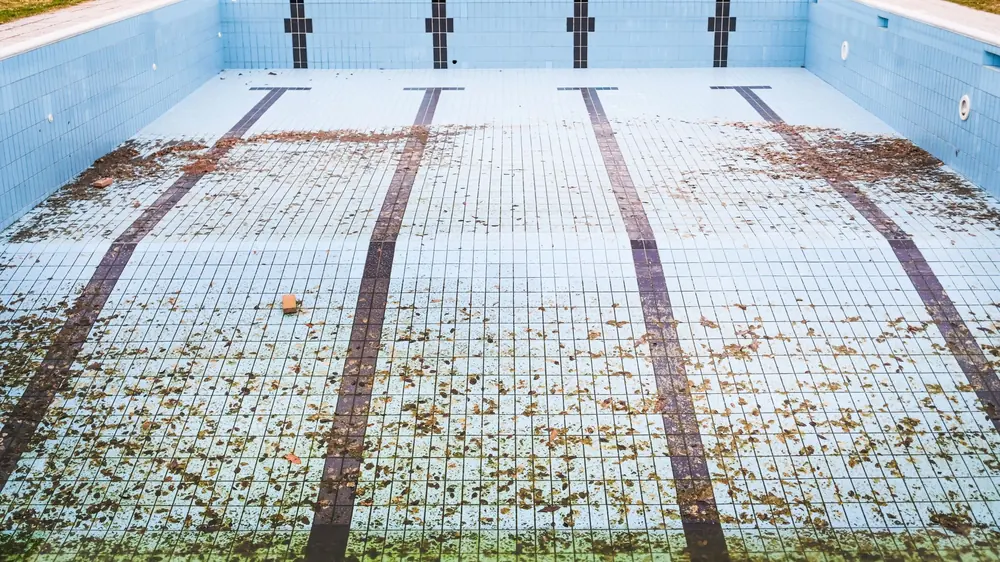
Pool cleaning in Varna: draining, washing and a look at the empty pool
Green walls, a white crust at the waterline, silt on the bottom after the winter. We drain the pool, wash it and look at the lining while it is empty, and leave the filter, the chlorine and the chemicals to the company that looks after the pool.
Our clients on video · all videos (in Bulgarian)
Pool cleaning in Varna before the season has three parts: draining, washing and looking. We pump the water out with a submersible pump once it is agreed where the water goes and whether the groundwater allows it, wash the tiles or concrete with cold water, and then look over and photograph the empty pool. The pool equipment, the filter, the chlorine and the chemicals stay with the pool company; we do not touch them and do not sell chemicals. This is a newer line of work for us, so we tell you by phone whether and when we can come. Pool cleaning is part of pressure washing in Varna. Call +359 52 993 333 or email info@kanalvarna.com — write to us in English and we reply in English.
Updated November 2026What pool cleaning before the season includes
Pool cleaning before the season is a job on an empty pool: the water is drawn off, the silt is scooped out, the walls and the bottom are washed, and the lining is looked over while it is dry. Then the pool is rinsed and filled from the mains, slowly, so the filling is planned backwards from the opening date. The weekly care with a net, a vacuum and chemicals is something else and stays with the pool company. Other jobs with pressurised water around the house are collected in pressure washing in Varna.
Waterline. The band on the pool wall at the level of the water. Limescale settles there, and sun cream, dust and pollen stick to it, so it darkens first and is the hardest to clean.
We wash with cold water; limescale is removed with a cleaner, not with heat. The filter, the chlorine and the start-up of the plant belong to the company that services the pool. We do not touch the equipment and do not sell chemicals.
Before we drain: groundwater, and where the water goes
A pool is not drained to the bottom until two things are clear: how high the groundwater stands around it, and where the water will go.
A full pool is heavy and its water presses the floor down; an empty one is light, and groundwater presses it from below. After long rain the soil is soaked and the pressure can lift an empty pool or break its floor lining. So we ask when it last rained, what the ground is like and whether there is a relief valve or drainage under the pool, which would be in the design. If in doubt, we do not drain to the bottom: some water stays as weight.
The PVC liner is held taut by the weight of the water. Left without it for long, especially in the sun, it can shrink, crease or come away in the corners, so a liner pool is rarely drained fully and the filling starts right after the inspection.
Chlorinated water does not go to the rainwater drain, the ditch towards the sea or a river. A few days before draining, the chlorinating is stopped and the pool is left uncovered until the chlorine falls, which is checked with test strips. Where the water goes is agreed beforehand, usually into the property's sewer under the operator's rules. A septic tank would overflow, so water does not go there. Before the first litre leaves, the filter and the lights are switched off: the pool pump must not run dry and underwater lamps overheat without water.
The pump is the kind used for pumping out a flooded basement; the difference here is the chlorine.
The lining decides how hard we wash
How strong the jet may be is decided by the lining, not by the dirt: tiles stand pressure, a liner does not.
| Lining | How it is washed | The risk |
|---|---|---|
| Tiles (ceramic, porcelain) | Pressurised water, a fan nozzle, from a distance | Close up, the jet takes out the grout, which fails before the tile |
| Glass mosaic | As tiles, but at a shallower angle and from further off | The pieces are on a mesh; a hollow spot comes away in a patch |
| Painted concrete | Low pressure, a soft brush, a cleaner as instructed | Old paint flakes, and a strong jet takes the sound paint too |
| PVC liner | Low pressure and a soft brush, no abrasives | Scratches, coming away in the corners, shrinking without water |
| Polyester | Low pressure, a soft sponge, no abrasive cleaners | The gloss goes dull and scratches collect dirt |
The rotating turbo nozzle is for sound bare concrete only. On every lining we wash a small place by the steps first, and only then the whole area. If the grout starts to crumble under the jet, the pressure goes down.
Call and send photos: size, lining and the date you want to open it. We say where the water can go and whether and when we can come.
📞 +359 52 993 333Green walls, a white crust, crumbling grout: sign, cause, what we do
| Sign | Likely cause | What we do |
|---|---|---|
| Green, slippery walls | Algae: the pool stood without filtering and chlorine | Washing; where needed a cleaner left to act, then rinsing |
| Black dots in the corners and grout | Algae or mould in the pores of the grout | A brush and cleaner, then washing; soft grout gets a photo and a look |
| A white crust at the waterline | Limescale from hard water, mixed with grease | A limescale cleaner, careful with grout and metal |
| The level fell by more than evaporation | Water lost through the lining or the pipes | A bucket test and a look; finding where is a separate service |
Limescale comes off with an acid pool cleaner. It also eats cement grout and stains metal, so it is put on in sections, with gloves and goggles, rinsed off well, and the acid water is neutralised before pumping out. It is never mixed with chlorine products: together they give off a gas that does not disperse at the bottom of an empty pool.
The empty pool: what shows only now
While the pool is empty and washed, the whole lining can be seen, which does not happen often and is worth using.
- Cracks. A fine net on the render is one thing, a crack through a tile and along the grout is another; we photograph the second with a tape measure beside it.
- Hollow tiles. We tap with a handle: a sound tile gives a solid, dull knock, a hollow one sounds empty, like a tin. Underwater you cannot hear it.
- The skimmer. The joint between its throat and the lining often cracks, so we look for cracks and missing grout.
- Nozzles and lights. The seals, rust, the niche of the lamp.
- The edge. The coping and the joint between it and the paving, which is where rain gets under the lining.
We photograph anything doubtful and go through it with you, with a short note for the pool company or a tradesman. If the level fell more than usual in summer, do a bucket test before we drain: stand a bucket on a step, fill it from the pool to the outside level, mark both levels and stop the automatic top-up. After a day, the bucket loses only to evaporation; if the pool has dropped visibly more, water is leaving elsewhere. Where from — the lining, the pipes or the skimmer — is a separate check with other instruments, and by phone we explain how it is done and with whom.
How the cleaning goes
- Photos and agreement. You send photos and tell us the size, the lining and the date you need it ready.
- Where the water goes. We agree the place and whether the chlorine has fallen; the filter and the lights are switched off.
- Draining. A submersible pump stands in the deepest part. On soaked ground, or in a liner pool, the pool is not drained to the bottom.
- Silt and washing. Leaves and mud are scooped out, then the walls are washed from the waterline down and the dirty water is collected and pumped away.
- Inspection and photos. Tapping the tiles, the skimmer, nozzles, lamps and the edge, with photographs.
- Rinsing and filling. A last rinse and the water from the mains goes in. Chemicals and the filter are for the pool company.
Filling is usually the slowest part, as it depends on the mains pressure, which falls when the neighbours water their gardens too. We give the time by phone. If you only want the paving round the pool washed, that is patio and driveway cleaning; a hotel or café terrace is restaurant terrace cleaning.
What to tell us, and what the price depends on
We give the price by phone after a short description or photos. Tell us:
- the size and the greatest depth;
- the lining: tiles, mosaic, painted concrete, liner or polyester;
- when it was last drained and what the water is like now;
- whether there is groundwater and whether it rained lately;
- where the water can go — is there a sewer inspection chamber close by;
- the date by which you want it full.
The price depends on the volume, on whether the draining is done in stages, on how much silt and limescale there is, on the lining and on access. We give an invoice for the work. If you let the house to guests and are abroad, tell us who will open the gate and show us the pool — a neighbour, a caretaker or whoever holds the keys — and send photos to info@kanalvarna.com. If you are also worried about the water supply to the house, see leak detection.
Frequently asked questions
Does the pool have to be drained every year?
Not necessarily. If the water is kept clear, a pool is often cleaned without draining, with a vacuum and a brush along the waterline. A full drain makes sense when there is a lot of limescale or algae, the silt is thick, or you want to look at the lining dry.
Where does the pool water go?
Where it was agreed beforehand, usually into the sewer of the property under the operator's rules. Not into the rainwater drain, the ditch towards the sea or a river. Before draining, chlorinating is stopped and the chlorine is left to fall. If the property is on a septic tank, the water does not go into it, as it would overflow; we say so by phone before we come.
Do you start the filter and add chemicals?
No. The filter, the pool pump, the chlorine and the water balance are the pool company's work; it knows the plant and answers for it. We do the draining, the silt, the washing and the look at the empty pool. If you work with a company under a contract, agree who comes when, so that the pool does not stand empty between the two visits.
Do you take hotel pools?
We can discuss it. A hotel pool is much bigger and the hotel usually has a contract with a pool company, so we first agree what that company takes and what is left for us: draining, washing and the inspection. Call early in spring.
Related pages
The pool has to be ready for the season?
Call and send photos: size, lining and the date you want to open it. We say where the water can go and whether and when we can come.
📞 +359 52 993 333or email info@kanalvarna.com — write in English and we reply in English.
Send us a message
Leave your name and a phone number with the country code. Add your email if you prefer a written reply — write in English and we reply in English. We confirm the price before any work starts.