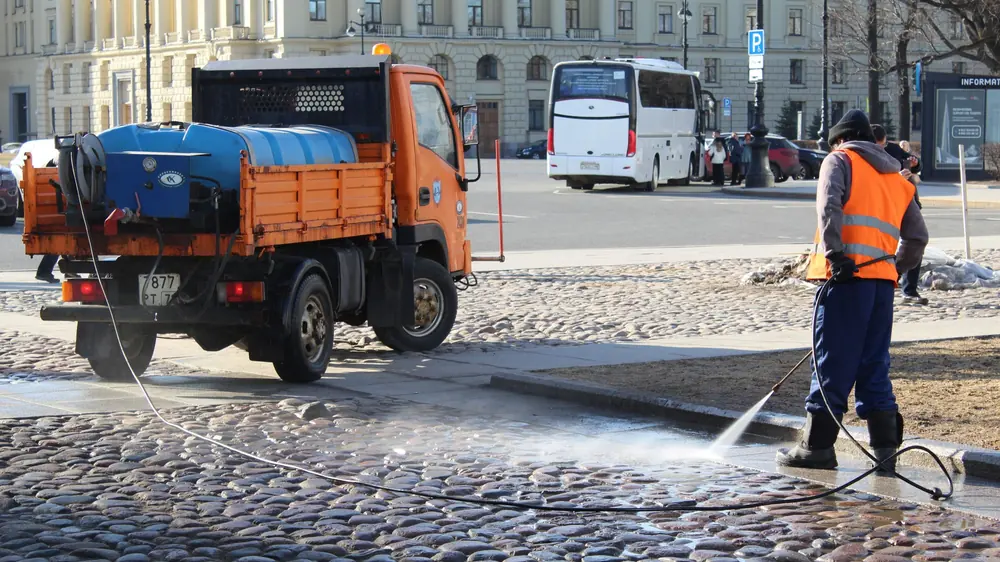
Patio and driveway cleaning in Varna: block paving washed, joints re-sanded
Green joints, slippery slabs, black spots on the concrete? Flat paving is washed with a rotary surface cleaner rather than striped with a gun, and the sand the jet carries out of the joints is put back afterwards. This is a newer line of work for us, so we tell you by phone whether and when we can come.
Our clients on video · all videos (in Bulgarian)
Patio and driveway cleaning in Varna is washing block paving, tiles, concrete and the ground-level terrace of a house with water under pressure, then filling the joints again with dry sand. The flat area is washed with a rotary surface cleaner so no stripes are left; edges and steps are done with a fan nozzle. Concrete and granite take more pressure, limestone and sandstone very little. We do not lay new paving or repair sunken areas. It is part of our pressure washing in Varna, a newer service, so we say by phone whether and when we can come. Call +359 52 993 333 or email info@kanalvarna.com — write to us in English and we reply in English.
Updated November 2026What patio and driveway cleaning includes
The job has five parts: sweeping and pulling moss out of the joints, cleaning product where it is needed, washing the flat area with a surface cleaner and the edges with a nozzle, rinsing towards a drain, and fresh dry sand in the joints. The same goes for tiles in a yard, a concrete pad by the garage and a house terrace that sits on the ground.
Rotary surface cleaner. A round cover with a bar of two or more jets spinning inside. It keeps the jet at one height above the paving, so the washing is even, and the spray and mud stay under the cover instead of flying at the walls.
A hand-held gun alone cannot keep one distance. Where the jet passes closer the paving comes up paler, where it passes faster it stays darker, and next day the yard has stripes. A surface cleaner does not make that mistake, but it cannot reach corners, the foot of a wall or steps, so there we use a fan nozzle, carefully, in several passes. The rotary (turbo) nozzle tempts because it removes dirt in seconds, but it hits a single point and strips the smooth top layer of concrete block; the paving then roughens and grows moss faster than before. It is kept for one stubborn spot or a kerb edge.
We do not lay new paving or repair sunken areas; that is for a firm that lays paving.
What the paving can take
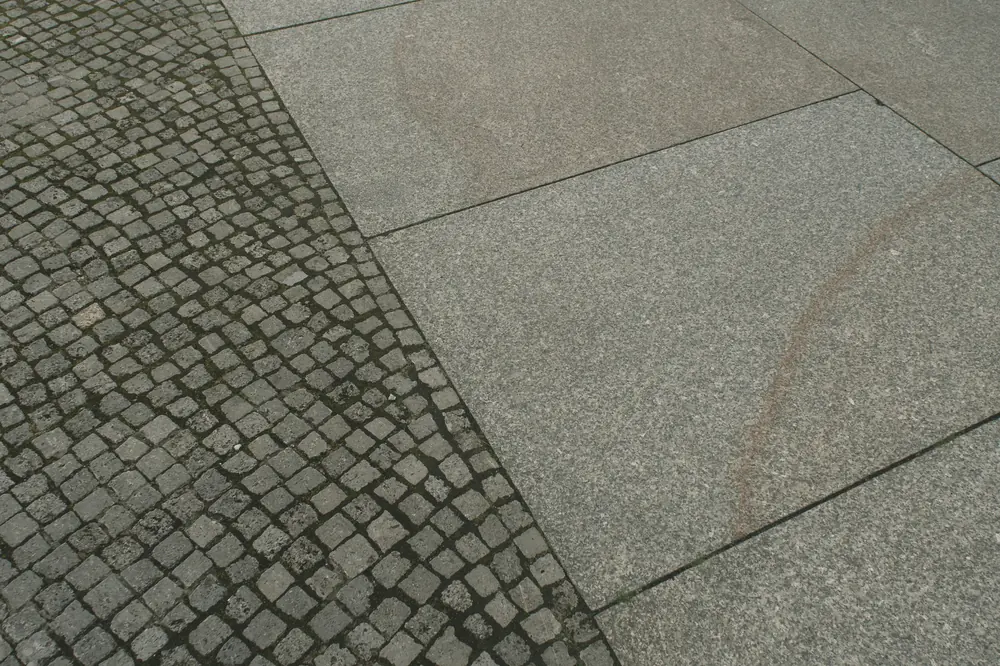
Different surfaces take different pressure and different products, so we first look at what your yard is made of. A jet that concrete block never feels will score a soft limestone slab.
| Surface | How it is washed | The risk |
|---|---|---|
| Concrete block paving | Surface cleaner, fan nozzle at the edges | A turbo nozzle strips the smooth layer and exposes the aggregate |
| Granite | Takes more pressure and a surface cleaner | Polished granite is slippery when wet, more so with product left on |
| Limestone, sandstone | Low pressure, wide nozzle, no acid products | They crumble, edges round off and grooves appear |
| Poured concrete: a pad or ramp | Surface cleaner and a moss product | Old oil stains sit in the pores and only fade |
| Tiles: porcelain, terracotta | Surface cleaner, no jet aimed into the grout | Cement grout crumbles; terracotta soaks up water |
If you do not know what the stone is, email a close photo and one of a chipped corner. Limestone is softer and paler in the break, granite is grainy and hard. When it is unclear, a test patch in a corner decides.
Moss, white salts and oil: what the mark means
The mark usually shows what caused it, and whether it will come out. The table is a guide; on site, the test patch confirms it.
| What you see | Likely cause | What we do |
|---|---|---|
| Green and slippery, mostly in shade | Algae and moss: shade and standing water | Product, a wait, washing and rinsing |
| Black spots that stay after the first pass | Lichen in the pores | Product and a longer wait; sometimes a second wash weeks later |
| White patches or a white film | Salts from the concrete or the mortar below | Dry brushing, a salt remover and little water, then patience |
| Dark greasy marks | Car oil, barbecue grease | Degreaser and a test; old stains fade, rarely vanish |
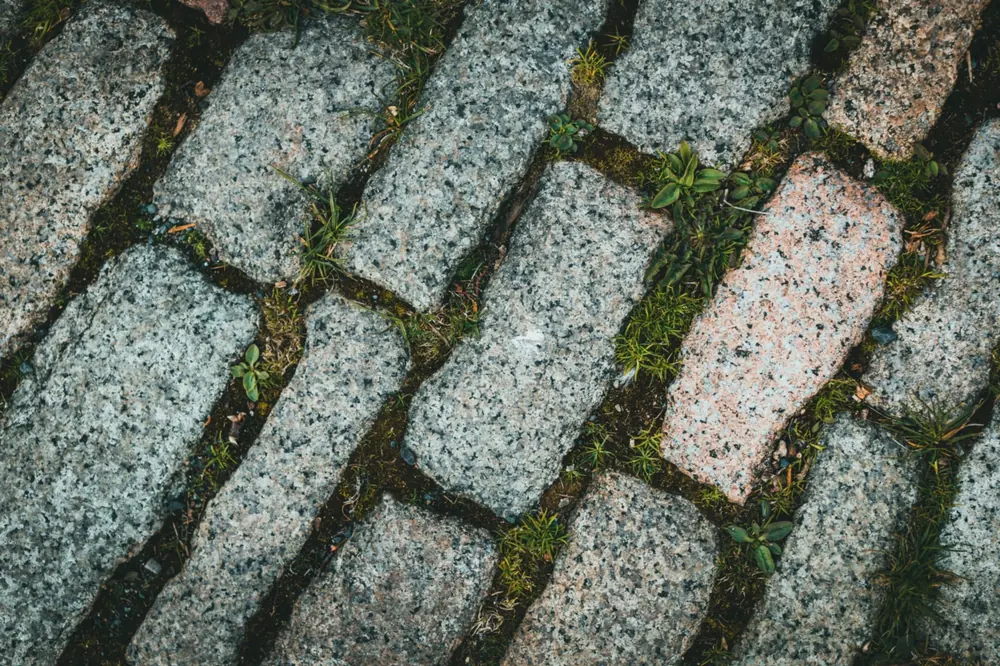
| Grass and ants in the joints | The sand has been washed out by water and wind | Clean the joints and refill with dry sand |
| Puddles in the same places | A settled base, or a fall towards the house | Not a washing job; see garden drainage |
White patches on new paving are salts that water draws out of the concrete and leaves as a white dust. Heavy washing brings out a fresh batch, so in the first year we wait, and older patches come off with dry brushing and a salt remover, after a test in a corner. Oil is the opposite case: it does not come out, it goes in. Concrete is porous, and cold water with a degreaser lifts only the top. A fresh stain fades a lot, an old one a little, and we tell you that by phone before we come, not after the washing. We have no hot water or steam, so we say honestly what to expect from a photo.
Email the rough area, what the paving is and photos of the marks, from close up. By phone we tell you what is likely to come out and whether and when we can come.
📞 +359 52 993 333Sand in the joints: why it goes back after washing
The jet carries sand out of the joints, mostly from the top. Without it the paving has no support at the sides: blocks shift under tyres, their edges knock together and chip, and dust, seeds and ants get into the empty joint. Where the sand is washed out, moss and grass come back quickly.
- Dry sand. Kiln-dried quartz sand is swept across the joints in several passes until they are full to the top. The surplus is swept off, not washed off.
- Only on dry paving. Wet sand sticks to the blocks and does not go into a narrow joint, so there can be time, sometimes a whole day, between washing and sanding.
- It settles. After the first rain the joints sink and are topped up. That is normal, not a fault.
- Polymeric sand, if you want it. It sets after a light spray from a hose and holds back weeds. It needs completely dry paving before it goes in and dry weather after; if rain catches it, or dust is left on the blocks, it leaves a cloudy film. It goes in only as its maker instructs.
Sand between blocks is nothing like the grout in a bathroom: grout is mortar, replaced with tools; here the sand is part of the paving and is topped up with a brush. The sand and the sealer are agreed separately from the washing.
Sealer, and why we measure first
A sealer or impregnator is a separate question. On damp paving it does not soak in; it stays on top and turns white in patches that are hard to remove later. Blocks can look dry after a sunny day and still be wet underneath. So before any sealing we measure with our moisture meter and compare the washed spot with a part of the yard that was not wetted. Whether we take on the sealing in your yard, we clarify by phone. More about the instrument is in the damp survey. A glossy sealer can also make slabs slippery, so the type is chosen for the stone and the maker's instructions.
How a patio cleaning job goes
- Photos and area. You email photos from close and from far, with the rough square metres. By phone we say whether and when we can take the yard, because the service is newer for us.
- Test patch in a corner. We try the nozzle, the distance and the product where it does not show. If the stone crumbles or the sand goes deep, we lower the pressure.
- Sweeping and protection. We sweep and pull moss out of the joints, move pots, wet the lawn and beds so they do not soak up the product, and protect the bottom of the garage door and the cellar vents.
- Washing and rinsing. Flat areas with the surface cleaner, edges and steps with a nozzle. We rinse towards a drain on the property and scoop up the mud rather than send it into the street.
- Sand and a note. When the paving is dry we brush in dry sand and sweep off the surplus. Then we tell you when you can park, when to top up the sand after rain and when the paving is ready for a sealer.
If you are away, tell us who will open the gate and show us the tap and the socket: a neighbour or whoever keeps the keys.
When you do not need it, and what the price depends on
- New paving with white patches: wait a year for the salts to come out, because washing now pulls out more.
- Sunken or rocking blocks: the problem is the base, for the firm that lays paving.
- Water standing by the garage or the house after rain: clean paving will still collect it; see garden drainage.
- The green is on the wall, not the floor: that is facade cleaning.
We give the price by phone after a short description and photos. Tell us roughly how many square metres, what the paving is, when it was last washed, how green it is and whether there are oil or white marks, how many steps and kerbs there are, whether a tap and a socket are close, where the water will drain, and whether you want sand and a sealer. Area, dirt and the amount of hand work at edges and steps weigh most. We can issue an invoice.
If you run a café or restaurant with a terrace, that has its own order of work: see restaurant terrace cleaning.
Frequently asked questions
Will washing ruin the joints between my block paving?
Some sand will come out, mainly from the top, and that is expected, which is why the joints are refilled afterwards. Damage comes from something else: a rotary nozzle used close and pointed straight into a joint digs the sand out deeply and chips the block edges. So flat areas are washed with a surface cleaner, and the turbo nozzle is kept for single stains.
How soon can we walk and park on it?
You can walk on it once the water has drained, but carefully, because wet slabs with a trace of moss are slippery. With a car it is better to wait until the joints are full of sand, otherwise the tyres shift the blocks, especially when turning on the spot. How long depends on sun and wind, and we say so in the note we give you after the job.
Can you remove oil from a car?
A fresh stain, largely; an old one usually only fades. If it is from today, do not wash it with water. Cover it with cat litter, sand or sawdust, let it soak up the oil and sweep it off, so less reaches the pores. We do not offer hot water or steam. Email a photo and we say honestly what to expect.
I live abroad and let the house out. Can you deal with it?
Yes. Email photos, the rough area and the address to info@kanalvarna.com, and say who can open the gate: a neighbour, the building manager or the person with the keys. By phone we tell you whether and when we can come. Write to us in English and we reply in English.
Related pages
Pressure, nozzles and what water cannot clean Facade cleaning
Walls, fences and plinths up to 3–4 m Restaurant terrace cleaning
Greasy marks on a café or hotel terrace Garden drainage
Puddles, falls and channels in the paving Balcony repair
Hollow-sounding tiles and a crumbling edge
Paving gone green, or marks on the concrete?
Email the rough area, what the paving is and photos of the marks, from close up. By phone we tell you what is likely to come out and whether and when we can come.
📞 +359 52 993 333or email info@kanalvarna.com — write in English and we reply in English.
Send us a message
Leave your name and a phone number with the country code. Add your email if you prefer a written reply — write in English and we reply in English. We confirm the price before any work starts.