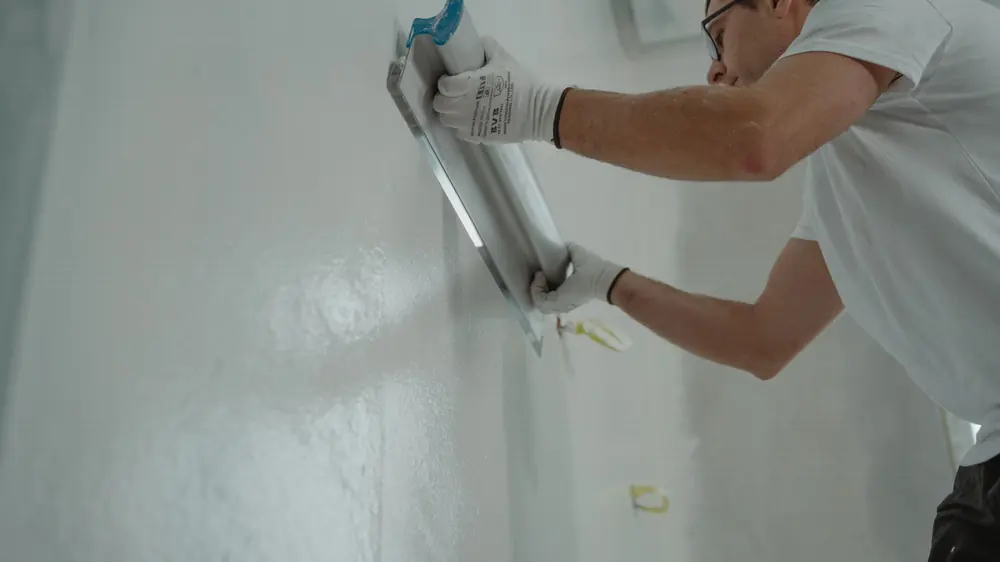
Skimming and painting in Varna: walls and ceilings, also after a leak
Paint over a damp wall and the damp comes back in a few weeks, as a stain, blisters or flaking. So before any paint we measure the moisture, and the old water stains get a stain-blocking primer so that they do not show through the new colour.
Our clients on video · all videos (in Bulgarian)
Skimming and painting in Varna is something we do after a leak too, but only when the wall is dry. First we measure with a moisture meter: the old stain must give the same reading as a wall the water never reached. Water stains get a stain-blocking primer so that they do not bleed through the paint. The work is carried out by the craftsmen we work with; we organise it and remain your one phone number. We give the price by phone after a short description or photos, and we tell you whether and when we can start. Painting is the last stage of a home renovation, after the plumbing and the plaster. Ring +359 52 993 333 or email info@kanalvarna.com — write to us in English and we reply in English.
Updated November 2026When a wall is ready for skimming and painting
A wall is ready when it is dry right through, not just dry to the touch. That is why our skimming and painting starts with a moisture meter and not with a roller. Paint on damp plaster seals the water in, and after a few weeks the stain, blisters or flakes return. Then you pay for the painting twice.
Skimming and painting. Preparing and finishing a wall or ceiling: scraping off what is loose, primer, levelling with a thin gypsum skim, sanding and two coats of paint. After a leak, a moisture reading and stain-blocking primer on the stains are added.
A moisture meter has no single figure for dry that applies to every wall. The reading depends on the plaster, the concrete and the instrument. So we measure the old stain and a spot the water never reached, made of the same material in the same flat. If the two figures still differ, it is too early to skim, and we arrange another measurement at the same points.
If an insurer or a neighbour is going to pay for the damage, the photos and readings must be recorded with a date before the wall is skimmed, because afterwards the marks are gone. See the page on a leak report for insurance. If there is no dispute and you only want to know whether the wall is dry, a reading with the moisture meter and the thermal camera is enough.
A stain after a leak: why it comes through new paint
The water has dissolved salts, rust and brown substances from the concrete, the plaster and the old layers, and left them on the surface. Ordinary water-based paint dissolves them again and they show through, usually as a yellow or brown ring where the water stopped and dried.
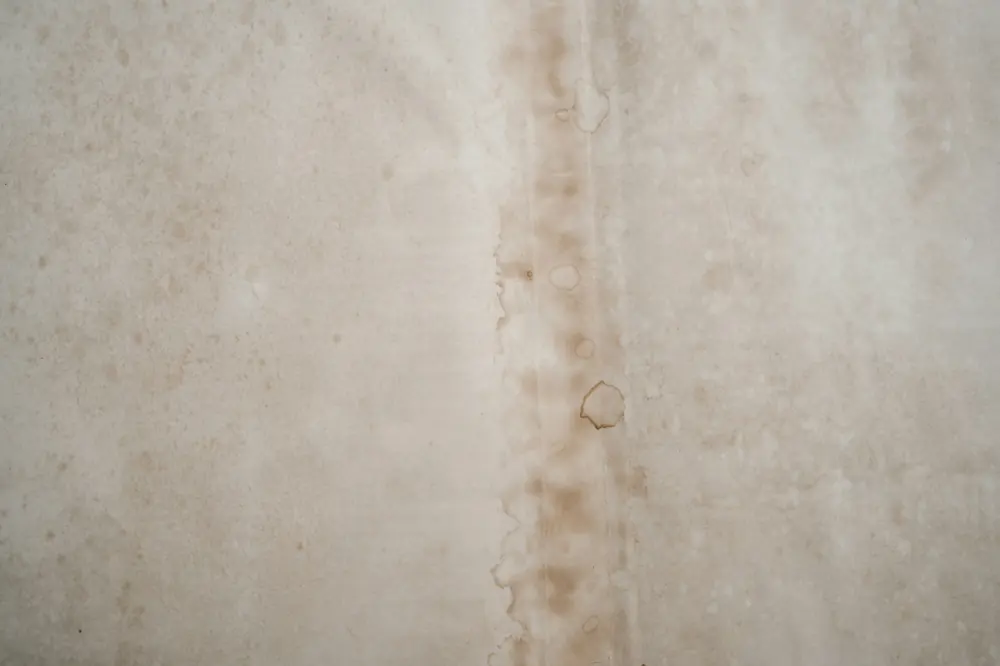
So a stain is never covered with one more coat of paint. Once the ceiling or wall is dry, the spot is cleaned, the loose material scraped off and a stain-blocking primer applied. It locks the stain in and does not let the salts and rust reach the top coat. We prime a little wider than the visible ring, because the salts travel further than the yellow edge. Then the wall is skimmed and painted as anywhere else. On a ceiling, the paint goes over the whole ceiling from wall to wall, otherwise the patch shows. If the water came from the flat above, first see a leak from the flat above: skimming comes after the repair upstairs, when the readings show a dry ceiling.
Flaking paint, a yellow ring, cracks: what they mean
How the old paint looks usually shows what is wrong with it and where we start.
| Sign | Likely cause | What we do |
|---|---|---|
| A yellow or brown ring round a stain | Salts and rust carried out by water in a leak | Measure; if the base is dry, stain-blocking primer, then skim and paint |
| Paint flakes or blisters | Damp under the paint, or too many old layers that no longer hold | Measure; if damp, let it dry first; if dry, scrape to a sound base and prime |
| Black dots, grey bloom in the corners | Mould from lasting damp or condensation | Clean and treat it first, then skim and paint; see mould removal |
| A crack exactly along a plasterboard joint | The joint was filled without tape, or the tape has come off | Open the joint, bed in reinforcing tape, skim again |
| A fine web of cracks in the plaster | Old plaster shrinking, or a skim coat that was too thick | Scrape what is loose, prime, skim in thin coats |
| White powdery salts, plaster crumbling | Salts brought out by damp, often low on the wall | Measure and find where the water comes from before talking about paint |
| Cracked reveal round a window | Crumbled foam under it, or movement of the frame | Take off what is loose, new foam if needed, then skim and paint; see window reveals |
A crack that runs diagonally from the corner of a window or door, or keeps widening, does not start with skim. It may come from movement in the structure, and then a builder or a structural engineer must look at it first.
Call and describe the room and the stains. We tell you whether and when we can come, and if you are not sure the wall is dry, we measure it first.
📞 +359 52 993 333Skimming and painting, step by step
- Moisture reading. We measure the old stain and a dry spot of the same material. If the figures differ, we stop here and agree on a new measurement.
- Covering and protection. The floor is covered, furniture is pushed into the middle of the room under sheeting, and skirting boards, switches and sockets are taped.
- Scraping. Blown and flaking paint, loose skim and salts are scraped off until the base is sound.
- Primer. The whole surface is primed so that the skim grips. Water stains get stain-blocking primer.
- Skim and sanding. Gypsum skim goes on in thin coats. Each coat dries and is sanded, the dust is cleared, and the wall is primed again before paint.
- Two coats of paint. A roller for the area and a brush for the corners. The second coat goes on when the first has dried as the paint's instructions say.
How long it takes depends mostly on the skim: how many coats and how quickly they dry. In humid weather, and in a flat near the sea, it is slower. If the wall is still to be closed with boards, the skim comes after the plasterboard. The dust from sanding keeps settling for days, so it is not a job for the household vacuum cleaner: see after-builders clean. We say by phone whether and when we can start.
Painting a ceiling, a bathroom and a kitchen
We choose the paint for the steam and dirt in the room: washable, moisture-resistant paint where there is steam and splashing, and ordinary breathable paint in dry rooms. The skim under it must suit too: moisture-resistant in a bathroom.
- Ceiling: white matt paint, which does not glare against the window. After a leak the stain primer goes on the stain and a little round it, but the paint goes on the whole ceiling.
- Bathroom: paint that takes steam and can be washed. It is not protection against water: round the shower and bath the wall stays for tiles. If the bathroom sweats every morning, an extractor fan helps more than expensive paint.
- Kitchen: paint that wipes clean with a damp cloth round the hob and sink. Greasy marks are washed off before the primer, otherwise nothing sticks to them.
The exact paints and skim are agreed before work. If you have already bought paint, tell us which one and for which room, and we say whether it will do.
When you do not need a painter yet, and when a wall needs plastering
- The stain is growing or darkening. If it changes after a shower upstairs, washing or rain, water is still arriving. Find the source first, see leak detection.
- The wall is cold and damp to the touch. It has to dry first, see drying after a leak.
- Black dots come back every winter. The cause is often condensation in cold corners, not a leak, and new paint will not stop it.
- You are going to claim compensation. Do not skim or paint before photos and dated measurements exist.
- The stain is small, old and dry. Sometimes stain-blocking primer on the spot and repainting the ceiling is enough. Ring us and we tell you whether you need a craftsman at all.
Skimming smooths, plastering straightens. If a wall is out of true by more than a few millimetres, crumbles, or was knocked about by strip-out, a skim is not enough and the wall needs plastering first. A gypsum plaster suits dry interior walls; a lime-cement plaster suits a bathroom, a cellar or walls that may get wet, because gypsum does not like lasting damp. For a wall that should be more than smooth and painted, see wallpapering or decorative plaster.
What to tell us, and what the price depends on
- how many rooms, or roughly how many square metres of wall and ceiling, and the ceiling height;
- whether there are leak stains, when the leak stopped, and whether the moisture was measured;
- the state of the old paint: flaking, cracks, how many layers; plaster or plasterboard;
- how much furniture is in the room, and whether you need a record for an insurer.
A photo of the wall in daylight lets us say more already on the phone. Email it to us with the address and say who opens the door: a neighbour, the building manager or whoever holds the keys. Payment is after the work by cash, card or bank transfer, and we issue an invoice. Noisy work in a block is only in the hours the building rules and the municipality allow.
Frequently asked questions
What if the plaster crumbles under the old paint?
Crumbling plaster is taken off down to a sound base, because skim will not hold on it. Small areas are filled and primed; if a large area crumbles, we say that new plaster is needed first. We can organise that as well.
Why did the stain come back after two coats of paint?
Usually the wall under the paint was still damp, or the stain had no stain-blocking primer. More coats do not help, because salts and rust pass through them. We scrape, measure the moisture and, if the wall is dry, prime with stain-blocking primer before painting again.
Is the whole wall skimmed or just the stain?
It depends on the wall. If it is sound and only the stain is swollen, we skim the spot and blend it in. If the old paint flakes in many places or there is a web of cracks, it is safer to scrape and skim the whole wall. We tell you once we have seen it or your photos.
What paint should go in the bathroom?
Moisture-resistant paint that takes steam and can be washed, over a suitable primer. Where there were black dots, they are cleaned and treated before anything else. Paint does not replace ventilation: without a working fan or window the dots come back even with the best paint.
I live abroad and let the flat out. Can you deal with it?
Yes. Email us the address and photos of the walls, and tell us who can open the door. We discuss the job and the price with you, and you can pay by bank transfer after the work.
Related pages
The order of work after a leak, from the leak to the paint Plasterboard
Boxing and ceilings that are skimmed afterwards Damp survey
Whether the wall is dry before you paint Mould removal
Black dots are treated before the paint A leak from the flat above
A stain that came from upstairs
Wall dry and ready for paint?
Call and describe the room and the stains. We tell you whether and when we can come, and if you are not sure the wall is dry, we measure it first.
📞 +359 52 993 333or email info@kanalvarna.com — write in English and we reply in English.
Send us a message
Leave your name and a phone number with the country code. Add your email if you prefer a written reply — write in English and we reply in English. We confirm the price before any work starts.