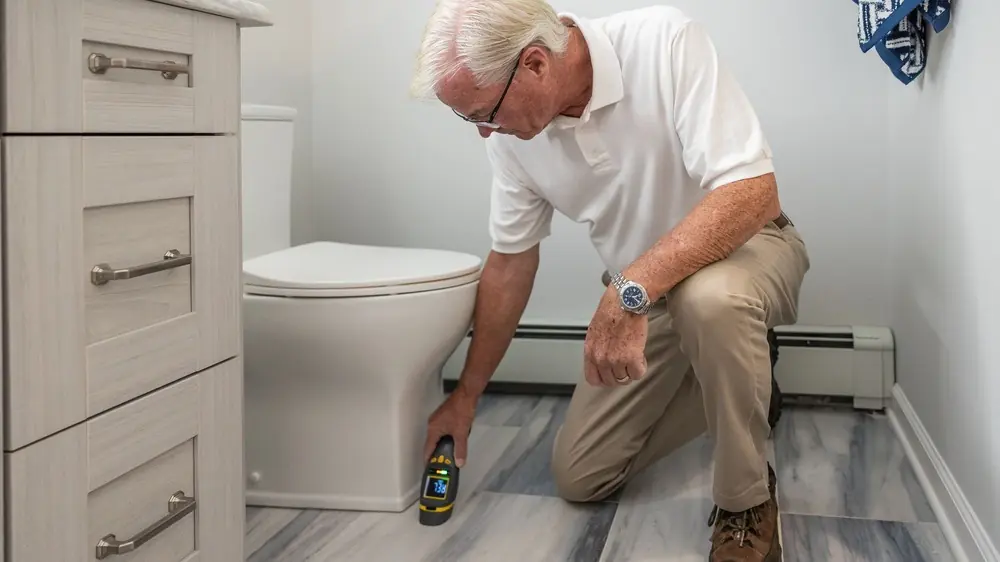
Leak report for insurance in Varna: what we inspect and what the report contains
Water came through the ceiling, or went from your flat into the one below, and someone now asks for proof? We inspect with instruments, find where the water comes from, and write down what is wet, how wet and what we conclude — for your insurer, your neighbour or the building manager.
Our clients on video · all videos (in Bulgarian)
A leak report for insurance is a private technical document written after an inspection on site: what is wet, where the water comes from if we could establish it, whether it is still coming, with moisture readings marked on a sketch, photos and thermal images, our conclusions and a recommendation. We send it by email, with an invoice if you need one. It is not a valuation of the damage — that is for your insurer and its assessor — and we cannot promise that an insurer will accept it, so ask yours what it wants first. Call +359 52 993 333 or email info@kanalvarna.com — write to us in English and we reply in English. We tell you the price before we come. How the leak itself is traced is on the leak detection in Varna page.
Updated November 2026What a leak report for insurance is — and what it is not
It is a technical record of an inspection. We describe what we saw and measured on site, with which instruments, where the water comes from if we established that, and whether it is still coming. You write to us because someone else has to see what happened: an insurer, a neighbour, a building manager, an owners' association meeting.
- It is a private document, with the date, the address and who ordered it, built on readings and photos.
- It is not a formal expert opinion for a dispute that has already started. If a dispute is already in a formal procedure, the expert there is appointed by that procedure — talk to your lawyer.
- It is not a valuation. We do not write what the damage costs. We describe how far it reaches: which walls, ceilings and floors are wet, and up to where.
Many insurers and building managers ask for a document like this, but each decides for itself what it accepts. We cannot promise it will be accepted. Ask your insurer before the inspection what it needs, and tell us.
What the report contains
Every figure in it is tied to a point on the sketch and to a date, so that someone else can check what we found, when, with what and with what result.
- Date of the inspection and the address; who ordered it.
- Which rooms, walls, ceilings and floors we inspected — and the neighbouring flat or the common parts, if we were let in.
- Which instruments we used.
- Where the water comes from, if we established it. If not, we write that, and what still needs to be checked.
- Whether water was still arriving at the time of the inspection.
- Moisture readings by point on a sketch, with a dry spot for comparison.
- Photos and thermal images of the same places.
- Conclusions and recommendations: what to repair, open or dry, and when to measure again.
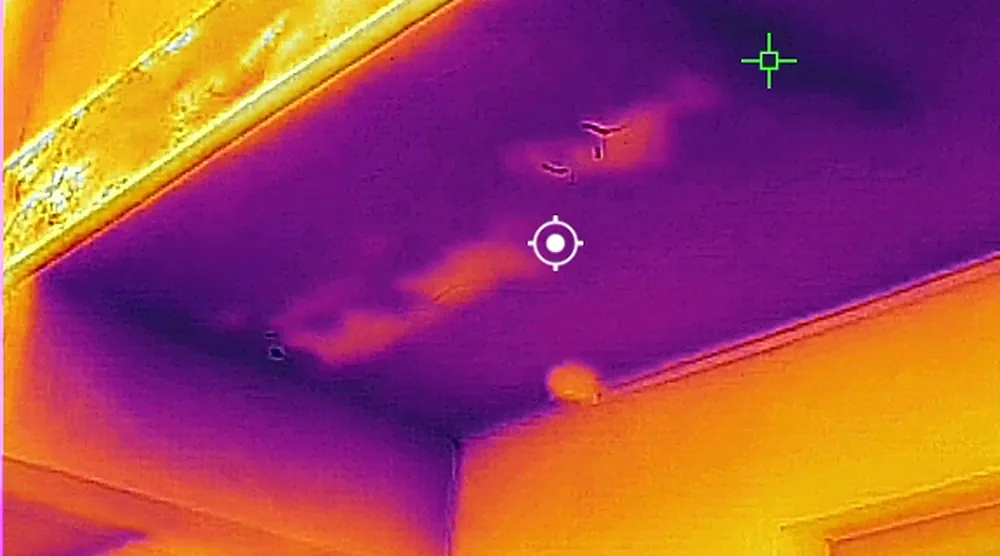
Next to each thermal image sits an ordinary photo of the same spot and a moisture reading, because a thermal image shows a difference in temperature, not water. The finished report comes to you by email.
How we find where the water comes from
A report is only as strong as the data behind it. We do not write "probably from above" on the strength of a stain; we check with instruments.
- Thermal camera — marks the cooler, damp zones, so we know where to measure. More in thermal imaging leak detection.
- Moisture meters — a pin type and a non-contact type. They give readings by point, compared with a dry spot on the same material.
- Listening device — hears a leak from a pipe under pressure inside a wall or floor.
- Pressure test — shows whether the water supply pipework holds pressure; if it does not, water is escaping somewhere.
- Drain camera — if we suspect the drain, it shows cracks and displaced joints from the inside.
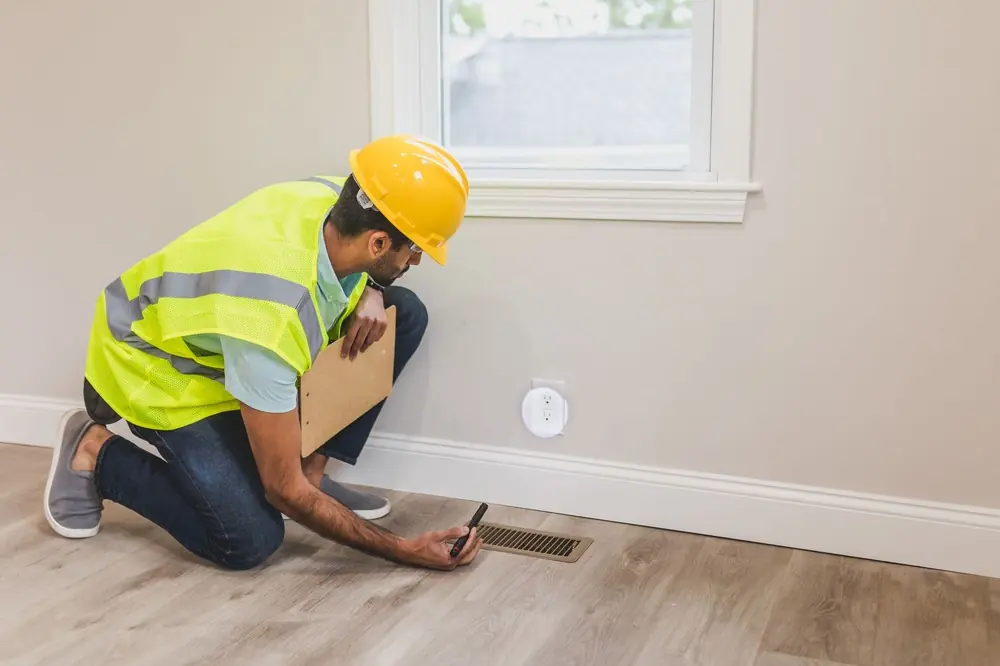
If the leak is at the neighbour's, the surest way is to inspect there as well. If they do not let us in, we describe what can be seen and measured from your side and state honestly that the source was not confirmed from the other side. The search itself is described on leak from the flat above.
Tell us what happened and who the report is for — we tell you the price before we come.
📞 +359 52 993 333The most common mistake: repairing before the report
Once the ceiling is painted and the wall filled, nobody can show what it looked like — not us, and not the insurer's assessor. Report first, repair after.
- Stop the water. If it is still coming, close the stopcock for that room or the main one by the water meter. If the water is near a socket or a light, switch off the power for that room at the fuse board first.
- Photograph. A wide shot and a close-up of each stain, the floor, the furniture, your belongings. Mark the edge of the stain with a pencil and note the date.
- Tell your insurer. The time limits are in your policy. Ask what documents it wants and whether it has its own form.
- Write to us before you start work. If repair cannot wait — plaster is falling or water is near the wiring — photograph in detail and contact us before you begin. We describe the condition while it is still visible.
For water that is pouring now, see the emergency plumber page first.
Who the report is for
| Situation | Who sees the report | What we establish |
|---|---|---|
| Water came from the flat above | Your insurer, the neighbour, the neighbour's insurer | What is wet in your flat, where the water comes from, whether it is still coming |
| Water went from your flat to the one below | Your insurer, the neighbour | Where it leaked, how far it reached, whether it stopped after repair |
| Water from the common parts — a riser, the basement | The building manager, the owners' association | Whether the cause is in the shared pipework or in one flat |
| The neighbour does not repair and the stain returns | The chair of the association or the manager, for the record | The condition on the day of inspection, so there is something to compare with later |
| Repair or painting is coming after a leak | You, the tradesman, the insurer | The condition before the repair and whether it is dry yet |
| A dispute about who is at fault | Both sides, and a lawyer if needed | Facts from instruments instead of judgement by eye |
A single report shows the condition on the day. A second measurement at the same points after the repair or the drying shows whether the leak has stopped and whether it is dry — so the neighbour, the manager and the insurer see a development, not just one photograph. Measuring again at the same points matters, otherwise there is nothing to compare. If the leak affects a tenant and a landlord, see leak in a rented flat; for the entrance and common parts, building managers.
How to order a report, and when it is not what you need
- Tell us what happened. What is wet, since when, whether it is still leaking, whether you can get to the neighbour and what the insurer wants. Photos by email help.
- We tell you the price. Before we come.
- Inspection. We go through the affected rooms and, if possible, the neighbouring flat and common parts.
- Measurements and source. Thermal camera, moisture readings by point and, where needed, the listening device, pressure test or drain camera.
- Report. Sketch, readings, photos, thermal images, conclusions and recommendations, sent by email, with an invoice on request.
- Measuring again. After the repair or drying, at the same points.
We work every day from 06:00 to 23:00 in Varna and the villages and holiday-home areas around it. We are not the right choice if you need a valuation of the damage, or if the dispute is already in a formal procedure. If there is no dispute and no insurer and you only want to know whether a wall is dry enough to paint, a damp survey is enough. We say so in advance, so you do not pay for a document that does not solve your problem.
If you are not in Bulgaria
This is a common case: the flat is let, the cleaner or the neighbour sends you a photo of a stain, and your insurer wants a document. Email us the address, the photos and the name and phone number of whoever can open the door. We arrange the inspection with them, and the report comes to you by email, so you can pass it on to the insurer yourself. We send an invoice to whoever you name, and you can pay by bank transfer.
Frequently asked questions
Will my insurer accept your report?
We cannot promise that. Each insurer decides what it accepts. Many ask for or use a technical report from an inspection, because it contains facts: readings, photos, thermal images and a date. Ask your insurer in advance what it needs and tell us.
Does the report say how much the damage costs?
No. We describe the extent — which walls, ceilings and floors are wet and how far — and the insurer or its assessor puts a value on it.
Who pays — my insurer or the neighbour's?
That depends on the policies and on the case, and we do not decide it. Ask your insurer, or a lawyer. What we give you are the facts that show where the water came from.
I have already painted the ceiling. Is it too late?
Not always, but it is harder. Paint and filler hide the trace. The instruments can still show where it is wet, and we write honestly what could and could not be established.
The neighbour will not let you in. What then?
We describe what is visible and measurable from your side and state in the report that the source was not confirmed from the other side.
I'm not in Bulgaria — can you still deal with it?
Yes. Send the address, photos and the contact of the person who can let us in. We arrange the inspection with them and the report comes to you by email.
Can I contact you in English?
Yes — write to us in English by email at info@kanalvarna.com or through the form on this page, and we reply in English. The phone number is +359 52 993 333.
Need a document for the insurer?
Tell us what happened and who the report is for — we tell you the price before we come.
📞 +359 52 993 333or email info@kanalvarna.com — write in English and we reply in English.
Send us a message
Leave your name and a phone number with the country code. Add your email if you prefer a written reply — write in English and we reply in English. We confirm the price before any work starts.