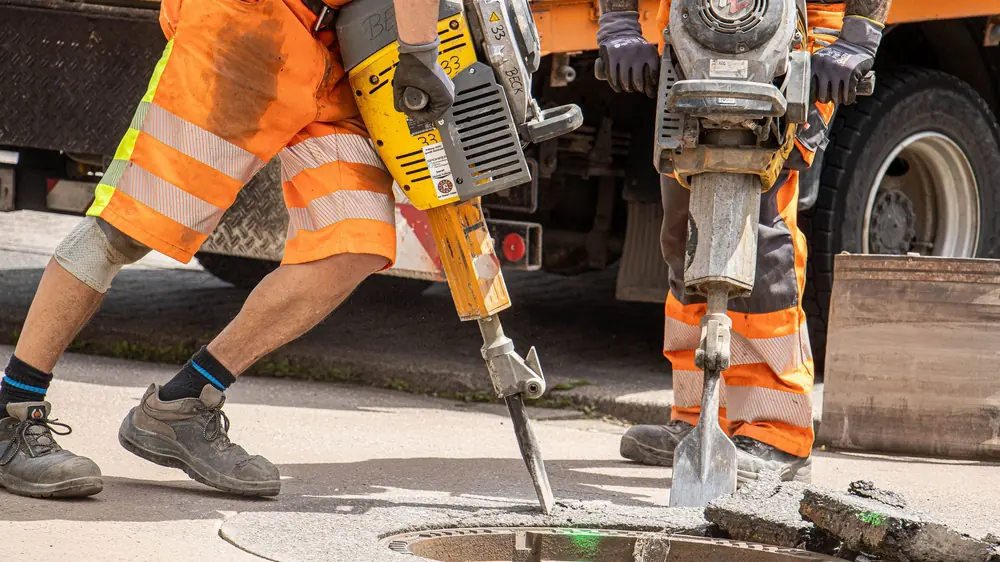
Concrete breaking in Varna: yard slabs, paths, steps and concrete floors
An old cracked slab in the yard, steps nobody needs, or a concrete floor on the ground? First we check the drain and the water pipe under it; cables and gas are shown by an electrician and the gas company. Then the contractor breaks the concrete and the rubble is taken away.
Our clients on video · all videos (in Bulgarian)
Concrete breaking in Varna is for concrete that lies on the ground and does not carry a building: an old slab in the yard, a path, steps in front of the entrance, the base of a canopy, shed or fence, or a concrete floor on the ground in a house garage or cellar. Before anything is hit we find out what runs underneath, because the drain, the water pipe and the drainage are what get damaged. The breaker belongs to the contractor, who brings it; the work is done by the craftsmen we work with, and we organise it and stay your one phone number. We give the price by phone after a short description and photos, before the work starts. Breaking up concrete outside is one of the home renovation jobs we organise. Ring +359 52 993 333 or email info@kanalvarna.com — write to us in English and we reply in English.
Updated November 2026What concrete breaking covers, and what it does not
We take on concrete breaking where the concrete lies on the ground and does not hold up the building: an old yard slab, a path, steps at the entrance, the base of a canopy, shed or fence, and a concrete floor on the ground in a garage or cellar of a house. The same work is sometimes called concrete removal or breaking out concrete.
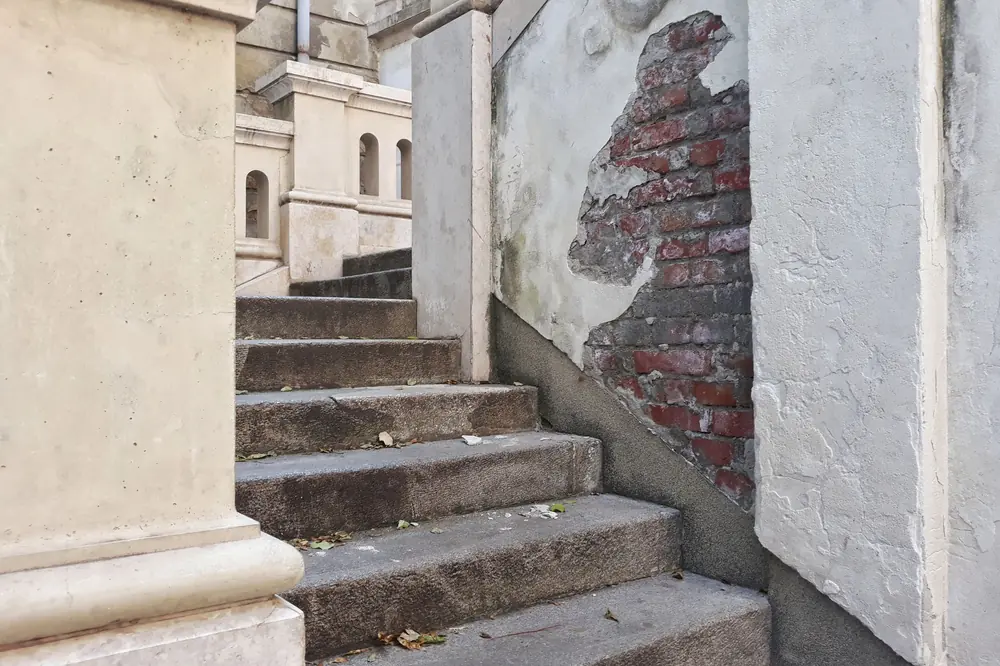
- Yard slabs and paths, steps, bases under a canopy, shed or fence once the structure itself is removed, and a concrete floor on the ground in a garage or cellar of a house.
Not included: columns, beams, floor slabs between storeys, the foundations of the building and retaining walls, which need a design and an engineer. Asbestos-cement sheeting and pipes are not broken by us; a specialist company works with them. Removing a whole building needs a permit from the municipality and is not something we take on.
Thin layers inside a flat, tiles, adhesive and screed, are another job; see demolition and strip-out. If the new structure is a canopy, pergola or fence, the steel part and its base are described under metalwork.
What runs under a yard slab: drain, water pipe, drainage and cables
Under an old slab in a yard something almost always runs: the house drain to the street, the water pipe from the meter chamber, drainage along the walls, or a cable for the lights. So we find out where everything is first, and only then is anything hit. Drains and leaks are our main work, and this is where we begin.
- The drain. We look for the inspection chambers and manholes in the yard; the pipe between two chambers is usually straight. Then the drain camera is run from the chamber towards the house: it shows where the pipe turns, how far from the chamber there is a joint and what state it is in.
- The water pipe. It runs from the meter chamber to the house. If the slab has sunk right above it, or the meter turns with all taps closed, an underground leak must be looked for first; otherwise you break concrete over a pipe that is already leaking.
- Drainage. A perforated pipe in gravel along the foundations. Crushed by a breaker, it stops carrying water away and the cellar starts to get damp.
- Cables. For yard lights, the gate or a pump. We do not search for cables and do not touch them: the circuit is switched off and, if in doubt, an electrician shows the route.
- Gas. If the property is connected to gas, the gas company shows the pipe route, before the breaking, not after it.
To be honest about the camera: it shows the pipe from inside, its bends, joints, cracks and how far in it reached from the chamber. It does not draw the route on the surface to the centimetre. So over the place where we expect a pipe the concrete is broken in small pieces and the last layer is opened by hand, with a bar and a hammer. See the CCTV drain survey. If the drain blocks repeatedly anyway, this is a good moment: under an opened slab a pipe is much easier to replace than under a new surface.
Thickness, reinforcement and the breaker
How heavy the job is depends on the thickness of the concrete, the reinforcement in it and access to the place.
| Element | Usually | What it means for the work |
|---|---|---|
| A slab in front of the house or garage | Thicker, often with a mesh, and thicker still where a car has driven | The mesh is cut; chambers, downpipes and inspection covers in it are marked beforehand |
| Steps | Concrete faced with tiles or stone, sometimes brick-filled | The facing goes first; steps against the house wall are separated carefully so that the foundation is not hit |
| A canopy, shed or fence base | Concrete pads under posts or a strip under a fence, going deep | Broken as far as needed; on a boundary, agree with the neighbour first. Where the ground on the two sides is at different heights, the base acts as a retaining wall and without an engineer it is not touched |
| A concrete floor on the ground in a garage or cellar | Concrete on fill, sometimes with insulation under it; a low, narrow space | More dust in a closed room and the drain often runs under it. If walls or columns stand on the floor, or it was cast with the foundations, an engineer comes first; the waterproofing underneath is restored afterwards |
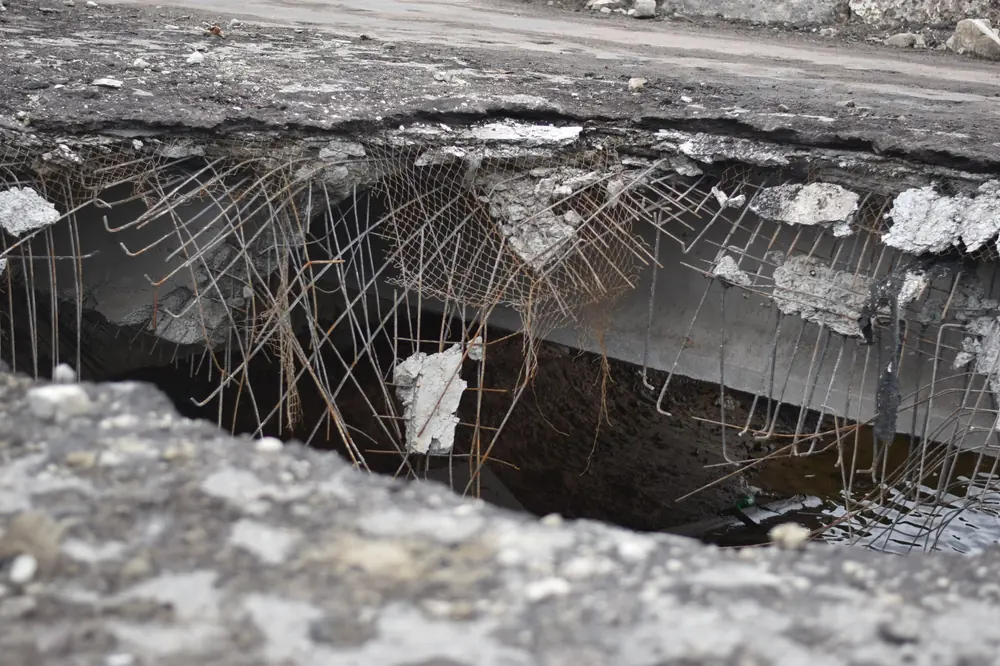
The breaker is not ours: the machine belongs to the contractor, who brings one suited to the job. Reinforcement is not broken, because the concrete hangs on it like a net, so it is cut between the pieces. The pieces are such that a person can lift them and take them off in a wheelbarrow.
Send a photo, the approximate area, and say whether a drain or manhole is nearby — we tell you the price by phone before the work starts.
📞 +359 52 993 333Vibration, dust and noise: the house, the car and the neighbours
Breaking concrete is loud and dusty, and the breaker passes its blows into the ground, so preparation is for the house and the neighbours both.
- Dust. Concrete contains quartz sand and gives fine dust when struck. Whoever works wears an FFP2 or FFP3 mask, goggles and ear defenders. The concrete is wetted with a hose, and an air conditioner is switched off, since its outdoor unit draws dust into its fins.
- Vibration. Near the house wall a lighter tool is used and the pieces are small. Photograph old cracks in the facade and the tiles inside before we start, so that it is clear afterwards whether there are new ones.
- Neighbours. Noisy work is kept to the hours that the municipality's rules allow, and the neighbours are told the day beforehand.
Whether the breaking may take place on a weekend depends on the contractor with the breaker, on the municipality's rules for noisy work and on the neighbours; we tell you by phone.
The rubble: heavy and plentiful
- Sorting. Concrete is collected separately and the reinforcement separately; the soil and gravel underneath stay in place unless there is a reason to dig deeper.
- Bags. For steps or a short path. A bag of concrete is filled only halfway, because a full one cannot be lifted and splits.
- Loose. For a big slab the rubble is loaded directly, without bags; the closer the vehicle stops, the fewer wheelbarrow trips.
- A container. It would stand in the yard, or in the street under the municipality's rules, usually with a permit. We do not have a container.
We organise the removal of the rubble to a designated site; if the amount calls for a container, we tell you whom to ask. How to choose between bags, a van and a container is described on the page about builders' waste removal.
When you do not need concrete breaking
- One crack in an otherwise sound slab. Breaking is too much; the crack is filled or watched to see whether it grows.
- You only need a hole for a pipe or a straight cut. That is done with a core bit or a blade without breaking the whole slab; see core drilling.
- The concrete is dirty, green or slippery. It is washed instead.
- The slab has sunk in one place. Water has often run out underneath and carried the soil away: find the cause first, a drain, a water pipe or yard drainage, or the new concrete will sink too.
- The garage floor is sound and you want a new surface. Epoxy often goes straight on, see epoxy flooring.
- A cellar floor is damp. Damp is no reason for the concrete to go: first measure the moisture and find out where the water comes from.
What to tell us, and what the price depends on
We give the price by phone after a short description or photos, before any work starts. Tell us:
- what has to come out (slab, path, steps, a base or a floor) and about how many square metres;
- how thick the concrete is, if the edge shows, and whether reinforcement is visible;
- whether tiles, stone or asphalt lie on top;
- whether you know where the drain, water pipe and cables run and whether there are chambers nearby;
- how close it is to the house wall or a neighbour's fence;
- whether a wheelbarrow can reach the street and where a vehicle can stop;
- whether the rubble has to be taken away and what is planned for the spot afterwards.
The price depends on the area and thickness, the reinforcement, access for the machine and wheelbarrows, the check underneath and the amount of rubble. An invoice is issued on request. If you own the house near Varna and live elsewhere, send photos and the address and say who can open the gate; payment is by cash, card or bank transfer after the work. Our phone is answered every day from 06:00 to 23:00.
Frequently asked questions
Will the breaker crack the walls of my house?
The risk is greatest where a slab or steps are cast tight against the wall. So that part is done last, with a lighter tool, and the concrete is first separated from the wall. If the house is old or already has cracks, tell us by phone and photograph them before the work.
Do you take the rubble away, or does it stay in the yard?
The rubble is collected and taken to a designated site, and we organise it. If you want some concrete left as fill in the yard, say so beforehand so it is sorted cleanly.
Do I need a permit to remove a slab?
A slab or path in your own yard is usually your decision; if the yard is shared with other owners, agree with them first. Removing a building such as a garage or shed needs a permit from the municipality, and we do not take it on. The pavement outside the property belongs to the municipality.
Do you break the floor in the cellar of a block of flats?
No. A cellar in a block stands next to the foundations and columns of the building and its floor is often a common part. Work there needs a decision of the owners' association and an engineer. Concrete on the ground is broken in the garage or cellar of a house, once it is clear that it carries nothing.
I live abroad. Can you deal with it?
Yes. Email the address and photos and say who can open the gate; write to us in English and we reply in English. We will also ask what you know about the drain and pipes under the slab.
Concrete to come out?
Send a photo, the approximate area, and say whether a drain or manhole is nearby — we tell you the price by phone before the work starts.
📞 +359 52 993 333or email info@kanalvarna.com — write in English and we reply in English.
Send us a message
Leave your name and a phone number with the country code. Add your email if you prefer a written reply — write in English and we reply in English. We confirm the price before any work starts.