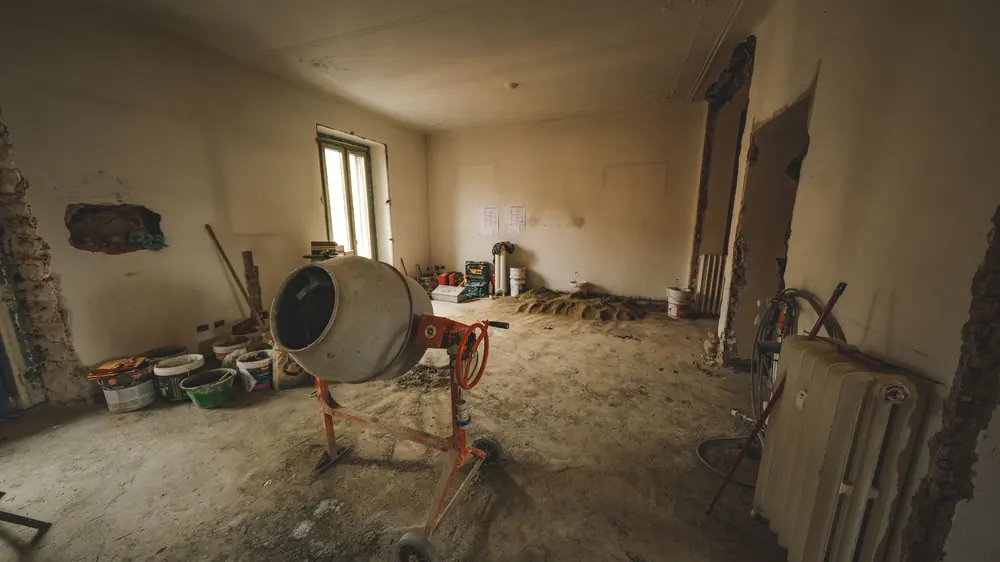
Floor screed in Varna: cement screed or self-levelling compound
A hollow, cracked or uneven floor, a new bathroom, underfloor heating: we tell you which screed you need, cement or self-levelling, and we measure the moisture before any flooring goes down. If a leak has made the floor wet, that comes first.
Our clients on video · all videos (in Bulgarian)
Floor screed in Varna comes in two kinds that do two different jobs. Cement screed is the thick layer that forms the floor itself, on the slab, on insulation or over underfloor heating. Self-levelling compound is a thin pourable layer that only evens out a base that is already sound. Which one you need depends on the base, the height left below the door thresholds and the flooring going on top. Before laminate or parquet we measure the moisture with a meter, because a screed can look dry long before it is. The mixing machine and the laser level belong to the craftsman. The work is carried out by the craftsmen we work with; we organise it as one stage of your home renovation in Varna and stay your one phone number. We give the price by phone after a short description and a photo of the floor. Call +359 52 993 333 or email info@kanalvarna.com — write to us in English and we reply in English.
Updated November 2026Cement screed and self-levelling compound: the difference
Cement screed is the thick layer the floor rests on. It is a mix of cement, sand and water, laid on the concrete slab or on insulation, and it carries the flooring. Self-levelling compound, also called liquid screed, is a ready-made mix as runny as thick cream, poured thin over a base that is already finished and primed. The two do not compete. Often there is cement screed below and a thin levelling coat on top before laminate, vinyl or parquet.
| Cement screed | Self-levelling compound | |
|---|---|---|
| Layer | Thick: this is the floor itself | Thin: it evens out, it does not fill big holes |
| Used for | A new floor on a slab or insulation, over underfloor heating, a fall towards a floor drain | Levelling before laminate, vinyl, parquet or tiles; it gives no fall |
| Water | Dries slowly, because a thick layer holds water | Some kinds dislike water, so a bathroom or balcony gets a cement base |
| Watch for | Cracks from drying too fast or in a draught | A skin and cracks in sun or a draught; the water is added exactly as the pack says |
That is why we look at the base, the height up to the thresholds and doors, and whether there is underfloor heating. If the old base has to come out first, that is a separate job: screed removal.
The base: old screed, concrete, tiles
A screed is only as good as what is under it. On a dusty, greasy or hollow-sounding base even a good mix comes away.
- Hollow sound. The craftsman taps the whole area with a hammer handle. Sound screed rings solid; screed that has come away from the slab sounds dull, like a drum. Hollow patches are marked and removed, because pouring over them only hides the gap.
- Dust and primer. Dust is cleaned off, grease and old paint are removed. Primer binds what dust is left and stops the base drinking the water out of the fresh mix, which would make it crumble from below.
- Edge strip and gaps. A strip runs round walls, columns and pipes, usually about 1 cm; without it the crack shows up in the corners. Gaps round the riser pipe and under doors are sealed, because liquid compound runs through every slit to the neighbour below.
Moisture is our part of the job. We measure the base with a moisture meter in a new slab, in an old screed after a leak and on lower floors, where damp comes up from underneath. Pipes under the screed are checked before the pour: the plumber pressure-tests them with a gauge, and the drain under a bathroom can be looked at with a drain camera. Once the screed is poured, the only way back to them is to break it out.
Old vinyl tiles and the adhesive under them may contain asbestos. We do not touch them; call a specialist company first.
Screed over underfloor heating
Over underfloor heating the screed goes on only after the pipes have been pressure-tested and while they are still under pressure. If a pipe is pinched or punctured, the gauge shows it while it can still be put right without breaking anything. How the manifold and the circuits are installed is on the page about underfloor heating installation.
A thermal camera helps you avoid drilling into a pipe: with the heating on, the warm lines show clearly and are marked with tape before anyone drills for a threshold. With the heating off, or through a thick screed, the picture is blurred, so photograph the pipes and measure from the walls before the pour. Electric underfloor heating, cables or mats on 230 V, is not something we do; an electrician installs and tests it.
Tell us what the base is, what flooring goes on top and whether there is underfloor heating. We say which screed you need and what we measure before the flooring.
📞 +359 52 993 333When you can walk on it and when flooring can go down
You may walk on a screed when the maker of the mix allows it, and flooring goes down when the screed has been measured and found dry. These are two different moments: walking is about strength, flooring is about moisture. How many days it takes cannot be said in advance, because it depends on the thickness, the mix, the ventilation and the season.
The surface looks dry long before the deep layer is. Moisture that rises later stays under the underlay and the foil, swells the joints of laminate and starts mould.
- How. A moisture meter, at the same points in the middle, by the walls and by the bathroom door, at intervals. We watch whether the readings fall and level out with a dry area. If the flooring maker asks for a final test by a special method, the flooring craftsman does it.
- How it dries. Away from sun, draught and a hot-air heater, because fast drying gives a skin on top and wet underneath. Fresh cement screed is covered with foil and then aired as the maker advises.
Laminate wants a dry base, tiles put up with more, and resin is the most sensitive of all: an epoxy floor blisters over damp. If the floor is wet because of a leak, see drying after a leak before anything new is laid.
Cracks, crumbling, hollow spots and bumps: what they mean
The kind of crack points to the cause: a dense net comes from drying too fast, one straight line from a missing joint or a moving slab.
| What you see | Likely cause | What we do |
|---|---|---|
| A dense net of thin cracks | Fast drying, draught, sun, too much water, no primer | Thin ones are closed with resin or mix as the maker says; under tiles the craftsman decides |
| One straight crack across a threshold or along a wall | A missing joint or edge strip, or the slab is moving | We check whether it grows. If not, a joint is cut and filled with flexible material; if it grows, we first find out why |
| Hollow, dull sound | The screed has come away from the slab | Small patches are cut out and filled; over a large area the floor is redone, not poured over |
| New screed, yet stains, a smell or damp appear | The water is not from the screed: a pipe, underfloor heating, condensation or damp from below | We measure with the moisture meter and use the thermal camera. If nothing else explains it, leak detection starts |
A new screed does not protect against water. If a floor gets wet again, the cause is a pipe or damp from below, and nothing is stuck down on a wet patch until we know where it comes from.
How a floor screed is laid
Screeding goes from the inspection to the pour, and the longest part is waiting. We organise the stages and the craftsman pours.
- Inspection and measuring. We tap for hollow spots, measure moisture and the height to the threshold, and ask whether the underfloor heating has been pressure-tested. Then we say which screed you need.
- Preparation. Hollow screed is broken out and carried away, cracks are closed, dust is cleaned, gaps are plugged and the edge strip goes on.
- Level and primer. The craftsman marks the level with his own laser level and, for cement screed, sets beacons. The primer is left to dry as the pack says.
- Pouring. The craftsman feeds the mix by machine or by hand. Cement screed is pulled off along the beacons and floated; self-levelling is poured in one go.
- Drying and protection. Nothing is dragged over the floor, and it is kept from draught and sun.
- Measuring and waste. Before the flooring we measure at the same points. Leftovers and packaging are carried out and taken to a designated site.
The work is carried out by the craftsmen we work with. Screed is one stage of a renovation in a flat; if we organise the whole job, we put the stages in order and stay your one phone number.
What to tell us, and what the price depends on
We give the price by phone once we know the base and have seen a photo of the floor. Tell us:
- the area and what is there now: bare concrete, old screed or tiles;
- the flooring that goes on top, because it decides how flat and dry the floor must be;
- whether there is underfloor heating, water or electric, and whether it has been pressure-tested;
- the height left below thresholds, doors and radiators;
- which storey, whether there is a lift and where the craftsman's machine can stand;
- a photo of the floor.
The price depends on the area and thickness, the type of screed, the preparation of the base (breaking out, primer, cracks), underfloor heating, which storey the flat is on and the access, and carrying the waste away. We issue an invoice. If you own the flat but live abroad, send the address and photos by e-mail and name whoever can open the door: a neighbour, the building manager or the person with the keys. Payment is after the work, by cash, card or bank transfer.
Frequently asked questions
My laminate springs in one spot. Is it the screed?
Sometimes. It can also be a creased underlay or a small stone, so we lift one or two boards and look underneath first. If it is the screed, the small spot is levelled locally, without breaking out whole rooms. If it is wet under the laminate, we measure the moisture first.
My new screed has cracked. Will it be all right?
Thin drying cracks often do not grow and are closed with resin. A long straight crack, or one that widens, is another matter: a joint may be missing or the base may be moving. Do not lay flooring over it. Photograph it and tell us how long it has been there and how long it is, and we tell you from the photo what is most likely.
Will a new screed cut the noise from the neighbours?
No. Screed is a dense layer and carries the sound of footsteps down to the slab. Insulation under it and an edge strip along the walls reduce noise, but that is a different job with different materials, and it takes up height. Tell us whether footsteps or voices bother you.
I live abroad and let the flat out. Can you deal with this?
Yes. E-mail us the address, photos of the floor and a note on what flooring you plan, and say who opens the door. We tell you by phone whether and when we can start and what the price depends on. Who decides in a block of flats depends on whether the work touches shared parts; the floor inside your own flat is yours, but noisy work follows the building's quiet hours, so ask the building manager.
Related pages
Uneven, hollow or cracked floor?
Tell us what the base is, what flooring goes on top and whether there is underfloor heating. We say which screed you need and what we measure before the flooring.
📞 +359 52 993 333or email info@kanalvarna.com — write in English and we reply in English.
Send us a message
Leave your name and a phone number with the country code. Add your email if you prefer a written reply — write in English and we reply in English. We confirm the price before any work starts.