Water underfloor heating in Varna: installation and flushing
A renovation with new wet underfloor heating, or an old system with loops that only warm in patches? The plumbers we work with fit the manifold and the loops, pressure-test them before the screed goes down, and flush an old system loop by loop.
Our clients on video · all videos (in Bulgarian)
For water underfloor heating in Varna, Kanal Varna fits everything from the manifold to the pipe loops in the floor: insulation boards, edge strip, laying the pipe, pressure test and first start-up, all done by the plumbers we work with. The loops are pressure-tested before the screed and stay under pressure while it is poured. We also flush and bleed an old system whose loops have gone cold. We do not fit electric underfloor heating (cables or mats are an electrician's work), and we do not sell boilers or heat pumps. The price depends on the area, the number of loops and the heat source, and we tell you before we start. Call +359 52 993 333 or email info@kanalvarna.com — write to us in English and we reply in English. More plumbing work: plumber in Varna.
Updated November 2026Water underfloor heating: what we fit and what we do not
Our installation runs from the manifold to the loops of pipe in the floor: insulation boards, edge strip, laying, pressure test and first start-up. It is plumbing work, done by the plumbers we work with as part of the repair jobs on our plumber in Varna page. Who pours the screed we agree with you beforehand; it depends on the job and on the builders already working there.
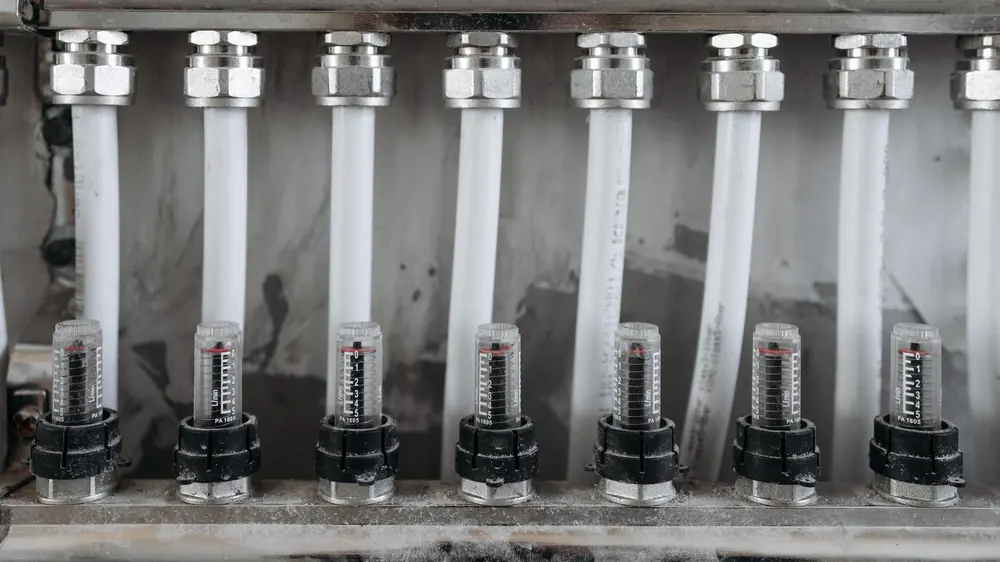
The manifold is a double comb that every loop starts from and returns to. The flow meters are normally on the supply side and the valves on the return side, which is how each loop is started, stopped and balanced. Underfloor heating runs at a lower water temperature than radiators, so where both share one boiler the floor is usually fed through a mixing unit with its own pump and a safety thermostat.
- Fitted: manifold with flow meters, insulation, edge strip, loops, pressure test, first start-up.
- Flushed: old loops that have gone cold or warm unevenly, bled and balanced.
- Not ours: boilers and heat pumps are not something we sell, a gas boiler connection is for a gas company, and the settings of a heat pump are for the firm that fitted it.
- Not ours either: electric underfloor heating. Cables or foil run at 230 V and are fitted and connected by a qualified electrician.
Before the screed: insulation, edge strip and pressure test
Everything that decides how the floor will heat happens before the screed. After that the pipes cannot be seen or touched, so this part is slow and checked.
- Insulation boards go on a flat, clean slab so the heat does not go downwards. They are thicker over the ground or an unheated cellar than between two heated floors.
- Edge strip runs around walls, columns and door frames. Without it the screed touches the wall, expands when warm and can crack.
- Pipe spacing is calculated. It is usually closer along external walls and under windows, where the room loses heat fastest.
- Whole loops. Every loop is one piece of pipe with an oxygen barrier, from manifold to manifold, with no joints in the screed. A big room is divided into several loops.
- Movement joints divide the screed in large or awkward rooms and under doors; the pipe passes through them in a protective corrugated sleeve.
Before the screed we fill the loops with water, bleed them and pressure-test them on our gauge, with the pressure and time that the pipe maker specifies. The system stays under pressure while the screed is poured, so that if a pipe is damaged it shows at once. We photograph the layout from several angles with a tape measure against the walls. Keep those photos: you will want them every time someone drills the floor for a threshold, a toilet or a furniture leg.
Cold loop, gurgling, uneven warmth: symptom and cause
How the floor warms usually shows whether the problem is air, the manifold settings or the pipes themselves. This table is for a system that is already running.
| What you notice | Likely cause | What we do |
|---|---|---|
| Room warms unevenly, cool by the wall | Loops of different length with flow meters not set; wide spacing at the external wall | Set the flow meters so long loops get more water, then check how the floor warms with a thermal camera |
| One loop is cold, the others are warm | Air in the loop, a closed valve or flow meter, sludge in the pipe | Bleed it and check the valve; if that does not help, flush that loop alone |
| Gurgling and noise at the manifold | Air in the system, an automatic air vent that is not working | Bleed through the manifold and check the vents |
| Floor warm only near the manifold and in the hall | Supply pipes run together there and give off heat on the way | On a new fitting, insulate the supply runs; on an old one, a thermal image shows the route |
| Boiler pressure keeps falling, you keep topping up | Water is probably being lost from the system | Do not keep refilling: see underfloor heating leak |
| Floor is about to be drilled and there is no plan of the pipes | Pipes were never photographed before the screed | With the heating on we scan the floor with a thermal camera and mark the loops |
Tell us the rooms, the stage of the work and the heat source. We tell you the price before we start.
📞 +359 52 993 333Flushing an old underfloor system
Flushing removes mud and sludge from loops that have stopped heating, without touching the screed. It helps most where the floor shares a system with old steel radiators or with pipe that has no oxygen barrier: rust then collects in the loops.
- Thermal image first. We run the heating and scan the floor with a thermal camera, so we can see which loops warm and which do not. We show you what we see on site.
- Loop by loop. All loops are closed except one, which is flushed with clean water until it runs clear. If it is badly contaminated, a cleaner that suits the pipe and the boiler is used.
- Sludge filter. If there is no dirt filter in the system we suggest one before the boiler, otherwise the sludge from the radiators reaches the loops again.
- Bleed and balance. The system is filled, the air let out and the flow meters set, then the floor is scanned again at the same boiler setting.
If a loop stays cold after flushing, a pinched pipe or a blockage that water cannot move may be the reason. We tell you honestly what the options are before anyone touches the floor.
Floor coverings, and what the price depends on
Wet underfloor heating works best under tiles, because they conduct heat well. Laminate, parquet and vinyl are also fine if their maker allows them over underfloor heating; that is printed on the pack or in the fitting guide. A thick carpet, or furniture standing directly on the floor, traps heat below it. And a cold floor does not always call for a new system: one cold loop is usually air, a closed valve or sludge, which flushing and balancing deal with.
The price depends on the area and the number of loops, the position of the manifold, whether there is a mixing unit and how far away the heat source is, the state of the slab, and who supplies the materials. For flushing, it depends on the number of loops and how dirty they are. To be accurate, tell us:
- how many square metres and how many rooms;
- whether it is new or a flush of an old system;
- the heat source (gas boiler, solid-fuel boiler, heat pump) and whether radiators share it;
- how far the renovation has got: bare slab, insulation, who pours the screed;
- what floor covering will go on top;
- for an old system, a photo of the manifold and any plan or photos of the pipe route.
If you are renovating from abroad
Underfloor heating has to be timed with the rest of the work: after the pipes and cables in the floor, before the screed and the final flooring. If the stages get out of order, things are broken out later. If you manage a renovation near Varna from another country, send us photos of the slab and the plans, tell us who is on site, and we tell you what to prepare and agree the visit with them. Payment is after the work, by bank transfer if you prefer. A heated floor that was flooded from above is a different question, covered under water under the floor.
Frequently asked questions
When can I switch the heating on after the screed?
When the screed has gained its strength. How long that takes is in the screed maker's instructions and differs between cement and anhydrite. The first start-up is at a low water temperature raised in steps. Underfloor heating is not a way to dry a fresh screed: heating it hard makes it crack, and the crack later shows through the tiles.
Can I have underfloor heating under laminate or parquet?
Yes, if the maker of the flooring allows it; look for the underfloor heating mark on the pack. The underlay must be made for it and the surface temperature must not exceed the maker's limit.
Do you fit electric underfloor heating?
No. Cables and heating foil work at 230 V and are fitted and connected by a qualified electrician. We do the water system: manifold, pipe loops, pressure test and flushing. If a renovation has both, we agree the order of work with you.
Do you connect the heating to the boiler or heat pump?
We do not sell boilers or heat pumps. The pipes from the manifold to the heat source are plumbing work, and how far our part goes we agree beforehand. The gas side of a boiler is only for a gas company, and heat pump settings are for the firm that fitted it.
What pressure do you test at, and for how long?
Whatever the pipe maker specifies, which differs between systems, so we do not guess. We fill the loops with water, bleed them, raise the pressure and watch our gauge. If the reading holds, the system stays under pressure while the screed is poured.
I'm not in Bulgaria. Can you still deal with it?
Yes. Send us the address, the plans or photos, and the contact of whoever is on site. We agree the price with you before we start, and you can pay by bank transfer.
Can I contact you in English?
Yes — write to us in English by email at info@kanalvarna.com or through the form on this page, and we reply in English. The phone number is +359 52 993 333.
Underfloor heating in a renovation, or a cold loop?
Tell us the rooms, the stage of the work and the heat source. We tell you the price before we start.
📞 +359 52 993 333or email info@kanalvarna.com — write in English and we reply in English.
Send us a message
Leave your name and a phone number with the country code. Add your email if you prefer a written reply — write in English and we reply in English. We confirm the price before any work starts.