
Epoxy flooring in Varna: moisture in the concrete first, then the resin
A garage, cellar, store or workshop with a dusty, stained concrete floor? Before any resin we measure the moisture in the base; the preparation and the layers are done by a contractor who has the right machines.
Our clients on video · all videos (in Bulgarian)
Epoxy flooring in Varna is a smooth, jointless coat of two-component resin on concrete, for a garage, cellar, store, workshop or utility room. It holds only on a sound and dry enough base, so we first measure the moisture in the concrete with a meter and a plastic-sheet test. Preparation and resin are done by a contractor with a dust-extracting machine, and we organise it. We do not have the carbide test device, so if the resin maker asks for that method it is arranged separately. Epoxy flooring is a newer line of work within our home renovation in Varna; the work is carried out through the craftsmen we work with, and we stay your one phone number. We tell you by phone whether and when we can take the job, and the price. Call +359 52 993 333 or email info@kanalvarna.com — write to us in English and we reply in English.
Updated November 2026What an epoxy floor is and where it makes sense
An epoxy floor is a continuous layer of resin on concrete or screed, with no joints, easy to wash and holding back oil and dust. It belongs in rooms with a hard, dry floor and no sun: a garage, cellar, store, workshop, boiler room or laundry.
Epoxy resin (two-component). A resin and a hardener, mixed in the exact ratio the maker gives. They set by chemical reaction, not by drying. After mixing there is only a short working time. The finished layer is hard and dense and lets almost no water or vapour through.
There are two main solutions. A thin coating of two or three coats with a roller, like a thick floor paint, suits a cellar, a store with light traffic and a utility room. A self-levelling layer is thicker resin spread with a squeegee and de-aired with a spiked roller; it suits a garage, a workshop and places with trolleys. Epoxy is not for terraces, balconies or yards: in sun it yellows and loses its gloss, and outdoors the concrete gets wet from beneath and moves with cold and heat.
Moisture in the base first
Epoxy most often comes away because of damp in the base, not because of poor resin. Concrete gives off moisture upward and the dense resin stops it. Vapour and salts collect underneath, push, and lift the coating into blisters, sometimes months after it was laid.
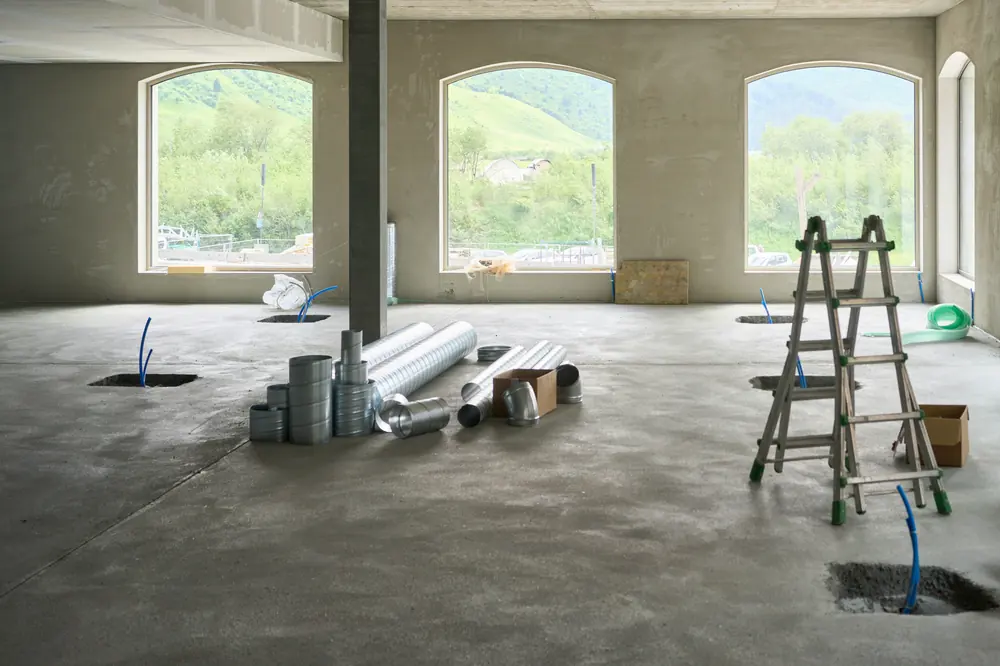
So we begin by measuring the moisture of the concrete. We use a moisture meter on a grid across the room and compare the readings with one another and with dry places. The meter shows where it is wetter and whether the base is still drying, not an exact percentage of water. We add a simple test and a few checks:
- Plastic-sheet test. A piece of clear plastic is taped down tightly at the edges and left for a day or two. If drops appear under it or the concrete darkens, the damp comes from below. A dry patch does not yet prove that the base meets the maker's requirement; the test is only a rough guide.
- New screed. Wait until it has dried as its maker instructs; the thicker, the longer. Then measure again.
- Cellar. A wet band on the walls and salt stains on the floor suggest damp coming up. Resin over such a floor does not stop the water, it comes out elsewhere or under it.
- Floor after a flood. Screed can stay wet long after the water is gone; see drying after a leak.
The damp the system allows is stated by the resin maker, for the primer, the main layer and the method of measuring. If the maker requires a carbide (CM) test, it is done separately: we do not have that device. There are primers for a damper base, but they are chosen by the maker's instructions, not by eye.
Blisters, white dust, tyre marks: what you see and the cause
Most trouble with an epoxy floor comes from the base and the preparation, not from the layer on top.
| What you see | Likely cause | What we do |
|---|---|---|
| Blisters and loose patches in the old coating | Damp or salts under the resin; a weak surface | We measure moisture and run the plastic-sheet test; loose coating comes off to sound concrete before any new layer |
| White dust and crumbling on concrete | Cement laitance, a weak top layer left from pouring | The contractor grinds it off to sound concrete, then primes |
| In a garage the coating lifts under tyres | Thin paint over a poorly prepared base; hot tyres pull on it | A system for the load: a thicker layer on a rough, primed base |
| The floor is slippery when wet | A smooth glossy finish without grit | Anti-slip quartz sand in the last coat |
| Cracks in the concrete | Shrinkage or a moving base | Quiet cracks are opened and filled; moving joints are carried through the coating |
| Dark oil stains | Oil has soaked into the concrete | Cleaning and grinding off the soaked layer, because resin does not hold on oil |
Call and tell us how many square metres the floor is, what is on it now and whether it gets damp. We say where we start and whether and when we can take the job.
Tell us the area, what is on the floor now and whether it gets damp. We say where we start, and whether and when we can take the job.
📞 +359 52 993 333Preparing the concrete
Preparation decides whether epoxy holds: resin sticks only to sound, clean, rough concrete. The smooth grey skin of old concrete, old paint and stains are removed mechanically, by grinding or shot blasting.
- The grinder needs a vacuum with dust extraction, which is the contractor's equipment. We do not have such a machine; this part is for the contractor with his own machines.
- Cracks and holes are opened, cleaned and filled with a repair mix compatible with the system.
- Dust is vacuumed off thoroughly, because resin on dust sticks to the dust, not the concrete.
- The primer soaks into the concrete and closes the pores; quartz sand is usually scattered into it for the next layer to grip.
- Thresholds and walls are protected with tape, and the door height is checked beforehand, because a self-levelling layer raises the floor.
If old concrete crumbles deeply or has sunk, it is sometimes broken out and poured again; see concrete breaking. An uneven floor with holes may need a levelling screed before the resin, and that is measured with the meter too: floor screed.
How epoxy flooring is laid
An epoxy floor goes down in layers with waiting between them, so it is planned together with the weather. Work goes ahead when the concrete and the air are within the maker's limits and the surface is a few degrees above dew point.
- Call and measuring. You describe the room by phone and we say whether and when we can take it. On site we measure moisture and set up the plastic-sheet test.
- Choice of system. Thin coating or self-levelling layer, colour, gloss or matt, anti-slip, by the load and the maker's instructions.
- Preparation. The contractor grinds or blasts with dust extraction, repairs cracks and removes dust.
- Primer. It is applied and, if needed, sprinkled with quartz sand; the surplus is swept off once the primer has set.
- Main and top layer. The resin is mixed in batches so that it does not set in the bucket. A self-levelling layer is de-aired with a spiked roller.
- Waiting. When you can walk on it, put furniture in and drive a car in is in the maker's instructions. In cold weather the resin sets more slowly.
While the work goes on, the room is aired, with no open flame and no smoking nearby, and children and pets stay out.
When you do not need epoxy, and what to tell us
- The cellar is wet or flooded. The water is dealt with first, see basement waterproofing and flooded basement. Resin comes last, if at all.
- A terrace, balcony or yard. Epoxy yellows and cracks outdoors; another system is needed there.
- The concrete only dusts. Sometimes a concrete sealer or primer is enough.
- A hall or kitchen where you want a floor without joints but a domestic look. See microcement.
If the measurements show the base is wet, we say so plainly, even if that means no resin for now. The garage or cellar must be empty before the resin; for clearing it see basement clearance.
For the price, tell us the area and the room, whether cars, trolleys or machines will go on it, what is on the floor now, any cracks and oil stains, whether it gets wet or was ever flooded, whether the screed is new, whether there is underfloor heating and whether you want colour or anti-slip. The price depends on the area, the preparation, the system, the anti-slip finish and the access. We issue an invoice. If you live abroad, e-mail the address and photos, and say who can open the door: a neighbour, the building manager or the person with the keys.
Frequently asked questions
Can epoxy go over old tiles?
Sometimes, but it is rarely a good idea. The tiles must hold firmly everywhere, the glaze is roughened mechanically and the grout lines are filled, or they show through the resin. Tiles that sound hollow, or that had damp under them, come off. Whether a particular system allows tiles as a base is for its maker to say; the contractor decides after a visit.
How long after a new screed can resin go on?
As long as the screed maker and the resin maker say; it depends on the kind and thickness of the screed and on ventilation. Instead of counting days we measure: a meter at several points, comparison over time and the plastic-sheet test. If the system requires a carbide-method measurement, that is done separately, because we do not have the device.
When can I drive the car into the garage?
When the resin has gained strength as its maker's instructions say; the times for walking, light objects and a car are different, and in the cold curing is slower. The first times, do not turn the wheel on the spot and do not park on hot tyres if the maker forbids it for a fresh coating.
Can I have epoxy in a cellar where damp comes up?
Not before the water is stopped. Resin is not waterproofing against ground damp; vapour and salts collect under it and lift it in blisters. First we find where the damp comes from: rising damp, groundwater or condensation. When the base reads dry on a second measurement, resin can be considered.
I live abroad. Can you organise it?
Yes. We measure the moisture and set up the plastic-sheet test, and the contractor does the preparation and the resin. E-mail the address, the room, the area and photos, and say who holds the keys. We tell you by phone whether and when we can start. In a block, grinding is noisy, so tell the building manager and keep to the hours the building allows.
Related pages
Which renovation jobs we take on, and in what order Basement waterproofing
When the damp in a cellar comes from outside or below Damp survey
Moisture meter and a map of the damp before resin Microcement
A jointless floor for the hall and the home Floor screed
Levelling and moisture before the resin
A dusty concrete floor in the garage or cellar?
Tell us the area, what is on the floor now and whether it gets damp. We say where we start, and whether and when we can take the job.
📞 +359 52 993 333or email info@kanalvarna.com — write in English and we reply in English.
Send us a message
Leave your name and a phone number with the country code. Add your email if you prefer a written reply — write in English and we reply in English. We confirm the price before any work starts.