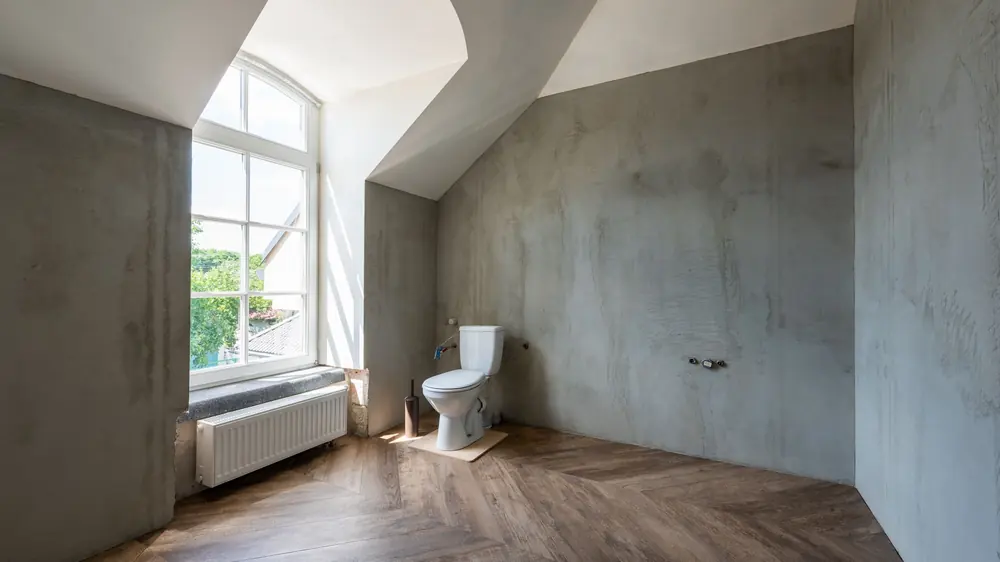
Microcement in Varna: jointless floors and walls, bathroom included
Want a bathroom or a floor without joints? We measure the moisture in the base and check the waterproofing first, then the craftsman applies the microcement in layers. We also tell you when tiles are the better choice.
Our clients on video · all videos (in Bulgarian)
Microcement in Varna is a thin jointless coating applied in several layers on a stable, dry base and sealed with lacquer. In a bathroom it is not waterproofing: underneath goes a liquid membrane with tape in the corners and collars, and on top a protective lacquer. Cracks in the base show through the thin layer, so we first measure the moisture and look at what moves. The work is carried out by the craftsmen we work with; we organise it, as part of your home renovation in Varna if needed, and stay your one phone number. We tell you the price by phone after a short description or photos, and we also say when tiles are the better choice. Call +359 52 993 333 or email info@kanalvarna.com — write to us in English and we reply in English.
Updated November 2026What microcement is and where it makes sense
With microcement a floor and walls become one surface, without the grid of tile joints.
Microcement. A thin coating of cement, polymers and fine filler. It is applied with a trowel in several layers over a primer, sanded between layers and sealed with lacquer or sealer. It is only a few millimetres thick, so the layer follows the base, smooth or cracked.
- Makes sense: floors and walls in a hall, kitchen and bathroom, stairs, a worktop. Over a sound old tile when you do not want to break it out.
- Makes sense with conditions: a shower without a tray, and a floor over underfloor heating. Only with waterproofing underneath and where the maker of the system allows it.
- Not for: a base that moves, gets wet or sounds hollow. Microcement does not mend it, it shows it.
Do not expect it to look like paint. The surface is cloudy, with darker and lighter areas, and trowel marks show in the light. That is the effect, not a fault.
Microcement in a bathroom: waterproofing below, lacquer above
Microcement is not waterproofing and does not protect the slab from water: it is a thin porous layer, and the membrane under it is what stops water. So in a bathroom the order does not change.
- Base. A sound, level and dry screed or tile.
- Liquid waterproofing. On the floor and walls of the shower area, with tape in the corners and collars round pipes and the drain. How it is done is on bathroom waterproofing.
- Primer, mesh and layers. The craftsman's work.
- Lacquer. It closes the pores, so water, soap and grease do not get in. It protects the surface, not the slab.
Lacquer wears. In a shower it is the most loaded and needs renewing first, so it often makes sense to tile the shower area itself and use microcement on the other walls. A shower without a tray needs a fall to the drain. If the drain is weak or falls the wrong way, it is better to see it before the coating: we can put a drain camera through it, and a floor or linear drain can be changed while the floor is still open. For the plumbing see bathroom renovation: the plumbing.
Over tiles, screed or plasterboard: the base decides
The coating is only a few millimetres, so everything beneath comes to the surface. The base must be sound, level, dry and still.
- Over tiles. We tap them: a hollow tile sounds dull and comes off. Grout lines are levelled with a mix, or their grid shows. Smooth porcelain needs a bonding primer, and mesh goes in corners and places that move.
- Over screed. A fresh screed still gives off moisture. We measure it with a meter in several places and compare with dry areas; what is acceptable is for the maker of the system to say. See floor screed.
- Over plasterboard. Only moisture-resistant board, and in the shower itself a waterproof cement board, not ordinary board. Joints and screw heads are filled and taped, or they show as a straight line of cracks.
We also look at why the base is damp. If a screed is wet from an old leak, a coating on top only locks the damp in, so we measure the moisture and look for the source first.
Tell us what is underneath now, how many square metres there are and whether it is wet anywhere. We say whether microcement is the right choice.
📞 +359 52 993 333Cracks, dark patches, white marks, scratches: sign and cause
Most faults in microcement come from the base or the lacquer, not the mix itself.
| Sign | Likely cause | What we do |
|---|---|---|
| Thin lines repeating the old tile joints | Joints not levelled, or the tiles have moved | Sanded, the line filled with a flexible mix and lacquered again; a hollow tile comes off |
| A straight crack in a corner or at a threshold | Two planes moving differently | The corner is cut and closed with flexible silicone instead of mix |
| A dark patch in the shower that does not dry | Water behind the coating: a leaking membrane, tape or collar, or worn lacquer | We measure with the meter and thermal camera and look for the source; if it is a leak, leak detection comes first, then repair |
| A whitish film or matt patches | Limescale from hard water, or lacquer worn by harsh cleaners | Cleaning with a mild cleaner; if the lacquer is worn, a new coat |
| Scratches and small holes | A knock, grit under a shoe, a sharp object | Small ones are sanded and lacquered; deep ones are filled with mix and lacquered again |
A dark patch that does not dry after airing is not a question of looks. The thermal camera shows the shape of the wet area and the meter how it changes. Call and tell us what is underneath, how many square metres it is and whether it is wet anywhere. We say whether microcement is the right choice, or whether it is more honest to keep tiles.
Microcement or tiles: which wins
Microcement wins where you want a surface without joints and do not want to break out; tiles win where it is wet every day and you want the least care.
| Microcement | Tiles | |
|---|---|---|
| Joints | None to collect dirt; corners are silicone | Grout darkens and crumbles; silicone in corners |
| Repair on the spot | Possible, but the shade differs; often a whole wall is redone | A tile is replaced if you have spares from one batch |
| Slipping | Depends on the lacquer: smooth is slippery wet, anti-slip is rougher | There are rough floor tiles, chosen for that |
| Care | Mild cleaner, no abrasives or acids; the lacquer is renewed | Washes easily; grout needs cleaning or regrouting |
| Base | A thin layer on a sound base; the floor hardly rises | Adhesive and a layer on top; old tiles are often broken out, with dust and waste |
Tiles win when the shower is narrow or you want to wash without worrying about lacquer; see tiling. For a garage, cellar or workshop, hot tyres, oil and dragging weight wear a thin lacquer, so see epoxy flooring instead. Away from water, a wall effect in a living room may be better as decorative plaster.
What to tell us, and what the price depends on
We give the price by phone after a short description or photos. Tell us:
- how many square metres, and where: floor, walls, shower area, stairs;
- what is underneath now: tiles, screed, plasterboard or an old layer;
- whether it is wet anywhere, and whether there are stains, cracks or hollow tiles;
- whether there is underfloor heating, and of what kind;
- the colour and effect you want, and how slippery the floor may be;
- a photo of the room and of the problem spots.
The price depends on the area, the base, the waterproofing and drain, the colour and effect and the lacquer. We issue an invoice. The craftsman shows how to clean it after the work. If you live abroad, e-mail the address, the room and photos, and say who can open the door: a neighbour, the building manager or the person with the keys. We take the waste away to a designated site. Lamps, electric underfloor heating and everything on 230 V are for an electrician, and load-bearing walls for a structural engineer; we do not take those on. Old vinyl tiles and the adhesive under them may contain asbestos, and we do not touch such a base; call a specialist company.
Frequently asked questions
Is microcement slippery in a bathroom?
A smooth lacquer is slippery when wet, like any smooth surface. For a shower and floor we ask the craftsman to use an anti-slip lacquer, which makes the surface slightly rough. The compromise is that it is a little harder to clean and soap holds in the texture. If there are older people or small children at home, say so in the first call.
Does microcement crack?
The mix itself rarely cracks, unless it is put on too thick or dried in a draught. A visible line usually repeats something beneath: an old joint, a seam between boards, a corner or the seam of a screed. The riskiest places are thresholds, corners and round the drain. That is why we look at the base first and put mesh where there is movement.
How do I clean microcement?
With a soft cloth and a neutral cleaner. Abrasive powders, wire sponges and acid limescale removers dull the lacquer and open the surface. In the shower, pull the water off with a squeegee so limescale does not leave a white film. When the lacquer starts to go matt in patches, it needs a new coat, so call us.
Can damage be repaired on the spot?
Yes, small damage is sanded, filled with mix and lacquered. We do not promise the same shade, because hand work and old lacquer do not repeat. For a bigger patch a whole wall is often renewed from corner to corner. Send a photo and we say which is more likely.
I let the flat out and live abroad. Can you deal with it?
Yes. E-mail the address and photos, and say who can let us in. We tell you by phone whether and when we can start. In a block, sanding is noisy, so keep to the quiet hours and tell the building manager. The craftsman does the applying, and we organise it and stay your one phone number.
Related pages
A bathroom or floor without joints?
Tell us what is underneath now, how many square metres there are and whether it is wet anywhere. We say whether microcement is the right choice.
📞 +359 52 993 333or email info@kanalvarna.com — write in English and we reply in English.
Send us a message
Leave your name and a phone number with the country code. Add your email if you prefer a written reply — write in English and we reply in English. We confirm the price before any work starts.