Internal door fitting in Varna: measuring, frame, hanging
Have you bought a door, or are you about to order one? We measure the opening and the wall first, so that the right frame arrives, then set it level and plumb and hang the door. Interior doors, a bathroom door and the entrance door of a flat.
Our clients on video · all videos (in Bulgarian)
Internal door fitting in Varna starts before the delivery: we measure the opening, the thickness of the wall and the way the door opens, so that you order the right frame. Then the frame is set level and plumb, fixed with foam in stages, the leaf is hung and the architraves go on. We also fit bathroom doors and the entrance door of a flat. We do not sell doors and keep no warehouse: you choose the model, the colour and the lock. The work is carried out by the craftsmen we work with; we organise it and remain your one phone number. Call +359 52 993 333 or email info@kanalvarna.com — write to us in English and we reply in English.
Updated November 2026Which doors we fit, and what we do not do
We fit interior doors, bathroom doors and flat entrance doors that you have bought yourself. We do not sell doors and have no warehouse, so the model, the colour and the lock are your choice; our job is for the door to stand straight and close lightly. We do not fit windows or balcony doors; what we repair on existing ones is in the window and door repair hub.
Door frame, architraves and extenders. The frame (door lining) is fixed in the wall opening and carries the hinges. The architraves cover the joint between frame and wall on both sides. Where the wall is thicker than the frame, extenders, extra boards, bring it out to the edge of the wall.
An interior door usually comes as a set: leaf, frame and architraves. The entrance door of a flat has a metal frame, is much heavier, and fitting starts with taking the old one out. Other small jobs waiting at home, such as a shelf, a curtain pole or flat-pack furniture, belong to the handyman.
Measuring before you order
The measuring is done before you order the door, not when it is already waiting in the hall. Most trouble comes from a size taken by eye or only from the old door.
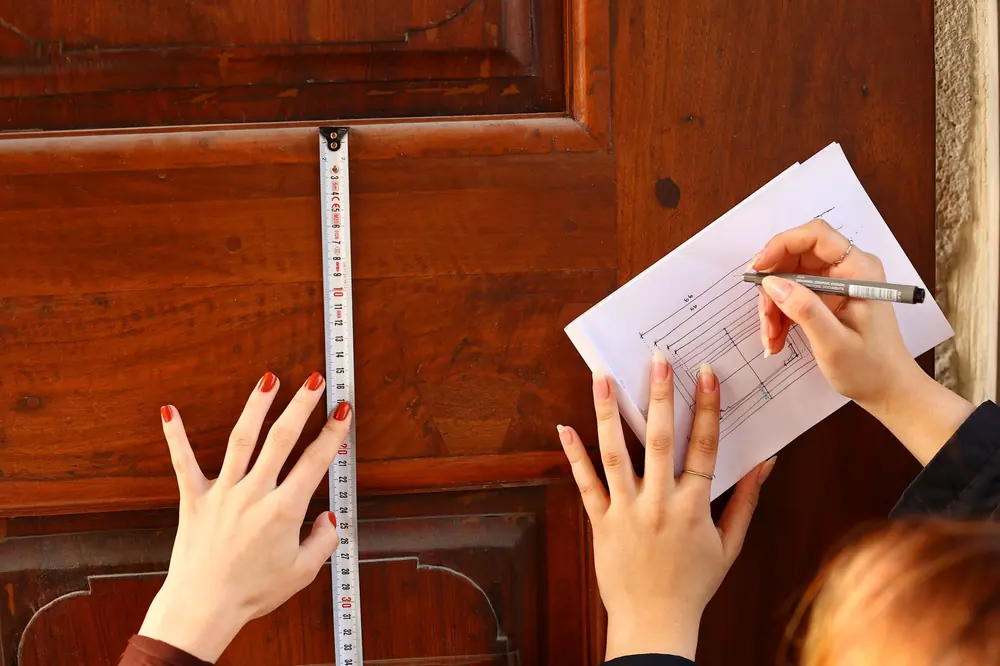
- Width of the opening at the top, middle and bottom, because walls are rarely parallel. The smallest figure counts.
- Height from the finished floor to the top of the opening, left and right.
- Thickness of the wall in several places and on both sides. It decides whether the frame is enough or extenders are needed.
- Direction of opening, and which side the hinges are on. Makers name left and right differently, so we check against the diagram of the model.
- What is around the opening, such as a light switch, a socket or a side wall that gets in the way of the architrave or the open leaf.
How much larger than the frame the opening must be is in the maker's instructions. An opening that is too wide is narrowed first. A narrow opening in a brick partition can be widened, but in a load-bearing wall it cannot be widened without a structural engineer and a design; in a panel block every concrete wall is often load-bearing. And the floor comes first: the commonest mistake is to fit the door before the flooring, after which laminate or tiles raise the floor, the gap below disappears and the leaf rubs. If the floor is not finished, its final height must be known, and the frame is set to it.
A bathroom door: air, damp and the threshold
A bathroom door has to let air through even when closed, otherwise the extractor fan or the shared vent duct has nothing to draw from and pulls weakly. So a gap is left under the leaf, or the lower part of the leaf has a grille.
Damp is our main work, and on surveys we often see bathrooms with mould round the frame: the fan is new but the door is solid, and the humid air stays inside. The gap comes from leaving the leaf higher above the floor, or a grille is built into the bottom of the leaf. Beside the shower and bath the door takes steam and splashes, so ask the seller whether the model is for a bathroom, with protected edges, above all the bottom one. Without a threshold the floor is level and air passes freely; a threshold keeps back a little spilt water, but then the air has to come through a grille. If the whole bathroom is being renovated, the door comes last, after the tiles and the fittings: see bathroom renovation and bathroom extractor fan.
Tell us how many doors there are, whether they are bought and whether old frames have to come out. By phone we say whether and when we can come and how the price is made up.
📞 +359 52 993 333The entrance door of a flat: the old metal frame and the building
Fitting an entrance door starts with taking out the old one, and that is often the harder part. Old metal frames in blocks are usually built into the wall and covered with plaster or concrete, so they do not come out by unscrewing. The wall is broken out around the frame, only as far as needed to release it. If tiles or cladding round the door also have to come off, that is breaking out and is agreed separately: see demolition and strip-out.
- The new frame is set in the opening level and plumb and fixed with anchor bolts through the holes in it; their number and places follow the maker's instructions.
- The joint between frame and wall is filled with fitting foam.
- The excess foam is cut off and a reveal is made round the frame on both sides.
- The leaf is hung, and the locks and the closing are checked all the way round.
The reveal and the paint belong to skimming and painting. The entrance door is heavy and needs two people to hang, which we settle by phone. We do not do locksmith work, such as opening a locked door in an emergency. Breaking out around an old frame is noisy and dusty, and part of the work is on the shared landing. In a block, noisy work is agreed with the owners' association and follows the rules of the building: warn the building manager and the neighbours beforehand, and think about which way the new leaf will open, so that it does not block neighbouring doors or the stairs. The old door and frame also have to leave the flat; the old metal frame can often be handed in as scrap.
Internal door fitting, step by step
- Check the set. The pack is opened and the size and direction are compared with the order. Hinges, lock, keeper, architraves and knocks on the leaf are checked; a missing part is better found before the old door comes off.
- Take out the old door. Leaf, architraves and frame come off. Old foam and crumbling plaster are removed so that the new frame lies on a sound base.
- Frame levelled with wedges. The frame is assembled, placed in the opening and wedged, then set level and plumb. The diagonals are measured so that it is not a rhombus.
- Foam in stages with spreaders. Spreaders go into the frame so that the foam does not bend it. The foam goes in at several places and in stages, not all at once, because it expands as it cures.
- Leaf, hinges, lock. Once the foam has set, the spreaders come out and the leaf is hung. The hinges, lock and keeper are set until it closes lightly and the gap is even all round.
- Architraves and check. Excess foam is cut, the architraves go on, and extenders too if the wall is thick. At the end you open and close the door and try the key yourself.
If there are several doors, tell us all at once so that we plan the work for all of them. A door that catches after a new floor does not need replacing: the leaf is shortened at the bottom and the cut edge painted or varnished against damp, and the frame and architraves are cut when the floor is laid; see laminate flooring.
When you do not need new fitting
- The leaf rubs but the frame is straight. Often it is enough to tighten the hinge screws or adjust them, if they are adjustable.
- Only the glass is cracked. The door stays. On uPVC and aluminium doors the glass is usually a unit made to size: see double glazing unit replacement.
- A uPVC balcony door has dropped. That is a setting, not a new fitting: see window adjustment.
What to tell us by phone, and what the price depends on
We give the price for door fitting by phone after a short description. Tell us:
- how many doors, and which: interior, bathroom, entrance;
- whether they are already bought and what is in the set: frame, architraves, extenders;
- whether old doors are to come out, and whether their frames are timber or metal;
- how thick the wall is and whether it has tiles on it;
- whether the floor is finished or the flooring is still to come;
- which floor you are on and whether there is a lift, important for an entrance door.
The price depends on the number of doors, taking out the old frames, the kind of frame, the extenders and whether an opening has to be repaired. We issue an invoice and work every day from 06:00 to 23:00. Taking away the old door and the packaging is agreed by phone before the work; we have no container, so if you are changing many doors at once, think beforehand where they will go. If you live abroad, email us photos and the address and tell us who will open the door: a neighbour, the building manager or whoever holds your keys.
Frequently asked questions
Do you sell doors?
No. We do not sell doors and have no warehouse; we fit the door you have chosen and bought. If you have not ordered yet, we can first measure the opening and the wall, and with those sizes the seller can offer the right size of frame and any extenders.
Can you fit a door I bought online?
Yes, if the set is complete. Before the agreed day open the boxes and check frame, leaf, architraves, hinges and lock. With online orders the commonest surprises are the wrong direction of opening and architraves too short for the thickness of the wall. Email us a photo of the label and the sizes and we tell you whether everything fits.
Do you take out the old frame?
Yes, taking it out is part of the fitting. A timber frame usually comes out without trouble. A metal one built into the wall means breaking out around it and then repairing the plaster, so tell us by phone which you have.
Can a bathroom door be fitted without a threshold?
Yes, and it is the more convenient way: the floor is level and air passes under the leaf to the extractor. A threshold makes sense if you want it to keep back a little water from the shower, but then the door needs a grille in its lower part, or the bathroom has no air supply.
Related pages
Have a door to fit, or still to order?
Tell us how many doors there are, whether they are bought and whether old frames have to come out. By phone we say whether and when we can come and how the price is made up.
📞 +359 52 993 333or email info@kanalvarna.com — write in English and we reply in English.
Send us a message
Leave your name and a phone number with the country code. Add your email if you prefer a written reply — write in English and we reply in English. We confirm the price before any work starts.