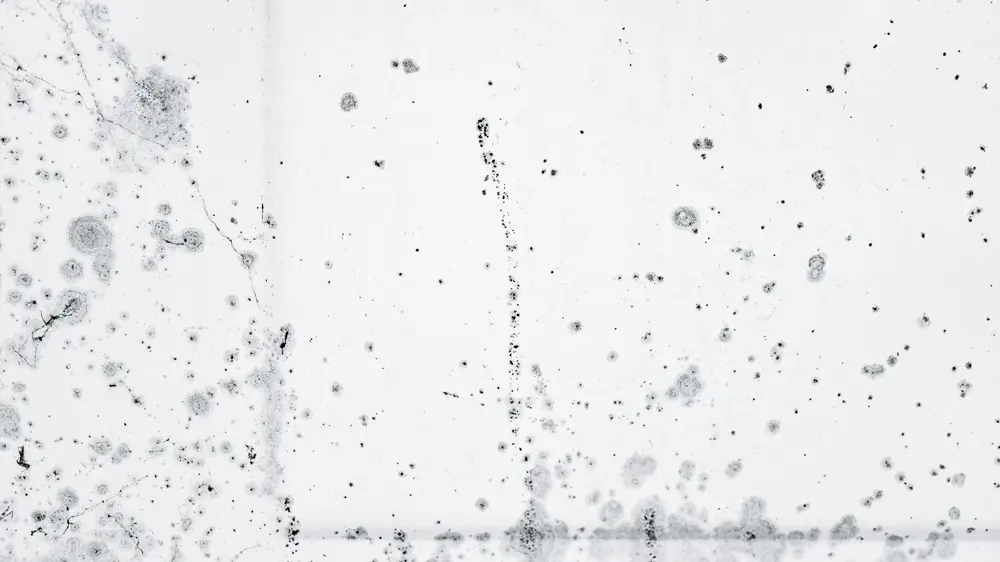
Mould in the bathroom in Varna: steam, grout or a leak behind the tiles?
Black spots on the bathroom ceiling, along the sealant or in the corners usually come from one of three places: steam that has nowhere to go, grout and sealant that let water behind, or water coming from a pipe or from the bathroom above. Here is how to tell which one you have, and why cleaning comes last.
Our clients on video · all videos (in Bulgarian)
Mould in the bathroom almost always comes from one of three things: steam from the shower that does not get out, water getting through cracked grout or old sealant, or a pipe leaking behind the tiles (or water from the bathroom above). Patches on the ceiling and in the corners that grow in winter usually mean steam; a patch in one place that grows even with good ventilation points to water. Kanal Varna inspects with a thermal camera and a moisture meter without breaking tiles, and we tell you the price when you call. The wider picture is on our mould and damp page. Call +359 52 993 333 or email info@kanalvarna.com — write to us in English and we reply in English.
Updated November 2026Where mould in the bathroom comes from: three causes
The bathroom is the dampest room in the house. A single shower leaves a lot of steam in the air, and the walls and ceiling are often colder than the steam. Mould needs two things: moisture that stays for a long time, and dust or soap to feed on. Every bathroom has the second. So the real question is always where the water comes from and why it does not dry.
The dew point is the temperature below which water vapour in the air turns into droplets. After a shower it is high, which is why the mirror, a cold corner of the ceiling and the outside wall get wet first, even with no leak at all.
- Steam that does not leave. No extractor fan, a fan that hardly pulls, or a tight door so air cannot come in. The spots are on the ceiling above the shower, in the upper corners and on the outside wall, bigger in winter.
- Grout and sealant. Blackened sealant around the bath and shower, cracked grout on the floor and in the shower area. Water gets behind them at every wash and does not dry.
- A leak behind the tiles or from above. A pipe in the wall, the connection under the shower tray, the trap, or your upstairs neighbour's bathroom. The spot stays in one place and grows even when the room is well ventilated.
Often there are two causes at once, for example weak ventilation and old sealant, and both have to be fixed or the spots come back.
Where the spot is and what it suggests
| Where the mould is | Likely cause | What to check yourself |
|---|---|---|
| Ceiling above the shower and upper corners | Steam is not leaving | How long the mirror stays fogged after a shower |
| Sealant around the bath and shower | Mould in the sealant itself | Whether it turns black again weeks after cleaning |
| Floor grout in the shower area | Grout letting water through, or water under the tray | Whether it stays dark for hours after washing |
| Lower part of the wall next to the bath | Trap, overflow or pipe | Whether it is also wet in the corridor outside the bathroom door |
| The wall behind the toilet | Cistern, pipe connection or pan connector | Dry toilet paper behind the pan after flushing |
| Plasterboard and the access hatch | Water or steam behind the lining | Open the hatch and look in with a torch |
| Ceiling under the neighbour's bathroom | A leak from above | Whether it grows after they have showered upstairs |
Mould on the ceiling and in the corners, symmetrical and in several places, is more often steam. Mould in one place, low on the wall or around pipes, is more often water. If it also shows on the wall facing the corridor or a bedroom, look for a leak before you buy a new fan.
Four checks before you call anyone
None of these needs tools. Do them on an ordinary day, after an ordinary shower, not after a deep clean.
- The mirror. Time how long it stays fogged after a shower with the fan on and the door closed. Then repeat with the door ajar. If it clears much faster with the door ajar, air has nowhere to enter. If it stays fogged both times, the fan is not pulling.
- A sheet of paper on the grille. Hold a sheet of toilet paper to the grille of the running fan, once with the door closed and once ajar. If it sticks only with the door ajar, the door is the problem. If it does not stick at all, the duct is blocked, the flap is stuck or the fan is weak. If it sticks with the door closed too, the ventilation is fine.
- Dry paper by the bath and under the trap. Dry the corners round the bath and shower and under the basin trap, and put dry paper there. Run each fitting one at a time. A wet mark on the paper shows where the water comes from.
- The water meter. If you suspect a pipe in the wall, turn off every tap and see whether the meter still moves. If it moves, check the cistern first. If it is still, the water pipes are probably dry and the cause is the drain, heating, grout, steam or the neighbour above.
Write down what you find and tell us. In a flat that is let out, ask the cleaner or guest to do the checks and send photos.
Tell us where the spots are, whether there is a window and a fan, and what you have tried — we tell you whether an inspection is needed and when we can come.
📞 +359 52 993 333When it is steam: air, door and habits
A fan draws out damp air, but dry air has to come in to replace it, under the door or through a grille in it. If the door is tight with no gap, the fan hums and the air hardly changes. That is the most common reason mould returns when the fan works.
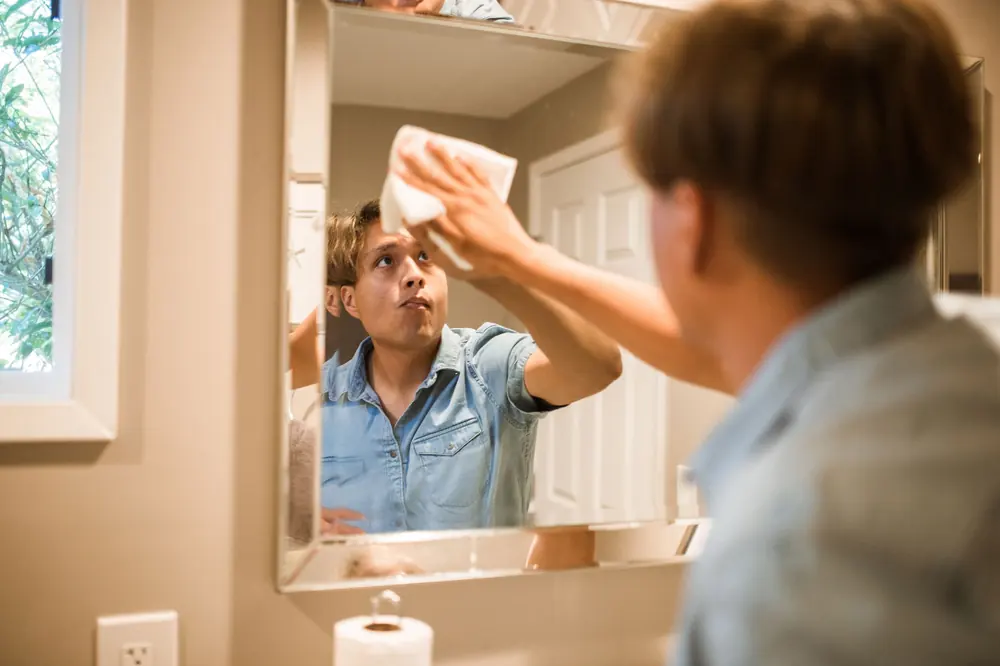
- Leave the fan on after the shower until the mirror and tiles are dry.
- Do not shut the door tight if there is no gap or grille under it.
- Squeegee the glass and tiles in the shower area so less water is left to evaporate.
- Do not dry washing in a bathroom with no window.
- If there is a window, air briefly and wide instead of leaving it ajar all day.
In many blocks the bathroom has no window and the fan is connected to a shared duct. If the duct is blocked or the flap stuck, even the strongest fan will not help; that is covered on our bathroom extractor fan page.
When it is grout and sealant, or a leak behind the tiles
Black dots on sealant around the bath usually do not clean off, because the mould is in the material. The sealant is cut out completely and new is applied on a clean, dry base. New sealant over the old does not stick and water keeps getting in underneath. Dark but hard grout is mostly cosmetic; cracked, crumbling grout in the shower lets water under the tiles at every wash, and then mould is only the first sign. See regrouting for what is replaced and how.
A leak in a bathroom rarely looks like a drip. It looks like mould and a dark patch that stays in one place, grows and does not respond to ventilation. Sometimes the stain is on the other side of the wall, in the corridor, the kitchen or a cupboard.
- Mould in one place, low on the wall or around pipes, not on the ceiling.
- The patch is there even when the bathroom has not been used for several days.
- Tiles sound hollow or move, and the grout round them crumbles.
- The neighbour below has a stain under your bathroom.
- Mould on the ceiling right under the bathroom of the flat above.
Then we measure with a thermal camera and a moisture meter without breaking anything, and if needed test the pipes with a pressure gauge. For leaks from the flat above, see a leak from the flat above; for a shower leak, shower leak. A new bathroom that smells of mould has the same two suspects: a leaking connection from the fitting, or steam entering behind plasterboard with no way out.
Cleaning is the last step
If you clean the mould without stopping the water, it returns in the same place. The right order is: stop the cause, let the bathroom dry, clean, replace sealant and crumbled grout, and paint the ceiling only once it is dry.
Bleach lightens a stain, but in porous plaster and grout it does not reach the roots. Never mix bleach with products containing ammonia or acid (vinegar, limescale removers); use one product at a time. Clean wet, with gloves, goggles and a mask, with a window or door open. Step-by-step cleaning is on our mould removal page. We tell you by phone whether we can also treat small areas; the inspection and measurements we carry out ourselves.
What to tell us when you write
- Where the spots are: ceiling, corners, sealant, grout, low on the wall, outside the bathroom.
- Whether there is a window and a fan, and what the paper test showed.
- Since when, whether it grows, and whether it comes back after cleaning.
- Block or house, which floor, and whether the neighbour below has a stain.
- Two photos, close up and from a distance, by email.
Contact us every day from 06:00 to 23:00. We do the inspection ourselves; repairs to grout, sealant or a leak are done by the tradesmen we work with. If you are abroad, send the address and the contact of whoever can open the flat.
Frequently asked questions
There is mould on the wall facing the corridor. Is it from the bathroom?
Often yes, and that usually means water, not steam. Steam rarely passes through a wall, while a leak from the trap, a pipe or under the shower tray often shows on the other side. We measure with a meter from both sides and compare to see where the moisture comes from.
My bathroom has no window. Is a fan enough?
It is, if it pulls and air has somewhere to come in. In a windowless bathroom the fan should keep running after the shower until the mirror clears, and there must be a gap or grille at the door. If the shared duct in the block is blocked or the flap is stuck, the duct comes first.
The fan works but the mould keeps coming back. Why?
Most often the door is tight so no air enters, the duct is blocked, or the fan stops as soon as the shower does. If ventilation is fine and the patch is in one place and growing, the cause is probably water — grout, sealant or a leak behind the tiles — and it is worth measuring.
How do I know if the mould comes from the bathroom above?
If it is on the ceiling right under the neighbour's bathroom, grows after they shower and has a dark halo, it is probably from above. Mark the edge with a pencil and compare after a day or two. With the thermal camera and a meter from below we show where the moisture points, and to confirm it we also have to look in the flat above.
Do I have to take off the tiles round the bath to see if it leaks behind them?
No. The non-contact meter shows whether it is wet under the tiles, in the grout we measure with pins, the thermal camera shows which way the moisture spreads and the pipes are tested with a pressure gauge. Tiles come off only where it is clear the water is, not over the whole wall.
Is the bathroom mould coming back?
Tell us where the spots are, whether there is a window and a fan, and what you have tried — we tell you whether an inspection is needed and when we can come.
📞 +359 52 993 333or email info@kanalvarna.com — write in English and we reply in English.
Send us a message
Leave your name and a phone number with the country code. Add your email if you prefer a written reply — write in English and we reply in English. We confirm the price before any work starts.