Drainage around a house in Varna: French drain, done after finding the cause
Damp or water in the basement that gets worse after rainy spells? First we check that it comes from the ground, and not from a leak or the downpipes. Only then do we build a French drain round the house, with waterproofing on the outside wall and an outlet for the water.
Our clients on video · all videos (in Bulgarian)
Drainage around a house — also called a French drain or perimeter drain — is needed when water from the soil gets into the basement or soaks the lower part of the walls after rain. The work is an excavation to below the basement floor, waterproofing of the outside wall, a perforated pipe in gravel and geotextile laid with a fall, inspection chambers and an outlet for the water. Before digging we check that the water is not a leak. We tell you the price after a site visit and level survey, before we start. It is one of the jobs on our drainage page. Call +359 52 993 333 or email info@kanalvarna.com — write to us in English and we reply in English.
Updated November 2026When a house needs drainage
Drainage around a house is a perforated pipe in gravel and geotextile, laid on the outside of the foundations. It collects groundwater before it presses on the wall and leads it away from the house. It makes sense when the water comes from the ground, not from a pipe or from the surface of the yard.
The usual call is: "after every heavy rain there is water in the basement." The signs:
- damp in the lower part of the basement walls that gets worse after rain and eases in dry weather;
- water on the cellar floor or along the joint between floor and wall, especially in winter and spring when the groundwater is high;
- the ground slopes towards the house, or the house is cut into a slope;
- clay soil, with water standing in the yard for days after rain.
In Varna this is common for houses on sloping ground — Asparuhovo, Galata, holiday-home areas, where old villas were often built without drainage — and in low-lying parts where groundwater is near. In clay, the backfill around the foundations is looser than the soil around it and collects water like a bath round the house.
When drainage will not help
Drainage solves only water that comes through the soil to the foundations. If the wet patch is from a burst pipe, from a drain, from a downpipe that discharges at the wall or from condensation, a trench around the house costs a lot and changes nothing. So we rule those out first.
| What you see | Likely source | What helps |
|---|---|---|
| Wet in dry weather too; the meter turns with all taps closed | Leak from a water pipe | Finding the leak and repairing it — see leak detection |
| Patch with a smell around a drain pipe | Leaking drain | Camera in the drain and repair |
| Yard water runs towards the house; downpipes discharge by the foundations | Surface rainwater | Drainage of the yard — see garden drainage |
| There is already water in the cellar that must go now | Groundwater or a flood | Pumping — see flooded basement |
| Mould high in the corners, no patches below | Condensation | Ventilation and mould treatment |
| Patches low on the walls that follow the rain | Water from the soil | Drainage around the house and waterproofing on the outside |
Often there are two sources at once. Then the surface is put right first, and only after that do we decide whether a drain is needed.
How a drain around a house is built, step by step
A proper drain round an existing house is more than a pipe in a trench: the wall is opened, waterproofed and protected, the pipe lies below the basement floor with a constant fall, and the water has somewhere to go.
- Visit and level survey. We check where the water comes from, measure the levels of the floor, the foundation and the ground, and choose the lowest point for the outlet.
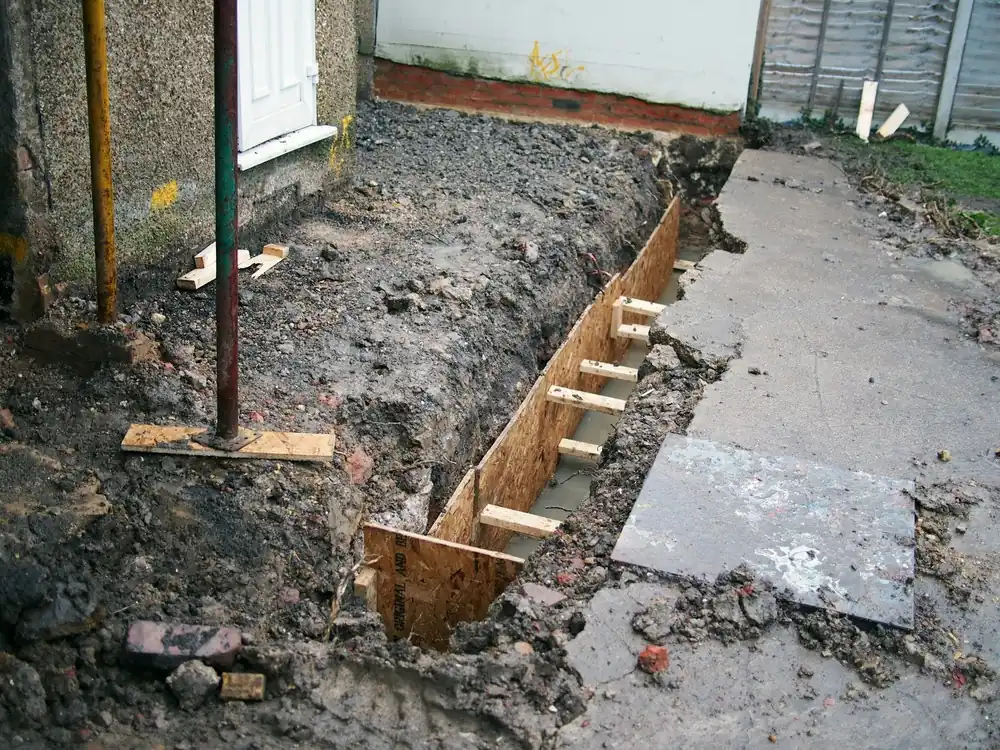
- Excavation. Along the walls to below the basement floor, but not below the bottom edge of the foundation right next to it. Beside an existing house we dig in sections so that the foundation is not undermined; deep trenches are shored.
- Cleaning and waterproofing. The wall is cleaned, cracks repaired and a bitumen membrane or bitumen-polymer coating applied. On top goes a dimpled drainage membrane that protects the waterproofing during backfilling and carries water down to the pipe.
- Geotextile and gravel. Non-woven geotextile on the bottom, with a bed of washed gravel on it.
- The drain pipe. A perforated pipe of 100–110 mm with a constant fall of 5–10 mm per metre, checked with a level. The gravel covers it all round and the geotextile closes over the top like a parcel.
- Inspection chambers. At corners and where the direction changes, for flushing and for a camera.
- Outlet. To a surface-water drain, a soakaway or a pump pit, depending on the ground and the soil.
- Camera and backfill. Before backfilling, water is run through the pipe and a camera is passed along it. The backfill is compacted in layers and the top layer shaped to slope away from the house.
Why waterproofing and drainage together: a drain reduces the water at the wall but does not make it watertight, and waterproofing in wet soil without a drain is under constant pressure. While the wall is open, both are done in one go — later, access from outside means a new trench. For the inside of the wall, see basement waterproofing.
Tell us where and since when — we check the cause first, and if a drain is not needed, we say so. The price comes after the visit, before we start.
📞 +359 52 993 333The details that decide whether it lasts
A drain lasts if three things are right: the pipe has a constant fall, the gravel is coarse and washed, and the geotextile stops the fine soil. If one is missing the pipe silts up, and you find out only when the water returns to the basement.
- Pipe of 100–110 mm. Corrugated and perforated, flexible and strong under the weight of backfill. A thinner pipe blocks more easily and is harder to flush.
- A constant fall. That is 5–10 mm per metre. Along a 30 m wall the end of the pipe is 15–30 cm lower than the start, so the outlet is thought out before digging, not after.
- Washed gravel of 16/32. Coarse grains leave pores through which water reaches the pipe quickly. Sand or gravel mixed with soil fills them from the start.
- Non-woven geotextile. It wraps the gravel and lets water pass but keeps the clay and fine soil that would otherwise fill the pores and the slots.
Where the water from the drain goes
The collected water needs an outlet that is lower than the pipe and still copes in long spells of rain. The choice depends on the lie of the land, the soil and the drains nearby, and often decides the price more than the digging, so we settle it at the visit. The route from the house to the outlet is a trench too, and is part of the price.
- Surface-water drain. The simplest, if the property has a surface-water chamber or outlet and the levels allow the water to run by itself. We check beforehand whether it can join the street network — we do not connect blind.
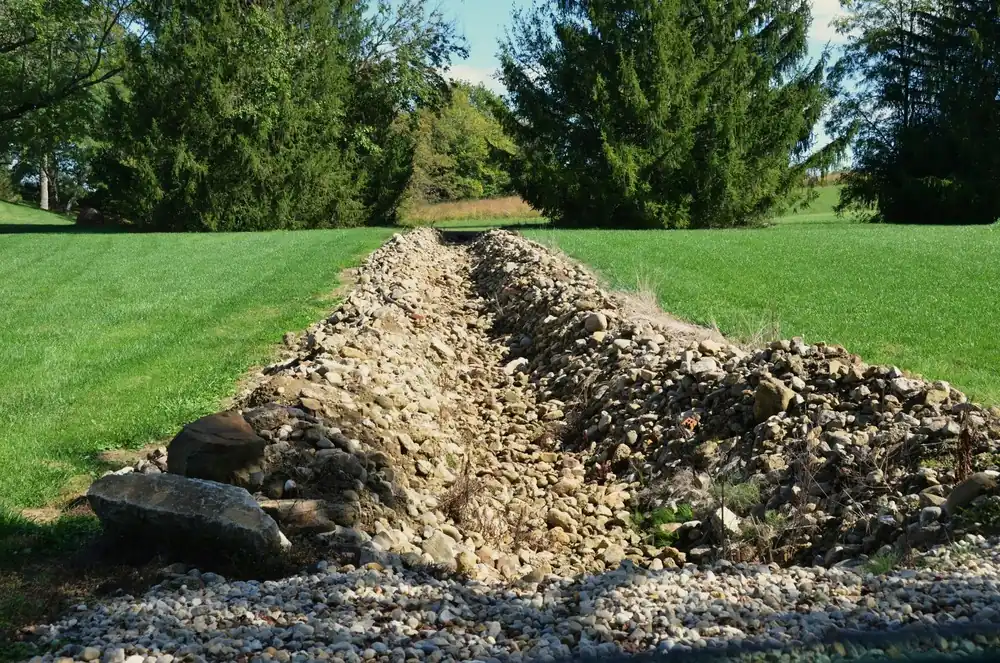
- Soakaway. A gravel pit away from the house. It works in permeable soil; in clay it drains slowly, and with high groundwater it does not work at all.
- Pump pit. When there is no lower point, for instance a basement below street level: the water is collected in a pit and pumped out by a float pump with a non-return valve — more in flooded basement.
This pit is for rain and soil water. Waste water from a toilet or bathroom in a basement is lifted by a sewage pump. On steep or landslide-prone ground it is not a good idea to let the water run freely down the slope: the collected flow softens the soil and carries it away.
The commonest mistakes, and an old drain that no longer works
- A pipe without a fall or with a sag. Water stands in the low parts, leaves silt and the pipe clogs from inside.
- No geotextile. Clay gets into the gravel and the slots; in time the drain stops taking water.
- The pipe above the basement floor. Water passes below it and still reaches the cellar.
- Connected to the foul drain. It is not meant for drainwater; when overloaded, water and smell run back towards the drain.
Before a new drain is dug, the old one should be seen from inside. We pass a camera through the chambers or from the outlet and check whether the pipe is silted, crushed, full of roots or without a fall. Sometimes flushing and repairing one section is enough, with no new trench. How a silted drain is flushed, and when flushing is not enough, is on our land drain cleaning page.
Drainage around a house: what it costs, and if you are abroad
The price of drainage around a house depends on the metres and depth of the trench, access, paving on the route, waterproofing on the outside and where the water goes. That is why we do not give a price per metre by phone: we give it after the visit and level survey, before we start, with a description of what is included.
Many owners are abroad and the house is let or empty. Send us the address, photos of the wet places and the plot, and the contact of the person who can open the gate; we do the visit with them, tell you what we found and what we propose, and agree the price with you before we start. You pay after the work by cash, card or bank transfer, with an invoice on request. We work in Varna and in the villages around it. Our main business is finding hidden leaks and CCTV drain surveys, so if the water is from a leak or from the yard, we say so instead of proposing a trench.
Frequently asked questions
How much does it cost to drain a house?
It depends mostly on the metres and depth of the trench, access for an excavator, paving on the route, waterproofing on the outside and where the water goes. Two houses with the same perimeter can cost very differently, so we give a concrete sum after the visit and level survey, before we start.
Drainage or waterproofing — which do I need?
For a basement in wet soil usually both. The drain leads the water away before the wall, and the waterproofing stops what still reaches it. When the wall is open for the trench, doing both at once is the most sensible. If you cannot dig outside, see basement waterproofing from the inside.
How do I know the water is from the ground and not a leak?
Close all taps and see whether the meter moves; if it does, there is probably a leak and drainage will not help. Damp that gets worse after rain and eases in dry weather points to ground or yard water. At the visit we check with a moisture meter and a thermal camera.
I'm not in Bulgaria — can you still deal with it?
Yes. Send us the address, photos and the contact of whoever can open the gate. We do the visit with them and agree the price with you before we start. Write to us in English and we reply in English, by email at info@kanalvarna.com.
Related pages
Water getting into the basement from outside?
Tell us where and since when — we check the cause first, and if a drain is not needed, we say so. The price comes after the visit, before we start.
📞 +359 52 993 333or email info@kanalvarna.com — write in English and we reply in English.
Send us a message
Leave your name and a phone number with the country code. Add your email if you prefer a written reply — write in English and we reply in English. We confirm the price before any work starts.