Well cleaning in Varna: silt, walls and disinfection
Cloudy water after rain, a smell, or a pump that keeps sucking up silt? We pump the well out, remove the silt from the bottom and the walls and disinfect. Whether the water is fit to drink is for a laboratory to say, not for us. Every day 06:00–23:00.
Our clients on video · all videos (in Bulgarian)
Well cleaning near Varna starts with pumping the water out with a submersible pump. Then the silt is taken from the bottom and the walls are scraped. If the water is for drinking, or something has fallen in, the well is disinfected with a chlorine product. Nobody goes down without ventilation, a harness with a rope and a person at the top. Whether the water can be drunk is shown only by a laboratory test. We tell you the price by phone once you have told us about the well — it is one of the jobs on our drainage page. Call +359 52 993 333 or email info@kanalvarna.com — write to us in English and we reply in English.
Updated November 2026Well cleaning: what it includes
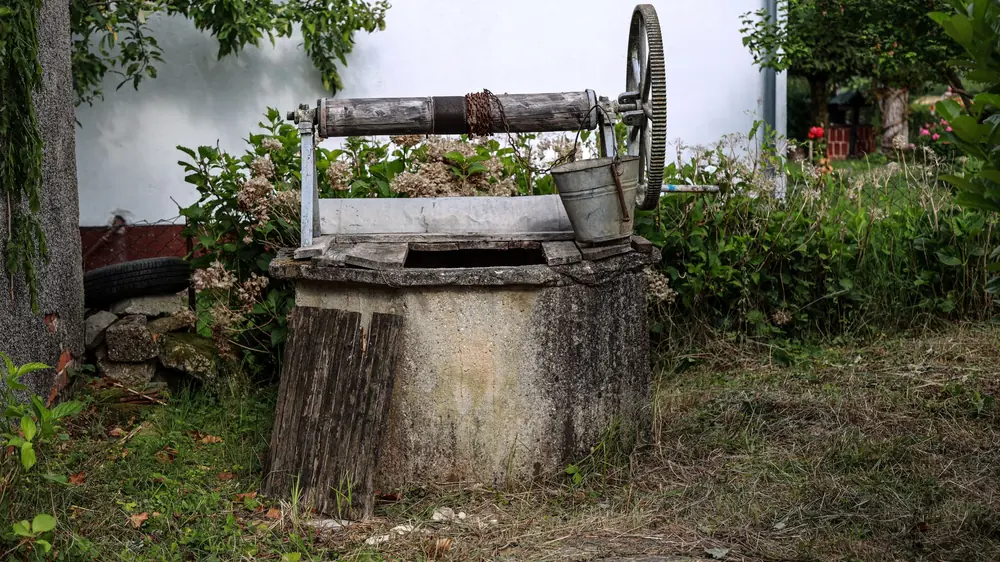
Cleaning a well means four things: pumping the water out, taking the silt from the bottom, scraping the walls and disinfecting with a chlorine product. We do it in yards in Varna, in holiday-home areas and in the villages around, wherever the well gives water for the garden and sometimes for drinking.
This page is about a dug shaft well: wide, lined with stone or concrete rings. Water comes in from the bottom and through the joints in the lining, so over the years silt and sand collect at the bottom and green slime on the walls. The pumping is our work. The descent and the removal of the silt we organise with partners we work with, and if there is a lot of water and mud, a tanker as well. You call us, and we arrange who does what and when.
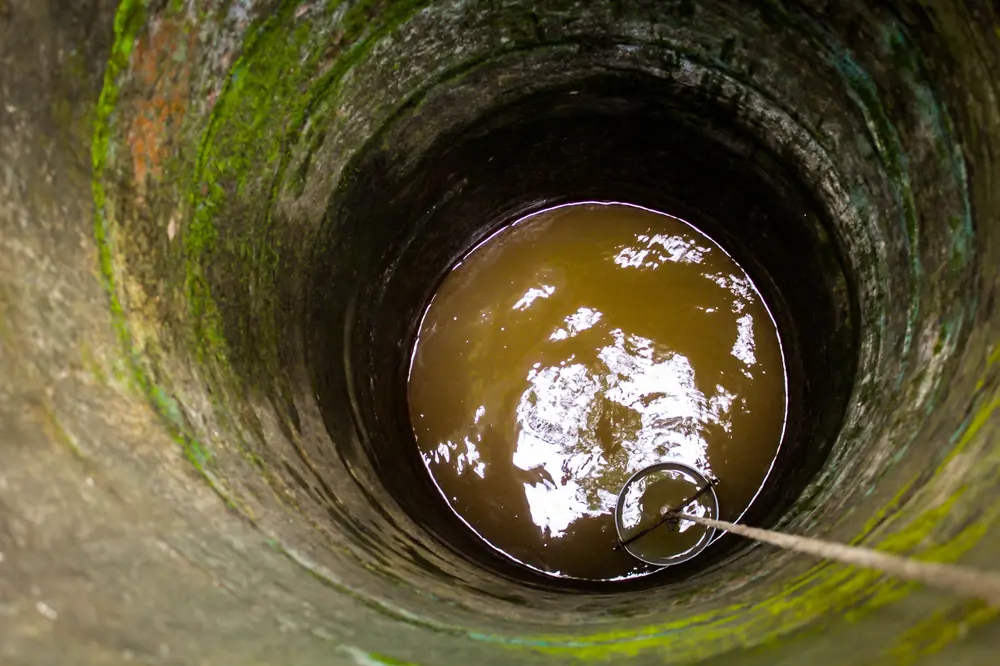
A well is a special case within drainage: here we want the water to stay clean. The pump we use is for clean water; waste water needs a different one — see sewage pump.
When a well needs cleaning: sign, cause, what we do
| What you notice | Likely cause | What we do |
|---|---|---|
| Water turns cloudy after every rain | Rainwater enters from above — through the cover, around the opening or between the top rings | Clean, and look at the upper part; while rain has a way in, the water will cloud again |
| Smell of bad eggs or rot | Rotting leaves and silt, stagnant water, sometimes pollution from outside | Pumping, silt out, disinfection; if the water is for drinking, a laboratory test |
| The pump sucks in sand and silt and stops | Silt has risen to the pump's intake | We take the pump out, the bottom is cleaned and the pump goes back |
| Less water than before | A clogged bottom, or a lower water table in a dry spell | Clean the bottom; if it is the drought, cleaning does not add water — we tell you at the visit |
| An animal, leaves or branches have fallen in | Organic matter rotting in the water | Removal, full pumping, cleaning and disinfection; no drinking until the laboratory result |
| After a flood or downpour, yard water has got in | Muddy surface water, sometimes with manure or sewage | Pumping, cleaning, disinfection and a test; for mud in the house see flood clean-up |
If the sign returns soon after cleaning, the cause is outside: in the cover, in rainwater or in something leaking nearby. Cleaning removes the result but does not close the way it gets in.
How a well is cleaned, step by step
- A conversation and photos. You tell us how deep the well is, how high the water stands and what you use it for. A photo of the opening, the cover and the path to it says more than a description.
- The visit. We measure the depth and the level, see how fast it refills, what it is lined with, whether there is a pump and cable inside and where the hose will run.
- Pump out. If a pump is inside, we take it out with its cable and rope. Then our submersible pump takes the water well away from the opening so that it does not seep back through the ground.
- Bottom and walls. Sand and silt come up in buckets on a rope and the walls are scraped of slime. Nobody goes down except under the rules in the next section.
- Disinfection. Where needed, a chlorine product is added following the instructions on its pack. After the standing time the water is pumped until the smell of chlorine has gone, and your pump goes back in its place.
- A sample, if the water is for drinking. When the chlorine no longer smells, you take a sample for a laboratory. They tell you how to take it and in what container.
How long it takes depends on the depth and on how fast the well refills; with a strong inflow it keeps filling during the cleaning and pumping goes on. If there is much more silt than can be seen from above, we tell you before we continue.
Nobody goes down a well just like that
Nobody goes down a shaft well without ventilation, without a harness on a rope and without a person at the top — even if it is shallow and the water has been pumped out. At the bottom there may be too little oxygen and carbon dioxide or gas from rotting silt. These gases often have no smell, and people notice the danger only when they feel faint.
The rules: ventilate first. Go down only in a harness tied to a rope, with a person above who holds the rope and does not follow. No petrol generator or petrol pump in the well or beside the opening — the exhaust gas collects in the shaft. In well accidents two people often die: the first loses consciousness at the bottom and the second goes down to help without a harness. If someone below feels unwell, do not follow; pull them up by the rope and call 112.
So we do not advise you to clean the well yourself. When we take the job, the descent is organised with the partners we work with, under these rules. While the cover is off, keep children and animals away from the opening.
Tell us how deep the well is, how high the water stands and whether there is a pump inside — a photo of the opening helps. We tell you the price by phone.
📞 +359 52 993 333After cleaning: disinfection and testing the water
Whether the water is fit to drink after cleaning can be told only by a laboratory test — not by colour or smell. Bacteria from manure or from a pit cannot be seen in the glass.
- When to sample. After the chlorine smell has gone, otherwise the chlorine distorts the result.
- Where. At a laboratory; the Varna water utility's laboratory takes samples from private customers, so ask there which tests to request and how to take the sample.
- Meanwhile. Drink and cook only with boiled water.
- If the result is bad. Look for where the pollution comes from — often the yard. Chlorinating again without removing the cause helps only briefly.
If you use the water only for watering, cleaning is usually enough. Disinfection makes sense when the water is for drinking or washing, after an animal has fallen in and after a flood. How much product is needed depends on the product and the volume of water, so the label is followed, not guesswork.
The well and the septic pit in the yard
A well close to a septic pit, an outside toilet or a manure heap can be polluted — water in the ground does not stop at the fence. If the pit leaks, cleaning gives clean water only until the new pollution reaches the well. So with cloudy or smelly water we look at the yard around the well too: where the pit is, whether it is watertight, where rain and water from the manure heap run, and whether the ground slopes towards the opening.
A pit that never fills is usually not watertight. Then the pit is dealt with first — see septic tank emptying — and only then does cleaning the well make sense. Rain from the roof and paths must not run towards the well; see garden drainage.
When you do not need the well cleaned
- The water is weak at the taps in the house. Clear water with low pressure is a matter of the pump, the pressure booster or the pipes, not the bottom. We do not fit or repair well pumps.
- The well only dries up in summer. If the water comes back with the autumn rains, the level simply falls in a dry spell. Cleaning the bottom does not make water where there is none.
- You mean a soakaway. A gravel pit that takes rainwater is not a water well; see garden drainage.
- The water is in the cellar, not the well. That is flooded basement.
- You want a new well or borehole. We do not dig wells and have no drilling rig. We can arrange a borehole through partners who do — see borehole drilling.
What to tell us, and what the price depends on
We tell you the price by phone or email, and it is more accurate if you tell us how deep and wide the well is, how fast it refills, what the cover is like, whether a car can get into the yard, whether a pump is inside, what you use the water for and where the property is. Photos help a lot.
The price depends on the depth and width, the inflow, the amount of silt, whether a tanker and disinfection are needed, and how easy the well is to reach. For places outside the city we tell you whether and when we can come. We issue an invoice, and you pay after the work by cash, card or bank transfer.
If you own a house near Varna but live abroad, send us the address, photos of the well and the contact of whoever can open the gate. We arrange the visit with them and agree the price with you first.
Frequently asked questions
How often should a well be cleaned?
There is no calendar that suits every well. It is cleaned when the water changes — clouds, smells, drops — when the pump starts sucking silt or when something has fallen in. If you drink the water, watch it more closely and have it tested even without a visible problem, especially after a flood or downpour.
Will the water be fit to drink after cleaning?
We cannot promise that. Cleaning removes the silt and disinfection acts against bacteria in the well, but if the pollution comes from outside — a pit, manure or rainwater — it comes back. So have a sample tested at a laboratory before you drink it unboiled.
Do you take the pump out of the well and put it back?
Yes. If there is a pump inside, we take it out before cleaning and put it back when we finish. We do not repair or install well pumps: if the pump has stopped or gives no water, we tell you what we saw, but repair is for a service shop.
I'm not in Bulgaria — can you still deal with it?
Yes. Send us the address, photos of the well, the cover and the way in, and the contact of whoever can open the gate. Write to us in English and we reply in English, by email at info@kanalvarna.com. We agree the price with you first and you can pay by bank transfer.
Well water cloudy or smelly?
Tell us how deep the well is, how high the water stands and whether there is a pump inside — a photo of the opening helps. We tell you the price by phone.
📞 +359 52 993 333or email info@kanalvarna.com — write in English and we reply in English.
Send us a message
Leave your name and a phone number with the country code. Add your email if you prefer a written reply — write in English and we reply in English. We confirm the price before any work starts.