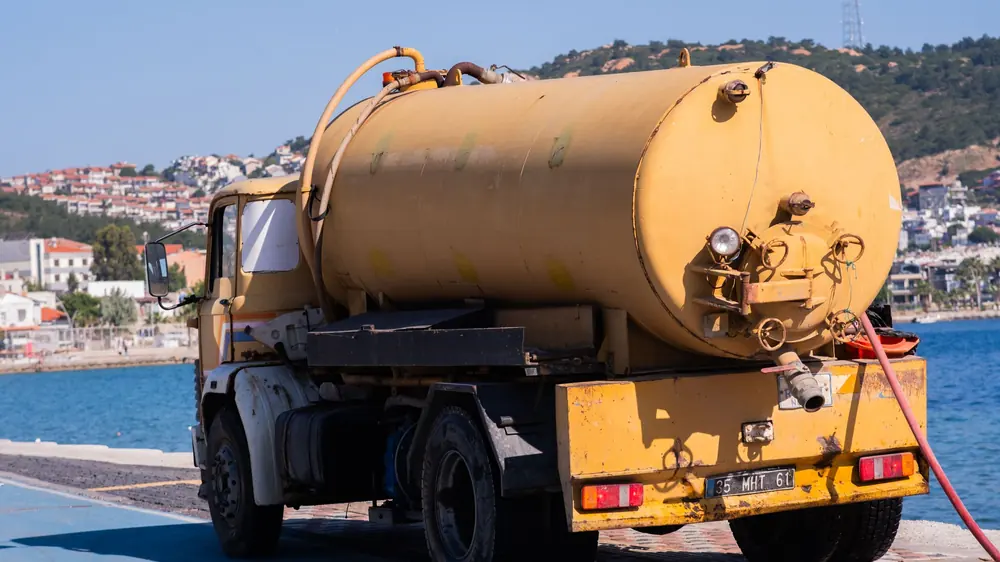
Septic tank emptying in Varna: the tanker, the pipe to the tank and a camera check
Water backing up in the house, or draining away slowly? A full tank and a blocked pipe to the tank look exactly the same from inside the house. We tell them apart, clear the pipe ourselves and arrange the tanker with the partners we work with. Every day from 06:00 to 23:00.
Our clients on video · all videos (in Bulgarian)
Septic tank emptying near Varna is really two jobs: pumping out a full tank with a tanker, and unblocking the pipe from the house to the tank. Kanal Varna arranges the tanker with partners and clears the pipe itself, through the inspection point or from the tank side; if the tank fills too fast we look at the pipes with a camera. A blocked main drain starts from €69 and a CCTV camera is from €59; for pumping out we give you the price once you have described the tank and the road to it. We work every day from 06:00 to 23:00. Call +359 52 993 333 or email info@kanalvarna.com — write to us in English and we reply in English.
Updated November 2026Septic tank emptying: two jobs that people call by one name
People say "clean the septic tank" and mean two different things: pumping out a full tank, and unblocking the pipe that leads from the house to it. The first is a job for a tanker, the second for a spiral machine. Telling them apart is the first thing we do on the phone.
Strictly speaking, a septic tank has chambers or a settling zone: the sludge settles and stays in it while clearer water flows on. A cesspit (a sealed holding tank) has no outlet: it only collects, and is emptied when full. In everyday speech both get called a septic tank. In either case the sludge does not disappear by itself.
Where there is no sewer in the street, the waste water of a house goes to a watertight holding tank or a treatment unit, so a tank in the garden is the normal arrangement in the villages and holiday-home areas around Varna. For the pipe between a house and a street sewer instead, see blocked outside drain. Everything else about blockages is on our blocked drains page.
Full tank or blocked pipe: how to tell
If water is coming back into the house, lift the lid of the tank first. If the level is below the incoming pipe, the tank is not the problem and the pipe is blocked. If the water reaches the pipe or is above it, the tank is most likely full and waiting for a tanker. Do not lean over the open lid and do not light a flame.
| What you notice | Most likely cause | What we do |
|---|---|---|
| Water comes back up in the lowest toilet, but the tank has room | Blockage in the pipe between the house and the tank | Clear it with the machine, from the inspection point or from the tank side |
| The tank is full to the incoming pipe | The tank is simply full | We arrange a partner's tanker, then check that the pipe runs freely |
| It fills much faster than before, with no extra water used | A downpipe, rainwater, groundwater through a crack or someone else's pipe | Camera in the pipes and a look at the tank |
| It never fills, for years | If it is a holding tank, it is not watertight and waste water is leaking into the soil | A look on site; we tell you what we see and the options |
| Smell in the garden around the lid | The lid does not sit tightly, there is no vent, or the tank is overfull | Check the lid and the level; tanker if full |
| Smell in the bathroom, not in the garden | A trap that has dried out, or a problem with the house's drain vent | See drain smell: the tank is usually not the cause |
| Gurgling in the toilet or sink when you run water | Pipe partly blocked, or the tank nearly full | Level first, then spiral or camera |
Rainwater does not belong in a tank. If a downpipe is connected to it, every heavy shower fills it again.
Emptying with a tanker: what to prepare
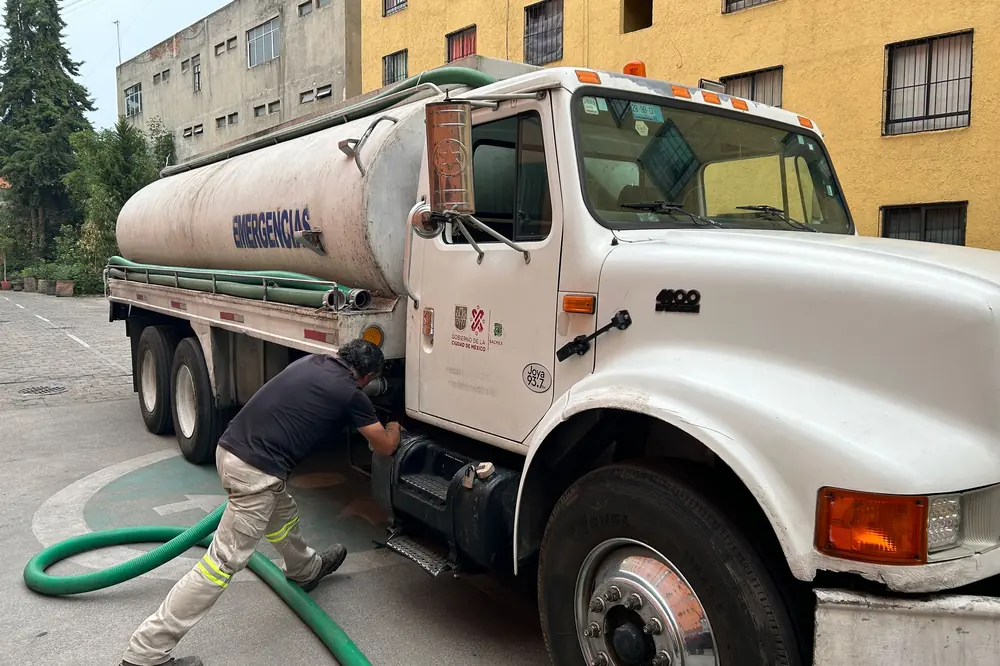
A tank is pumped out by a vacuum tanker; in the villages people simply call it a "fekalka". The tanker is not ours: we arrange it with partners we work with, and you deal only with us. The truck has to stop close to the tank, because its hose is long but not endless.
- The route. Tell us how far the lid is from where a truck can stop: from the street, the gate or inside the yard. A narrow lane or a muddy track also matters.
- An open lid. Not buried under soil, covered with tiles or pinned under something heavy.
- Dogs tied up and the gate unlocked, or somebody there to open it.
- The size. If you know how big the tank is, say so. If not, describe it: round from concrete rings or rectangular, roughly how deep.
You cannot call a tanker like a taxi. When it can come depends on the partner and the place, so ring or write as early as you can, and we will tell you in the first conversation what is possible. If it is a manhole that is full rather than a tank, or you need water delivered for a pool, see sewage tanker.
Tell us the village, when the tank was last emptied and where the water comes back — we tell you which is more likely, the price before we start and when we can come.
📞 +359 52 993 333The pipe from the house to the tank
When there is room in the tank but water comes back up in the house, the blockage is in the pipe to the tank, and that part we do ourselves. The pipe is often long, with no inspection point: it was laid once and buried. So we go in wherever there is access: the inspection point, a manhole if there is one, the toilet, or from the tank end.
We have machines with spirals of different lengths. A typical call: a house in a village, the tank a long way from the toilet, and a short spiral that does not reach the blockage. So for long runs we bring the machine with the longer spiral, and we ask in advance how far the tank is from the house. If the spiral does not get through, a camera can show what stops it.
If the pipe to the tank turns out clean and the blockage is inside the house, see blocked drains.
A camera in the pipes: where is the extra water coming from?
When the tank fills faster than you use water, water is getting in from somewhere else, and a camera can show where. We push it in from the inspection point or, once the tank has been pumped out, from the tank end, and look at every junction along the way. It can turn out to be:
- a downpipe or rainwater drain connected to the drain when the house was built, and then forgotten;
- somebody else's pipe — from the neighbouring plot, a summer kitchen or an old bathroom;
- a cracked or displaced pipe letting groundwater in, which shows as clean water running when nobody uses any;
- a leaking tank wall, which shows up when the tank itself is inspected, not on the camera.
A tank that never fills is a sign too. If it is a holding tank, it is not watertight, and the waste water is going into the ground and possibly the groundwater. If there is a well in the garden, it is the first to suffer, so sort out the tank before having the well cleaned. More on the camera: CCTV drain survey.
Safety around the tank
Nobody should go down into a septic tank, even to retrieve something that has fallen in. Hydrogen sulphide, methane and carbon dioxide collect at the bottom. Hydrogen sulphide dulls the sense of smell, so you stop noticing the smell exactly when it is strongest, and it can make a person pass out. Methane burns, so no naked flame, cigarette or blowtorch over an open lid. If someone loses consciousness in a tank, do not go down after them — a large share of deaths in confined spaces are people who went in to rescue someone. Call 112.
The lid must be sound, heavy or locked, and always closed. A rotten board or a sheet of metal thrown on top is a trap for children and animals.
If you are not in Bulgaria
If your house stands empty for months, you may only discover the tank is full when you arrive or when a tenant gets in touch. You do not have to be there, but somebody must open the gate and show us where the lid is and where we can get into the pipe; if we work from inside the house, someone has to be inside too. A neighbour or relative who knows the plot is fine. Photos help a lot: the lid, the inspection point, and the route from the road to the lid.
Give us the village or area, when the tank was last emptied and where the water comes back up. We tell you which is more likely and when we can come, and you can pay by bank transfer. We issue an invoice on request; for the tanker part we tell you in advance how it is invoiced.
Frequently asked questions
How much does septic tank emptying cost?
We do not quote a number for pumping out without knowing the tank. We give you the price once you have described it or sent photos: the size, the road to it, how far the lid is from the truck, and whether the pipe needs clearing too. Clearing a main drain or the pipe from a manhole starts from €69 and a camera from €59. See the price list. You pay after the job.
How quickly can you empty the tank?
It depends on when the partner's tanker is available, so tell us in the first conversation by when you need the tank empty, and we say what is possible. We work from 06:00 to 23:00, and when the tanker comes depends on the partner and the place. While you wait, stop using the washing machine and dishwasher if water is already coming back into the house.
Do you come to the villages around Varna?
Yes, to Varna and to the villages and holiday-home areas in the region. Tell us the village and how far the lid is from the road, and on the phone we say whether and when we can come. Some narrow lanes are too tight for a big truck, so we ask about the route.
I'm not in Bulgaria. Can you still deal with it?
Yes. Send us the address, photos of the lid and the route to it, and the name and phone number of someone who can let us in. We arrange the visit with them, and you can pay by bank transfer.
Can you pump out only part of the tank? Does sludge stay at the bottom?
Whether a partial pump-out is possible, and how much, we agree on the phone with the partner who runs the tanker. The liquid comes out easily; thick sludge at the bottom is harder, and a tank that has not been emptied for years may keep a layer. If you want it empty to the bottom, for example to inspect the walls, say so when you book.
Can I contact you in English?
Yes — write to us in English by email at info@kanalvarna.com or through the form on this page, and we reply in English. The phone number is +359 52 993 333.
Related pages
All types of blockage and the general prices Sewage tanker
Tanker or water tanker: which truck for which job Blocked outside drain
When the drain goes to the street, not to a tank CCTV drain survey
Where the extra water in the tank comes from Villages around Varna
Which villages have no street sewer
Tank full or pipe blocked?
Tell us the village, when the tank was last emptied and where the water comes back — we tell you which is more likely, the price before we start and when we can come.
📞 +359 52 993 333or email info@kanalvarna.com — write in English and we reply in English.
Send us a message
Leave your name and a phone number with the country code. Add your email if you prefer a written reply — write in English and we reply in English. We confirm the price before any work starts.