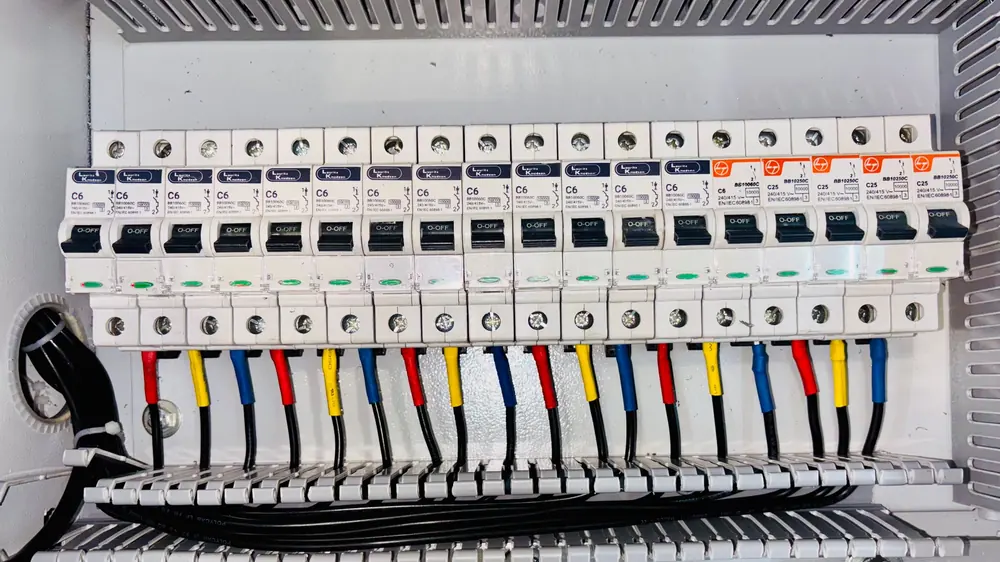
High electricity bill in Varna: finding where the electricity goes
The bill has jumped and nothing new is running at home? We come with a clamp meter and a thermal camera, measure circuit by circuit in the consumer unit and show you the numbers there: which appliance is using the power, whether current is leaking to earth, and whether the meter keeps counting when everything is off.
Our clients on video · all videos (in Bulgarian)
A high electricity bill nearly always has an explanation that can be measured: an appliance running more than you think, a heater that does not switch off, a pump that never stops, or current leaking through damaged insulation. With a clamp meter we measure each circuit in the consumer unit, check the big consumers, measure earth leakage current in milliamps and look at the consumer unit and sockets with a thermal camera. You see the numbers there, and we leave you a report. The repair, if one is needed, is done by an electrician qualified for the job, with whom we work. This page is part of home testing in Varna; a high water bill is a different search, see leak detection. Ring +359 52 993 333 or e-mail info@kanalvarna.com — write to us in English and we reply in English.
Updated November 2026High electricity bill: how we find where the electricity goes
The cause can almost always be measured. It may be an appliance that works longer than you think, a heater that does not cut out, a pump that never stops, or current leaking through damaged insulation. We measure while the appliances are running.
- A clamp meter on each circuit in the consumer unit: how many amperes flow in each one — kitchen, water heater, air conditioners, sockets, underfloor heating.
- A leakage clamp: measures in milliamps the current that escapes past the neutral, in a circuit or an appliance.
- A thermal camera: overheated terminals in the consumer unit, sockets and plugs.
- The big consumers: how much they draw and for how long.
The clamps go round the wire from outside, so we disconnect nothing.
Kilowatt-hour (kWh). The unit on your bill. A 2 kW appliance running for one hour uses 2 kWh.
Before you call: check the bill and the meter
Some high bills need no instrument. Look first at these:
- The kilowatt-hours, not the amount. Compare the kWh with the same month last year. If the kWh are the same, the cause is the price, not the installation.
- The period. A longer period, or a catch-up bill after estimated readings, looks high without you using more.
- New appliances and the season. A new air conditioner, winter, a guest for a month: all of it shows in the kWh.
If none of that explains it, switch off all appliances in the evening and look at the meter: if the light keeps flashing often, something in the property is running. Then switch off the main breaker too; if the meter still counts, see the section on that below.
Circuit by circuit: which one is using the power
In the consumer unit each circuit breaker protects one circuit. We put the clamp round the wire of the circuit and see how many amperes flow at that moment. We measure twice: with the usual appliances on, and with everything off.
A rule of thumb: at 230 V each ampere is about 0.23 kW, so a circuit carrying 9 A draws about 2 kW, like an ordinary water heater. If that happens when nobody uses hot water, we know where to look. The constant load of a fridge, router and standby appliances is usually a few tens of watts up to about 200 W. One ampere flowing continuously comes to about 165 kWh a month, so a steady current above 1 A in a quiet flat means something is running that you do not know about.
The big consumers and what goes wrong with them
| Appliance | What goes wrong | What we look at |
|---|---|---|
| Water heater | Thermostat does not cut out; limescale lengthens heating; a hidden hot-water leak keeps it heating | Current while heating and afterwards; how long it heats |
| Air conditioners | Dirty filters, running at maximum all day, a wrong mode | Current when running; whether the compressor stops at the set temperature |
| Electric underfloor heating | A thermostat with a faulty sensor: the cables heat and do not stop | Current in the circuit; the floor with the thermal camera |
| Pumps: booster, circulation, drainage | A booster pump that switches on constantly because of a leak; a circulation pump that runs all summer | How often and how long it switches on |
| Fridges and freezers | Worn door seal, ice build-up, an old compressor that hardly stops | How long the compressor runs and rests |
If a water heater heats constantly because hot water is leaking away, the water bill rises too, and we look for the leak: see water heater leak. The element and thermostat are replaced in water heater repair; a booster pump that starts with no tap open gives away a leak, see booster pump; for heating, see circulation pump.
Tell us the kWh now and before, what large appliances you have and whether the breaker trips. On the phone we say whether a measurement will help and when we can come.
📞 +359 52 993 333Earth leakage current: a faulty appliance, damaged insulation and the residual current device
Earth leakage means that part of the current does not come back along the neutral but escapes to earth: through damp or damaged insulation, through a heating element with a cracked casing in a water heater, washing machine or dishwasher, or through a socket in a wet room.
Residual current device (RCD). A breaker in the consumer unit, usually with a test button. It compares the current going into the circuit with the current coming back and, when the difference reaches its threshold, which is most often 30 mA for sockets, it trips the circuit.
If the device trips, it is usually doing its job and is not broken. We measure the leakage in milliamps on each circuit behind it; in the circuit with the highest value we switch appliances off one by one until the leakage drops, which finds the faulty appliance. If it stays with everything unplugged, it is in the installation: a cable, a junction box, a socket.
One thing is rarely said: leakage itself seldom makes the bill high. 30 mA at 230 V is about 7 W, around 5 kWh a month. It matters because it makes the device trip and shows damaged insulation; the bill usually rises from an appliance that runs more than it should.
The meter keeps counting with everything switched off
This is the clearest sign that electricity is going somewhere you do not expect. The two tests show different things:
- Appliances off, main breaker on, meter counting: something in your installation is running — a forgotten appliance, a heater, a pump, a leakage. The circuit clamps find it.
- Main breaker in your consumer unit off, meter still counting: the current passes before your consumer unit, along the cable from the meter, through something connected to your meter, or the meter itself reads wrongly.
In the second case we clamp the cable after the meter where it can be reached. If current flows, we look for what is connected: in a block, the stair light or a neighbour's socket is sometimes wired to another flat's meter. If none flows and the reading still rises, it is a question for the network operator.
A dispute with the supplier: what our report can and cannot do
In Varna the bill for most households comes from the supplier Energo-Pro, while the meter and the network belong to the network operator, Elektrorazpredelenie Sever. If nothing in your installation explains the kWh on the bill, or the meter counts while no current flows in the cable after it, the dispute is with them. The usual order: object in writing to the supplier and keep the incoming number; ask the network operator to check the meter, asking beforehand who pays and how long the answer takes; photograph the meter reading with the date several days running; and if the reply does not satisfy you, complain to the energy regulator (KEVR).
You can attach our report to the objection. It is not an official document and does not bind the company, and we cannot promise the outcome of the check. If you need an official document of the measurement of the installation, we arrange an accredited laboratory.
How the check goes and what you receive
- Call or e-mail. Tell us since when the bill is high, how many kWh now and before, which large appliances you have and whether the breaker trips.
- A booked time. A day when appliances run as usual; we may switch single circuits off briefly.
- Measuring. Current in each circuit with appliances on and off, leakage current, the big consumers, the consumer unit with the thermal camera.
- Numbers on the spot. We show you which circuit and which appliance uses the power, and why.
- Report. Values by circuit and appliance, thermal photos and what we suggest putting right.
A flat takes about an hour and a half to two hours; a house longer. We work every day from 06:00 to 23:00. If the cause is a setting, we show you what to change yourself; a repair is done by an electrician qualified for the job, who gives the price before starting.
When it is not worth calling us
- The kWh are the same as before and only the amount grew: ask the supplier about the price.
- The bill is a catch-up after estimated readings: check the meter reading first.
- There is a smell of burning or a melted socket: an electrician comes first.
If you let the flat out and live abroad, say who holds the keys: a neighbour, the building manager or the tenant. Write to us in English and we reply in English. You get an invoice; payment is by cash, card or bank transfer.
Frequently asked questions
Why is my electricity bill so high?
Compare the kWh with the same month last year. If they are equal, the price changed. If they rose, a circuit or an appliance is drawing more: a water heater, air conditioner, underfloor heating, a pump or an old fridge. We measure each circuit with a clamp meter to find it.
Does a current leakage make the bill high?
Seldom by itself: 30 mA at 230 V is about 7 W. It matters because it makes the residual current device trip and points to damaged insulation.
The meter counts although everything is off. What do I do?
Switch off the main breaker in your consumer unit. If it still counts, the current passes before your consumer unit, so start with the network operator. If it stops, something in your installation runs; our clamps find which circuit.
Can I use your report in a dispute with the supplier?
You can attach it to your objection as evidence of what the installation consumes. It is not an official document, it does not bind the company and we cannot promise the result. For an official document we arrange an accredited laboratory.
I let the flat out and live abroad. Can you do the check?
Yes. E-mail us the address, a photo of the consumer unit and the bill, and tell us who opens the door. Someone must be there, because we switch single circuits off for a short time.
A bill you cannot explain?
Tell us the kWh now and before, what large appliances you have and whether the breaker trips. On the phone we say whether a measurement will help and when we can come.
📞 +359 52 993 333or email info@kanalvarna.com — write in English and we reply in English.
Send us a message
Leave your name and a phone number with the country code. Add your email if you prefer a written reply — write in English and we reply in English. We confirm the price before any work starts.