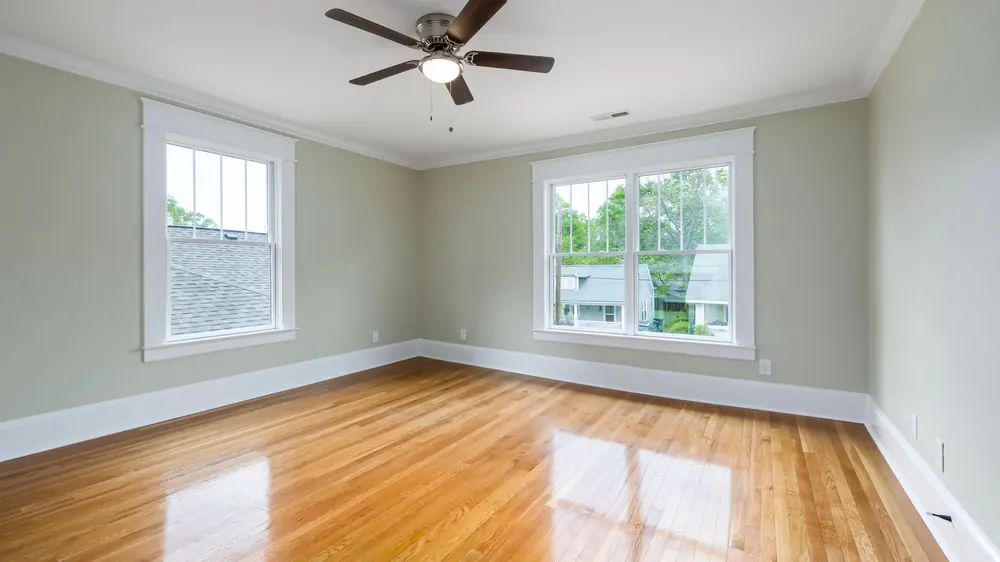
Floor sanding in Varna: parquet sanding, repair and new varnish
Worn varnish, grey paths and gaps? We measure the moisture first and look for where stains come from, then the craftsman sands the floor with a dust-extracting machine of his own and applies varnish or oil.
Our clients on video · all videos (in Bulgarian)
Floor sanding in Varna means taking off the worn top layer of wood together with the old varnish, so that clean wood is left for new varnish or oil. Solid parquet can be sanded, and so can engineered parquet with a thick enough top layer; laminate and vinyl cannot. We measure the moisture first and look for where the stains come from, because water does not come out with sandpaper. The sanding machine and its dust extractor belong to the craftsman; we measure and organise. The work is carried out by the craftsmen we work with, usually as the last stage of a home renovation in Varna, and we stay your one phone number. We tell you the price by phone after photos. Call +359 52 993 333 or email info@kanalvarna.com — write to us in English and we reply in English.
Updated November 2026Which parquet can be sanded and which cannot
Sanding a floor with a machine removes a thin layer of wood together with the old varnish, so new varnish or oil goes onto clean wood. It only works where there is enough sound wood above the tongue and groove of the board. It comes after the dirty work of the renovation, not before.
Floor sanding. Taking the surface layer off a wooden floor, meaning old varnish, dirt and unevenness, with sanding belts down to clean wood. The old craftsmen did it by hand with a steel scraper; today a machine does it.
- Solid parquet: yes. Boards or strips of whole wood, such as oak, beech or acacia, are sanded several times in their life until the paper nears the tongue.
- Engineered parquet: by the top layer. If it is only as thick as veneer, the paper goes through it to the glue. A thicker one is sanded lightly or just freshened.
- Laminate, vinyl, SPC: no. The top is a photograph of wood on HDF, or a PVC layer. For replacing it, see laminate flooring.
Before floor sanding: moisture, nails and creaking
Before the machine the floor must be dry, stable and with no metal sticking out, otherwise sanding only hides the problem for a few months.
- Moisture first. Wet wood swells and shrinks when it dries. If a swollen floor is sanded, the machine takes off the raised edges and then the boards drop below level. So we measure with a wood moisture meter on several boards and on a dry place for comparison. If something is wet we look for the water; see water under the floor.
- Nails and creaking. In an old floor on joists the nail heads stick up; the belt catches them, tears and leaves a groove. The craftsman punches them below the surface and fixes loose boards. Sanding cures neither creaking nor a board that has come unglued.
- Underfloor heating. With water heating the pipes are in the screed. The thermal camera shows where they run when the system is warm, so we look before anything is nailed. The heating is brought up gradually after the varnish.
- Cables. Electric underfloor heating, cables under the skirting boards, sockets and switches are on 230 V; we do not touch them, an electrician is needed.
Grey patches, black edges, gaps: what you see and what we do
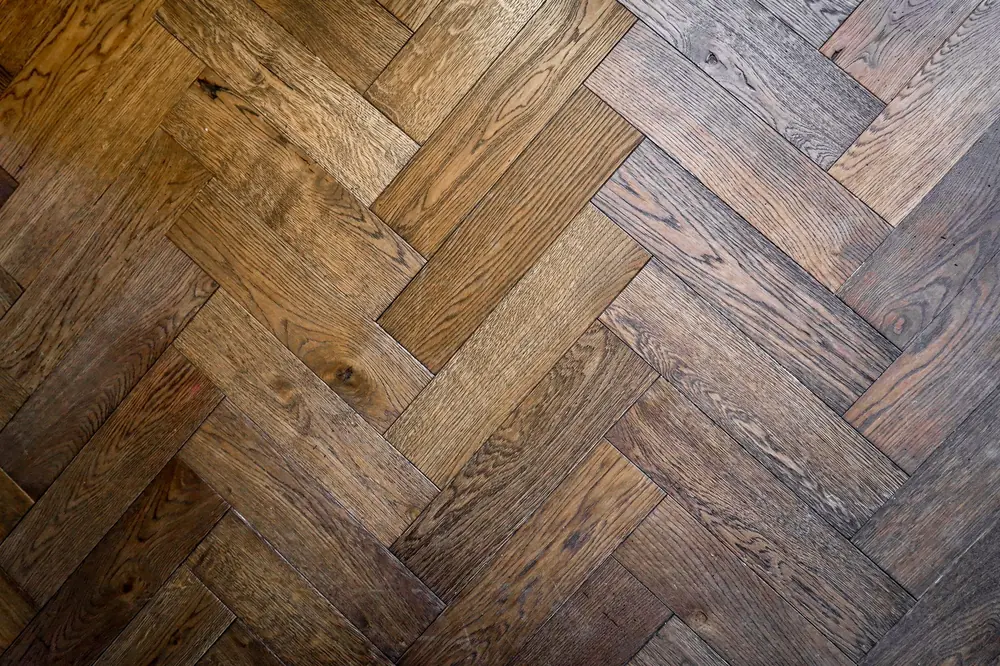
On parquet the colour points to the cause: grey is usually worn varnish and dirty wood, black is water in the wood, gaps come from dry air or a loose floor.
| What you see | Most likely cause | What we do |
|---|---|---|
| Grey matt paths in front of doors | Worn varnish, bare wood taking up dirt | Sanding helps: varnish and dirty layer come off, new varnish goes on |
| Black patches by the bath, a radiator, the balcony, under a plant pot | Water in the wood, often with the tannins of oak | Often not removed by sanding because they are deep. A trial sanding shows the depth; deep ones mean replacing the board |
| Gaps between boards | Dry air in the heating season, or a loose floor | Narrow ones get a paste of fine dust; wide ones get strips of the same wood |
| Boards like a trough, the edges raised | Water that has stopped while the wood is still drying | Not sanded until dry; we measure at intervals |
| A hollow rattle on some boards | Boards come away from the screed | Single boards are glued or replaced; for a whole room, the base first |
Paste in a gap that breathes with the seasons cracks again, so wide gaps are closed with a strip. A swollen parquet may come from a leak from the flat above; until the water has stopped, the stain returns even under new varnish.
Tell us what the floor is, how many rooms there are and where the stains are. A photo of the edge of a board and of the worst spot helps us say what to do.
📞 +359 52 993 333Varnish, oil or hard wax
The choice is between a film on top and protection inside the wood: varnish forms a hard skin, while oil and wax enter the wood and leave it open.
- Varnish is water-based or solvent-based polyurethane. Water-based smells less, dries faster and leaves a lighter tone. Solvent-based gives a warmer colour, but it smells strongly, needs long airing and its fumes are flammable. A two-component varnish with a hardener is more resistant. The craftsman chooses the product by the maker's instructions.
- Oil makes no film and does not peel. A worn path or a stain is mended on the spot with light sanding and fresh oil, without redoing the room. On the other hand it needs more care: the paths are renewed, and spilt grease marks it more easily. Hard wax is oil with wax, denser.
| Room | What suits | Care |
|---|---|---|
| Living room and bedroom | Water-based varnish or oil | Varnish: a well wrung cloth; oil: a special cleaner and renewing the paths |
| Hall and entrance | Two-component varnish | Not washed with much water; grit from shoes wears varnish faster than steps |
| Home with children or a dog | Two-component varnish or oil | Claws scratch even hard varnish; oil is mended on the spot |
The wood is primed before varnishing, with a primer from the same system. Neither varnish nor oil makes parquet waterproof, and we do not recommend it in a bathroom or on a terrace.
Dust and smell: what to take out and what to switch off
Sanding is one of the dustiest jobs in a renovation. The room has to be empty of furniture, everything else is covered and the air conditioning is switched off. The craftsman's extractor catches most of the dust but not all, since the finest escapes from the edges and corners. Doors are taped along the joints, and rugs, curtains and clothes leave the room. A running air conditioner blowing onto wet varnish brings specks that stay as dots in the layer.
With solvent-based varnish there must be no smoking or open flame. If you have a gas appliance with a permanent pilot flame, tell us before the start: while solvent varnish is used the flame must be out, and lighting it afterwards follows the appliance rules or a gas company. The machine is loud, and in a block the noise goes down to the neighbour below, so ask the building manager about the hours the rules allow.
What to tell us, and what the price depends on
We give the price by phone after a description of the floor or a few photos. Have ready:
- how many rooms and halls, and roughly the area;
- what the parquet is: solid or engineered, glued down or boards on joists;
- its condition: worn varnish, stains, gaps, creaking boards;
- whether there is underfloor heating and what kind;
- whether there are built-in units (the floor under them is not sanded), and whether you want varnish or oil;
- a block or a house, which floor and whether there is a lift.
The price depends on the area, the condition of the parquet, the repair of boards, the varnish or oil and the built-in units. We issue an invoice. If you live abroad, e-mail the address with a photo of the edge of a board and of the worst spot, and name whoever can open the door: a neighbour, the building manager or the person with the keys.
Frequently asked questions
How many times can parquet be sanded?
It depends on the wood above the tongue and groove of the board. Thick solid parquet takes several sandings in its life, while engineered parquet depends on its top layer, and a thin one often does not survive even one. Each sanding takes off some wood, so we look at the edge of a board and do not sand without need.
Varnish or oil with children and a dog?
With children, a water-based varnish suitable for a child's room by its maker, and waiting until it has fully hardened. With a dog, a hard two-component varnish or oil. Varnish resists better, but when it is scratched deeply the whole room is redone; oil is mended on the spot. Tell us how you live and how much the floor is used.
Do black stains disappear when the floor is sanded?
Often not. Sanding only takes off the surface layer, while the darkening is deep in the wood. A trial sanding in a hidden place shows how deep. If the stain stays, the board is replaced or accepted as part of the floor. Before that we check whether there is still moisture, because a wet stain returns.
Does the creaking stop after sanding?
Only if the cause is in the board. A loose board is fixed before sanding and then it stops. If the creak comes from the joist or the base under the parquet, sanding does not help and the floor may have to be opened. Tell us where it creaks and with what step.
I live abroad and let the flat out. Can you deal with it?
Yes. Send photos by e-mail, the address and the number of rooms, and say who can let us in. We tell you by phone whether and when we can start. In a block the sanding noise is a matter for the building's quiet hours, so the building manager should know.
Parquet grey, stained or gapped?
Tell us what the floor is, how many rooms there are and where the stains are. A photo of the edge of a board and of the worst spot helps us say what to do.
📞 +359 52 993 333or email info@kanalvarna.com — write in English and we reply in English.
Send us a message
Leave your name and a phone number with the country code. Add your email if you prefer a written reply — write in English and we reply in English. We confirm the price before any work starts.