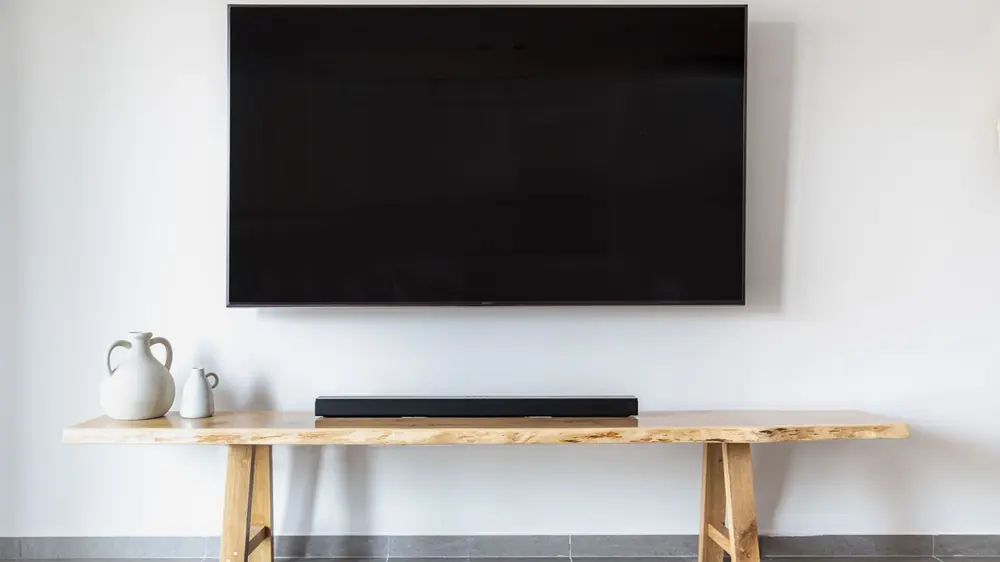
TV wall mounting in Varna: the right bracket, the right plugs and no drilling into a pipe
A TV on a bracket, curtain rails and shelves on the walls of a flat in Varna. The wall is checked for pipes before the first hole, the bracket is set with a spirit level and the TV is hung. The brackets and rails are yours; the fitting is ours to organise.
Our clients on video · all videos (in Bulgarian)
TV wall mounting in Varna starts with the match between three things: the bracket (chosen by the VESA hole pattern and the weight of the TV), the plugs (chosen by what the wall is made of) and the place behind the wall (checked for pipes and cables before we drill). We also fit curtain rails and shelves. We do not sell brackets or rails — we fit the ones you have bought. The work is done by the craftsmen we work with; we organise it and stay your one phone number. It is one of the small jobs on the handyman page. Call +359 52 993 333 or email info@kanalvarna.com — write to us in English and we reply in English.
Updated November 2026TV wall mounting: what is done
For a TV on the wall we choose the spot and the height with you, check the wall, fix the bracket level and hang the TV; the cables are tidied into trunking on the surface.
VESA. A standard for the position of the mounting holes on the back of a TV, given in millimetres, for example 200×200 or 400×400. A bracket fits if it supports your TV's VESA size and carries its weight.
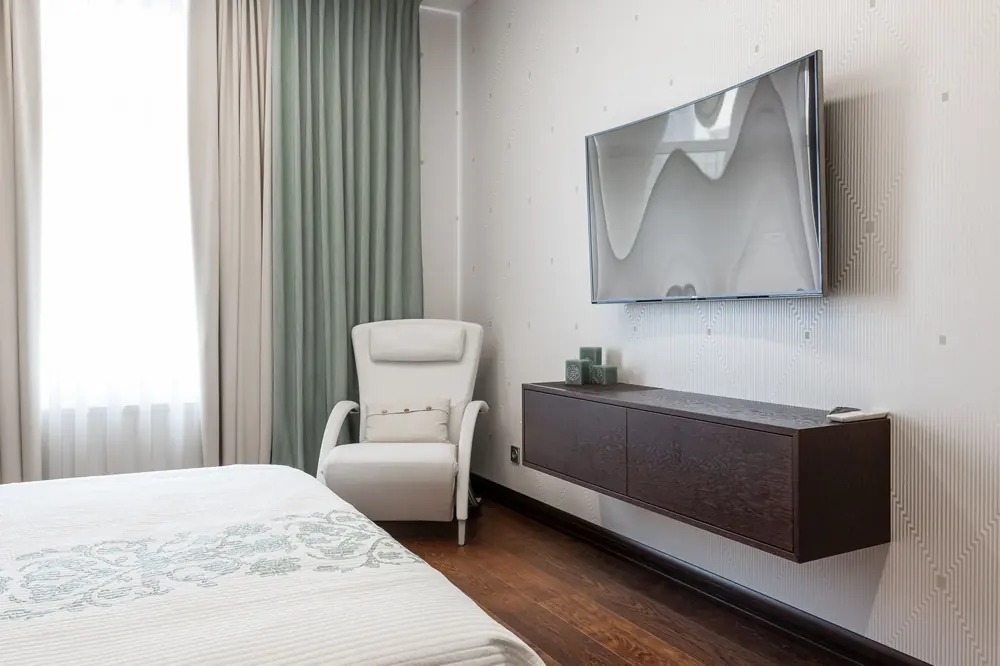
- Fixed: the TV sits flat to the wall. The simplest and lightest on the wall; right when you look straight at the screen.
- Tilting: the screen leans down a few degrees. Useful when the TV is high, for example above a chest of drawers.
- Swing arm: the TV pulls out and turns towards the sofa or the kitchen. The most convenient, and the heaviest load on the wall.
We do not sell brackets — we fit the one you have chosen. What to check before you buy one is in the questions below.
The wall decides what can be hung
The same bracket holds differently in concrete, brick, aerated block and plasterboard, so we first find out what the wall is made of and only then choose the plugs. The further the TV sits from the wall, the harder it pulls on them.
- Concrete in a panel block: usually holds even a swing arm. If the bit hits reinforcement, the hole shifts a few centimetres — the slots in the bracket plate normally allow it.
- Brick: solid brick is a good base. In hollow brick the plugs are long ones made for hollow materials, and the drilling is done without hammer action. For an arm on hollow brick we ask for the size and weight of the TV already on the phone.
- Aerated concrete: soft and crumbly, an ordinary plug spins in it. Plugs made for it are used, and a heavy arm in such a wall is a risk we tell you about beforehand.
- Plasterboard: a light TV on a fixed bracket can go up, but a heavy one on an arm cannot hang from bare board. If the wall is still being built, ask for reinforcement at the spot — see plasterboard.
Before drilling we look for pipes. If the bathroom or kitchen is behind the wall, or there is a radiator below the spot, the hot water or heating is switched on and we look with the thermal camera: it shows warm pipes and underfloor heating only while warm water runs through them. Cold water and cables do not show reliably, and we have no wall scanner. So we do not drill in line with a socket or switch — above, below and to the side of them — and where in doubt the breaker is switched off.
Bracket, wall, cables: the sign and what we do
| Sign | Likely cause | What we do |
|---|---|---|
| The bracket is smaller than the TV | The VESA size does not match, or the bracket carries less than the TV weighs | Sometimes an adapter plate helps with different holes; if the bracket carries too little, only another bracket will do |
| The wall is plasterboard | The board alone does not carry a heavy TV, especially on an arm | We look for the stud; a light TV on a fixed bracket goes on cavity fixings |
| The socket is in the wrong place | The socket is low and the TV will be high | We do not make a new socket — that is for an electrician; the cable runs in a trunking to the existing one |
| Cables hang under the TV | No trunking or hidden route | Paintable trunking on the wall, or the cables go behind a piece of furniture |
| Old holes in the wall | An earlier bracket, or the TV was elsewhere | The old bracket comes off; the holes are filled and skimmed — see skimming and painting |
| The TV hangs crooked | The bracket is not level, or a plug has given way | We check the plugs, drill again if needed and set the bracket straight |
Call and tell us the size of the TV, what the bracket is and what the wall is made of. If there are rails or shelves too, say so together.
Tell us the size of the TV, what the bracket is and what the wall is made of. If there are rails or shelves too, say so together, and we tell you whether and when we can come.
📞 +359 52 993 333Curtain rails and shelves
A curtain rail goes on the wall above the window or on the ceiling, and its load grows with every heavy curtain and every tug.
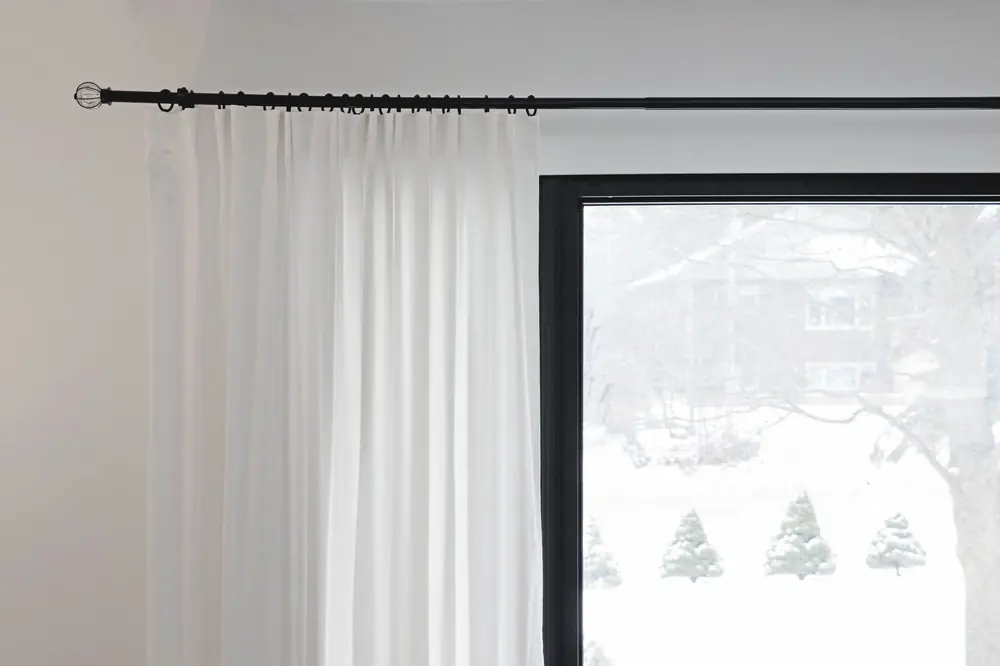
Above windows there is often a concrete lintel, especially in brick buildings. It is harder to drill than brick, but a plug in it holds better. On a concrete ceiling the rail is fixed straight into the slab, away from the line between the switch and the light, where a cable often runs in panel blocks; in a plasterboard ceiling, only into a stud or a reinforcement put in when it was built. For a rail we ask:
- how wide the window is and how far the rail should stick out at each side, so the gathered curtain does not cover the glass;
- how many poles or tracks — a net curtain and a heavier one, sometimes a blind as well;
- how heavy the curtains are — lined and blackout ones weigh more;
- whether there is a roller-blind box above the window — we do not drill into it.
A long rail also needs a middle bracket, or it sags. Shelves carry more than they look — books, plant pots, crockery. Visible brackets spread the load better; hidden (floating) ones, where the shelf seems to hang in the air, need a solid wall and accurate holes. On plasterboard a heavy shelf is fixed only into the stud. If there are dark patches round the window, the curtain will hide them while they keep growing behind it: look at the cause first, see mould and damp.
How the mounting goes, and what we do not do
- Place and height. We settle where you will watch from, at what height the screen should be and how far the cables reach.
- Checking for pipes and cables. We look at what is behind the wall and under the spot, check warm pipes with the thermal camera, and switch off the breaker if a cable is possible.
- Marking with a level. The holes are marked through the bracket plate, which is set straight with a spirit level.
- Drilling and bracket. The right plugs go in and the bracket is tightened. Before the TV is hung, we check that it does not move.
- TV and cables. The plates go on the back of the TV, it is hung, and the cables are tidied into trunking or behind furniture.
- Final check. We check the level and the movement of the arm, and tighten any anti-theft screws on the bracket.
We do not fit chandeliers, lamps, new sockets or switches, and we do not bury cables in the wall where that means work on the wiring. That is work on the 230 V installation and needs an electrical qualification we do not hold, so you need an electrician. It helps if the electrician comes first: if the socket is moved the socket behind the TV or the cables run into the wall, we then fit the bracket on a finished spot. Aerials, cable TV and internet are for your provider, and we do not fit brackets or rails outside, on a facade or on a balcony above the second storey.
What to tell us, and what the price depends on
We give the price by phone after a short description. Tell us:
- the size and weight of the TV — they are in the manual or on the label at the back;
- what the bracket is — fixed, tilting or arm — and whether you have already bought it;
- what the wall is made of, if you know, and what is behind it;
- how many rails and shelves there are, and how wide the windows are;
- how high the ceiling is, if a rail goes on it;
- whether an old bracket or rail has to come off.
The price depends on the number of jobs, on the wall — concrete and lintels are drilled more slowly — and on the bracket: an arm takes more time than a fixed one. If there is furniture to assemble in the same visit, see flat-pack furniture assembly and tell us together. A big TV is lifted by two people, so give us its size. If you let the flat and are abroad, email the TV size, photos of the wall and the address, and say who opens the door.
Frequently asked questions
Do you bring the bracket?
No. We do not sell brackets — we fit the one you have bought. Before you buy, look up the VESA size and the weight in the TV's manual, and choose a bracket that supports that size and carries more than the weight. If you are unsure, tell us the model on the phone and we say what to look for.
Can a TV go on a plasterboard wall?
It can, if the TV is light and the bracket is fixed — on cavity fixings or, better, on screws into the metal stud. A heavy TV on a swing arm is not hung on bare board. If there is a reinforcement from when the wall was built, an arm becomes possible, so we look for the studs first.
Will you also hang the chandelier in the living room?
No. Chandeliers and lamps connect to the 230 V installation and need an electrical qualification we do not hold. Call an electrician. If the room also has curtain rails, shelves or a TV, we take those on — mention them in one call.
A TV waiting to go up on the wall?
Tell us the size of the TV, what the bracket is and what the wall is made of. If there are rails or shelves too, say so together, and we tell you whether and when we can come.
📞 +359 52 993 333or email info@kanalvarna.com — write in English and we reply in English.
Send us a message
Leave your name and a phone number with the country code. Add your email if you prefer a written reply — write in English and we reply in English. We confirm the price before any work starts.