Drain relining in Varna: repairing a cracked drain from the inside, without a trench
A cracked pipe under concrete does not have to mean a dug-up garden. A camera survey shows whether your drain can be relined. The liner is fitted by partners we work with; the camera work and the cleaning are ours. Every day from 06:00 to 23:00.
Our clients on video · all videos (in Bulgarian)
Drain relining, also called no-dig pipe repair, mends a drain from the inside: a flexible liner soaked in resin is pulled or inverted into the old pipe and hardens there, forming a new pipe with no joints inside the old one. It suits cracks and displaced joints, but not a crushed pipe or one laid with a reverse slope. Kanal Varna looks at the pipe with a CCTV camera first (from €59) and cleans the line; the liner itself is fitted by partners we work with. You get the price of the repair after the survey, once the partner has seen what the camera showed. We work every day from 06:00 to 23:00. Call +359 52 993 333 or email info@kanalvarna.com — write to us in English and we reply in English.
Updated November 2026Drain relining: what it is and when a pipe is repaired from the inside
Drain relining is the repair of a drain pipe from the inside, without digging along its whole length: a new pipe is formed inside the old one, pressed tight against its walls. It is also called no-dig drain repair, trenchless pipe repair or sewer pipe lining. It makes sense when the pipe has kept its shape but is cracked, has displaced joints or leaks.
The liner is a flexible sleeve of felt or glass fibre, soaked in resin, pulled into the old pipe and cured in place. The result is a jointless pipe lying tightly in the old one. In technical literature it is known as CIPP (cured-in-place pipe). If the pipe is merely blocked, see blocked drains: relining is for when the blockages are caused by the pipe itself.
The liner is fitted by partners we work with. Our part comes before and after: the camera survey that tells you whether lining makes sense at all, and cleaning the line.
Camera first: does the pipe suit a liner?
You cannot tell from the outside whether a drain can be relined — not from the age of the house, nor from how often it blocks. We run the camera from the manhole or inspection point and look at the pipe from inside, joint by joint. A camera survey is from €59; more on our CCTV drain survey page.
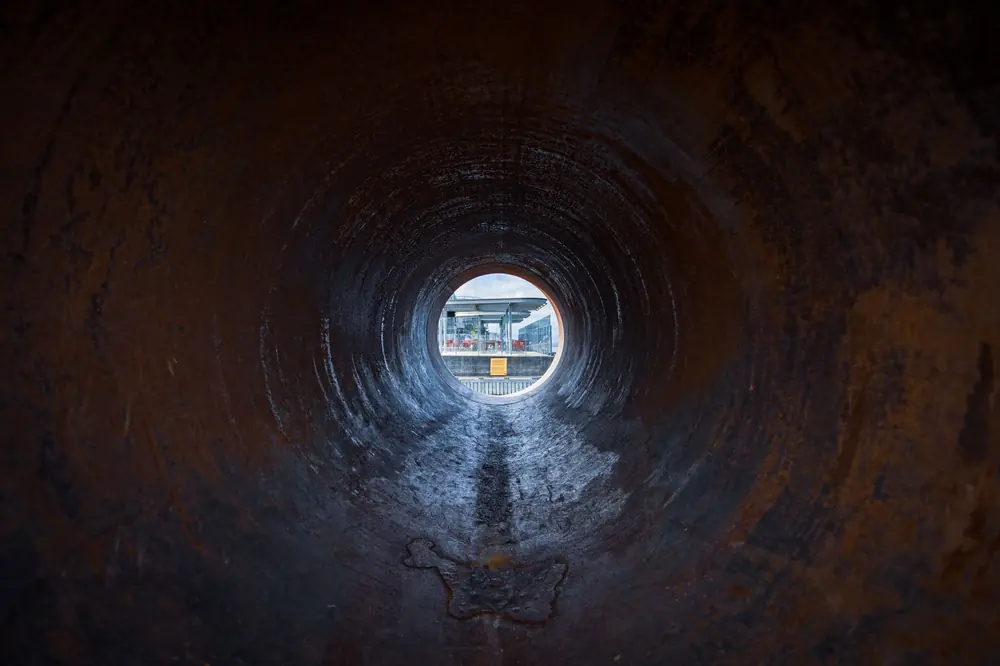
- Cracks and broken pieces: where they are and whether the pipe has kept its round shape.
- Displaced joints: a step between two pipes where paper and grease catch.
- Roots: fine hair-like strands or a dense mat that has grown in through the joints.
- Deformation: a flattened, oval or sunken pipe.
- Standing water: a sign of a sag or a reverse slope.
- Junctions: how many side pipes join the line and where.
If the line is blocked, we clear it first: the camera sees nothing useful through standing water and a plug. It does happen that the camera finds a cracked old pipe in a building's shared main drain — and then clearing it again is not the answer.
What the camera shows, and whether relining will work
A liner closes cracks and joints but does not correct the shape or fall of the pipe.
| What the camera shows | Can it be relined? | What we do |
|---|---|---|
| A crack, and the pipe is round | Yes: this is the typical case | Clean; the partner lines the spot or the whole section |
| A displaced joint with a step | Usually, if the step does not block much of the bore | Look closely at the step, then decide on a short liner |
| Roots through the joints | Yes, once the roots are removed | We open a way with the spiral; dense roots are cut out by a partner with a cutter — see tree roots in drains |
| Crushed, flattened or sunken pipe | No: the liner has nothing to lie in | A trench in that place and a new pipe for the section |
| Reverse slope or sag, water stands | No: the liner repeats the old line | The section is redone with a trench |
| Old pipe under concrete, tiles or a building, shape kept | Yes: this is where lining helps most | Camera, cleaning, a look with the partner |
| A pipe narrowed a lot by deposits or deformation | Only if cleaning opens it | Clean and run the camera again; if it does not open, a trench |
Tell us what the line runs under, roughly how long it is and whether there is a manhole — we tell you when we can survey it with the camera.
📞 +359 52 993 333How a liner is fitted
Lining goes through four stages: preparation, insertion, curing and reopening the side connections. Partners do it; we clean the line before and look at it with the camera afterwards.
- Preparation. The pipe must be clean, with nothing sticking into it. We remove sediment with the spiral; it only deals with light root growth, so dense roots or a connection protruding into the pipe are removed by the partner with their own equipment. While the work is going on, no water may run into the line: the flow is diverted or nobody uses the fittings that drain into it.
- Insertion. The resin-soaked liner is either turned inside out into the pipe with water or air (inversion) or pulled through. It goes in through the manhole or inspection point and can follow bends.
- Curing. The resin hardens with hot water, steam or, for glass-fibre liners, UV light. With steam there can be a resin smell, which usually passes.
- Reopening the junctions. The liner also seals over the side connections, so after curing a small robotic cutter goes into the new pipe and reopens them from the inside.
A liner has its own wall, so the bore becomes slightly smaller. The direction and fall of the line stay as they were.
The whole line or one spot
If the camera shows one crack or one displaced joint in an otherwise sound pipe, the whole line is usually not lined: a short liner can close just the damaged spot. If there are cracks along several lengths of pipe, roots in every other joint or an old line falling apart, patch after patch stops making sense and the whole section between two manholes is lined.
Relining pays off most where digging is expensive or dangerous: under a concrete yard or tiles, under the house, under a car park or an old wall. If the pipe runs shallow under grass, a trench may be the simpler way, and we tell you so after the survey.
When a liner is not the answer, and what is
A liner does not work when the pipe is crushed, collapsed, badly narrowed or laid with a reverse slope. It needs an old pipe to lie in and repeats its line exactly. If water stands in a pipe because it sags, after the repair it will stand in the same place, only in a new pipe. Then that section is dug up and replaced — the excavation is also arranged through partners; for a new line see new drain installation.
There is another no-dig way, pipe bursting: a head is pulled through the old pipe, breaking it and drawing a new pipe in behind, usually polyethylene. It is the only no-dig method that can leave you with a wider pipe than before. But it needs a launch pit and a receiving pit at the two ends, is hard with many junctions and bends, and the line and fall stay the same. Whether it suits your line, and whether we can arrange it, we tell you after the survey.
- The camera shows grease, wipes or sediment in a sound pipe: that is a job for unblocking — see blocked outside drain.
- The problem is the vertical pipe inside a block of flats: that usually ends in replacing the soil stack; whether relining makes sense there, we can only say after seeing it.
- Only one sink or toilet is slow: the branch to that fitting is blocked, not the main line.
Before the survey, and for owners who are away
Before we come, make sure the manhole cover and the inspection point cap are uncovered and reachable. Do not pour drain chemicals into the manhole or toilet. Do not climb down into the manhole: the gases inside can be dangerous. And do not dig down "to have a look": the pipe may be shallow, or next to a water main or a cable. If you do not know where the line runs, drain tracing marks it first. If the line is shared with another house or serves one entrance of a block of flats, tell the neighbours: they must not run water into it on the day of the repair.
If you are not in Bulgaria, you do not need to be there for the survey: send us the address, photos of the manhole, the inspection point and the paving above the line, and the name and phone number of someone who can open the gate. We tell you what the camera showed and, once the partner has seen it, the price of the repair — before any work starts. You can pay by bank transfer.
Frequently asked questions
Do you do the relining yourselves?
Not on our own. The liner is fitted by partners we work with. Our part is the camera before and after the repair and the cleaning of the line. For you it is one job and one phone number: you talk to us, and we arrange the partner and the survey.
Will nothing really be dug?
Along the route, usually not, but it cannot be done with no access at all. The liner goes in through a manhole or inspection point. If there is none along the line, it is sometimes opened in one place to reach the pipe. Whether that is needed becomes clear after the camera survey, and then it means one hole, not a trench across the whole garden.
Will the pipe get narrower?
Slightly. The liner has its own wall, which takes up part of the cross-section; how much depends on the liner the partner chooses for your pipe.
Will relining fix a reverse slope?
No. The liner lies in the old pipe and repeats its line, sags included. If water stands in a section, it will stand there after the repair. Such a section is redone with a trench to get the right fall.
How much does drain relining cost?
We do not name a figure before the pipe has been seen from the inside. The camera survey is from €59, and if the line also needs high-pressure jetting, that is from €79; see the price list. The price of the repair depends on the length and diameter, the number of junctions, whether a short liner is enough and how easy the manhole is to reach, and we give it after the survey, before any work starts. You pay once the work is done.
How long can we not use the drain?
It depends on the length, the curing method and how many connections have to be reopened, so we do not give a figure in advance — we give it after the survey, when the partner knows what the job involves. The day is agreed beforehand so you can prepare: who must not run water and which fittings will be out of use.
Can I contact you in English?
Yes — write to us in English by email at info@kanalvarna.com or through the form on this page, and we reply in English. The phone number is +359 52 993 333.
Related pages
Cracked drain under concrete?
Tell us what the line runs under, roughly how long it is and whether there is a manhole — we tell you when we can survey it with the camera.
📞 +359 52 993 333or email info@kanalvarna.com — write in English and we reply in English.
Send us a message
Leave your name and a phone number with the country code. Add your email if you prefer a written reply — write in English and we reply in English. We confirm the price before any work starts.